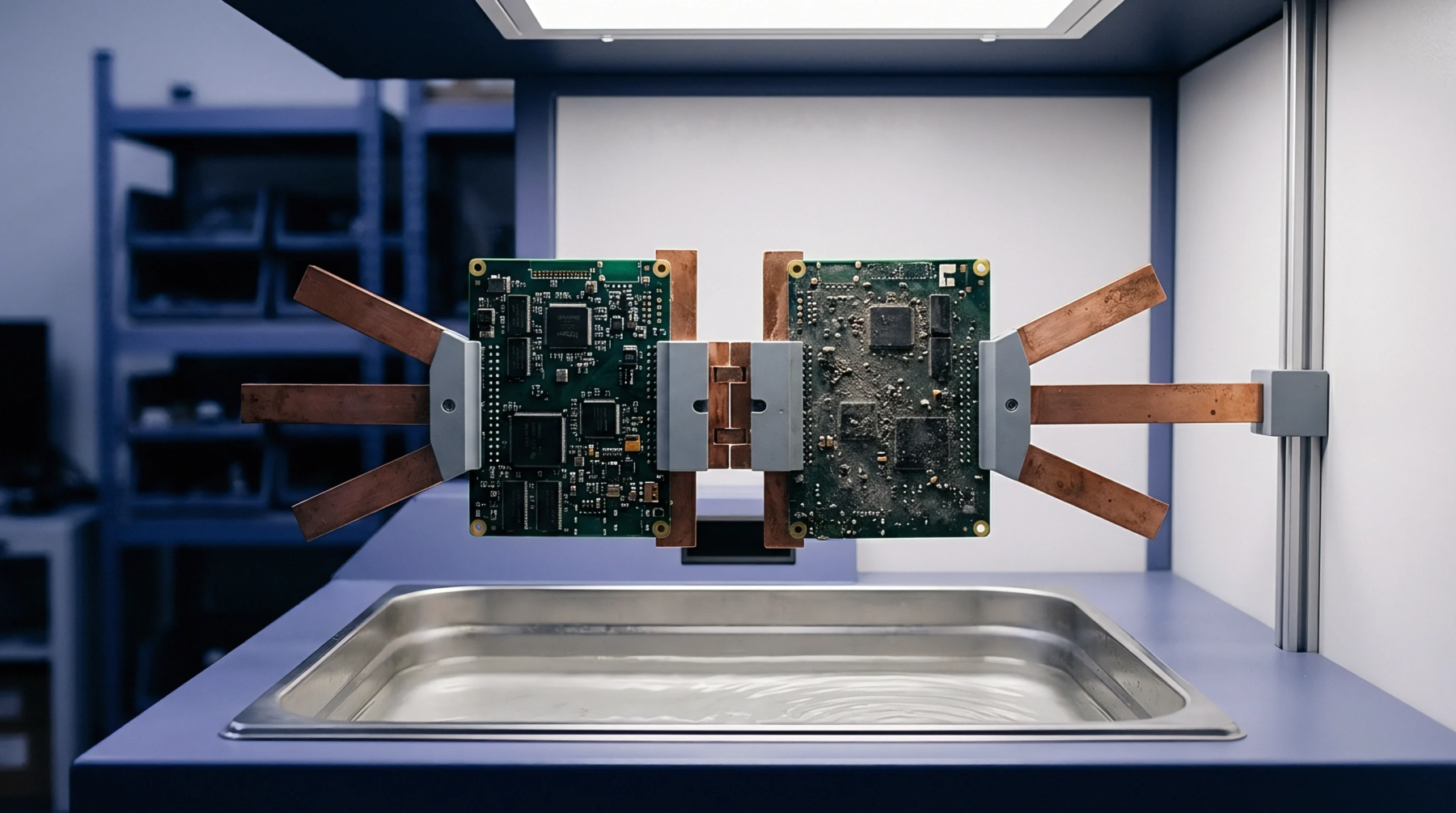
Thermal Obstruction
Airflow patterns during reflow soldering dictate the heat distribution across a populated printed circuit board. Convective thermal shadowing occurs when large surface mount components shield smaller adjacent devices from the heated air currents circulating within the oven chamber. This blockage prevents the solder paste beneath the obscured component from reaching the liquidus temperature required for a reliable metallurgical joint.
Process engineers observe incomplete wetting or cold solder joints on the side of the device facing away from the primary airflow direction. The phenomenon creates a delta in temperature that forces operators to increase oven conveyor speeds or zone temperatures to compensate for the uneven thermal transfer.
Manufacturing Constraint
Design layouts featuring dense component populations heighten the risk of uneven heating cycles. Tall connectors or high-mass integrated circuits act as physical barriers that deflect forced convection streams away from secondary pads. Thermal profiling boards carry thermocouples placed at specific locations to detect the resulting temperature gradients that cause these localized cooling effects.
Automated optical inspection equipment identifies these gaps by monitoring for fillet formation issues on components positioned downstream of air dams.
Optimization Requirement
Reflow oven performance relies on the careful management of turbulence to minimize the impact of stagnant boundary layers behind larger components. Maintaining high air velocity throughout the cooling and heating phases forces thermal energy into the gaps created by component geometries. Proper board orientation relative to the airflow direction remains the primary strategy for reducing the severity of temperature variances across a high density assembly.
The precision of joint formation remains tied to the capacity of the convection system to overcome the physical resistance posed by complex component topographies.