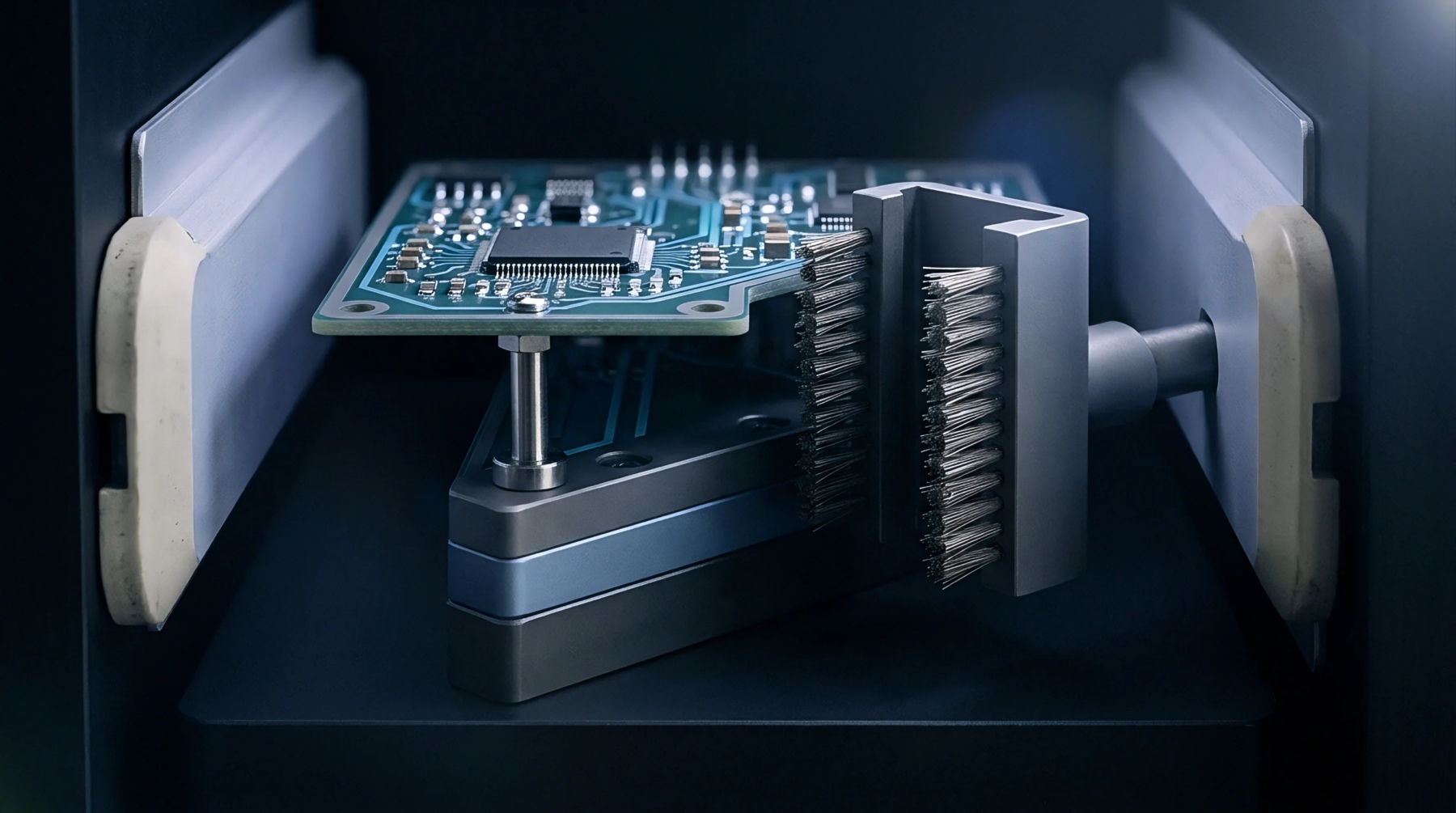
Substrate Z-Axis Thermal Expansion Mechanics in High-Density Interconnect Laminates
Z-axis laminate expansion exceeding copper ductility during lead-free reflow drives microvia failure, requiring high-Tg filled dielectrics and coupon screening.
Tensile plastic strain sustained by an electrodeposited metallic foil prior to fracture defines its mechanical reserve under thermal stress. In multilayer circuit board fabrication, copper plating elongation quantifies the percentage increase in gage length of an isolated deposit pulled to failure under axial load. The measurement governs IPC-6012 qualification criteria for Class 2 and Class 3 rigid boards, setting a baseline floor to survive downstream thermal excursion.
IPC-TM-650 Method 2.4.18 specifies stripping plated copper foil from stainless steel mandrels and pulling micro-tensile specimens at controlled crosshead speeds. A high percentage elongation demonstrates that the deposit possesses sufficient internal flexibility to absorb z-axis laminate expansion without sustaining micro-cracking across plated through-hole barrels. Acceptance boundaries mandate that elongation testing remains restricted to pure electrolytic foil deposits, terminating where underlying dielectric materials alter the composite stress profile.
Acid copper bath chemistry and additive concentrations dictate the crystallographic growth mode that produces high plastic stretch. Brighteners, levelers and suppressors regulate the nucleation density, preventing coarse columnar structures that shear prematurely along grain boundaries. When copper plating elongation drops below twelve percent, electrodeposited barrels frequently suffer barrel-cracking during wave soldering or multiple surface mount assembly reflow passes.
Organic breakdown products generated through electrolytic oxidation incorporate into the crystal matrix, creating lattice pinning sites that restrict dislocation motion. Routine bath management mitigates this embrittlement through continuous carbon filtration and precise replenishment of consumption-driven organic agents. Cyclic voltammetric stripping tracks active additive concentrations to ensure grain formation remains fine, uniform and ductile.
Insufficient bath agitation produces localized additive starvation, depressing local elongation values along high-aspect-ratio hole centers.
Receiving inspection teams and chemical process engineers evaluate electroplating line integrity by processing periodic test coupons alongside production panels. Tensile pull testing of stripped copper specimens identifies metallurgical degradation before assembly failures register on thermal stress microsections. IPC Class 3 high-reliability designs require copper plating elongation to match or exceed eighteen percent alongside minimum tensile strength thresholds of thirty-six thousand pounds per square inch.
Solder float tests per IPC-TM-650 Method 2.4.13 serve as the destructive assembly validation, exposing finished barrels to thermal shock at two hundred eighty-eight degrees Celsius. Microsection inspection under optical magnification confirms whether plated barrels expanded elastically with surrounding laminate without generating circumferential cracks or corner knee fractures. Low ductility yields immediate non-conformance holds, requiring thorough chemical purification of the plating bath before line clearance resumes.
Plating bath operating windows rely entirely on this mechanical metric to balance brightener shine with structural ductility.
Z-axis laminate expansion exceeding copper ductility during lead-free reflow drives microvia failure, requiring high-Tg filled dielectrics and coupon screening.
Expertise is a utility, not a secret. sentiention™ publishes its working knowledge as open reference: intelligence layer covering the materials it sources, the markets it enters, and the reference that serves both.