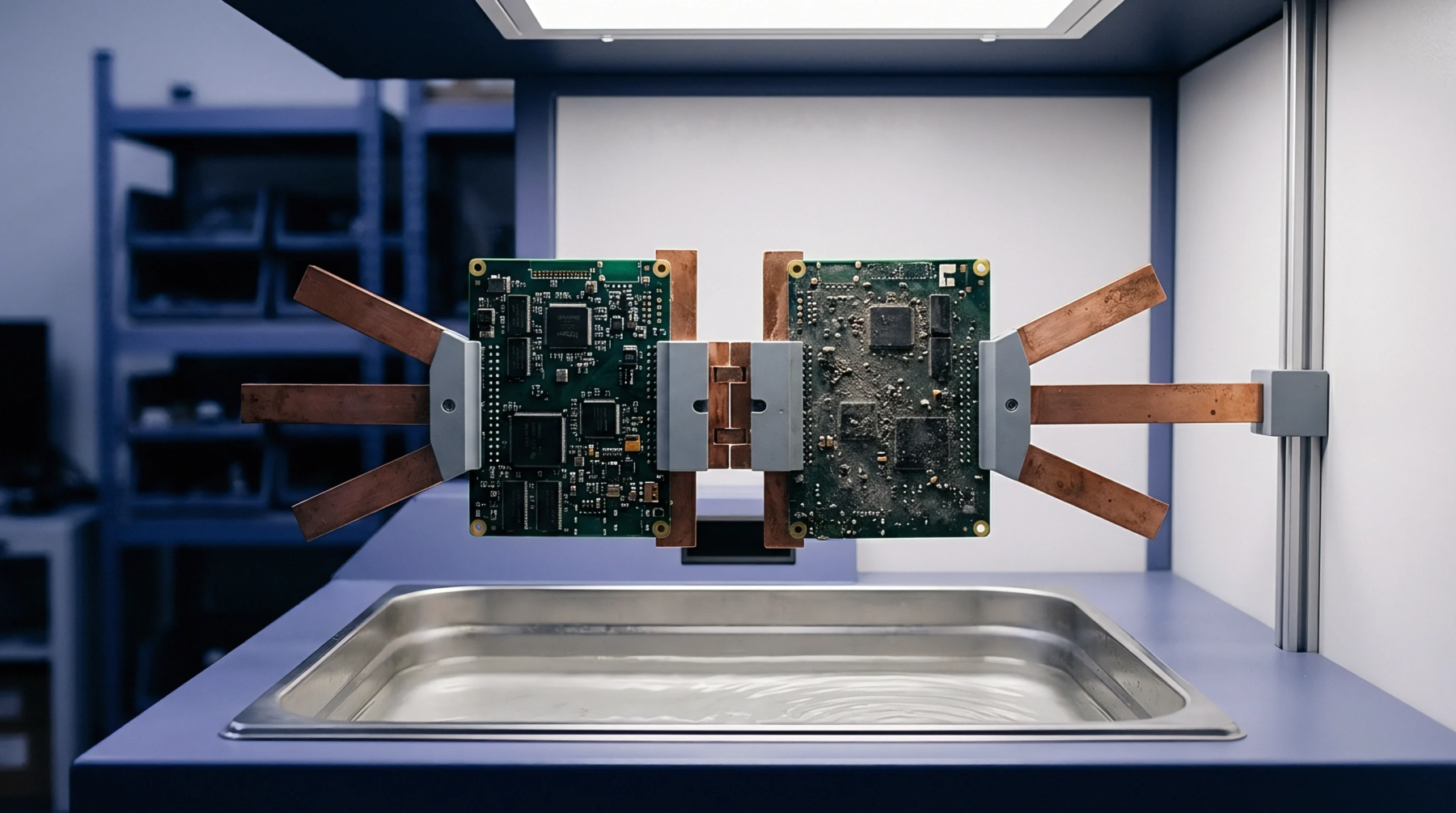
Density Distribution
Multilayer printed circuit board stackups suffer structural imbalance when spatial copper volume ratios vary across dielectric planes. Copper retention gradients describe the localized differential between dense power planes and sparse signal routing zones within an etched copper foil layer. Manufacturing operations monitor layer copper distribution during layout preparation to mitigate mechanical strain during thermal lamination cycles.
Etching processes remove unshielded copper areas, creating differential CTE forces between solid copper regions and resin-rich dielectric zones. The parameter applies strictly to etched planar conductive layers within rigid or flex-rigid multilayer boards.
Warp Dynamics
Unequal copper density across adjacent substrate layers induces panel bow and twist during high-temperature press cycles. The copper retention gradients generate uneven hydraulic pressure distributions within curing prepreg resins, pushing glass fibers out of nominal parallel alignment. Fabricators balance inner layer copper coverage by placing dummy copper flooding in empty signal routing channels.
Unbalanced resin flow leads to thickness variations across dielectric layers, altering targeted signal trace impedances. Thermal stress testing reveals localized strain concentrations near boundaries where high copper retention meets etched dielectric clearance channels. Vacuum lamination presses compress resin unevenly across unbalanced copper fields, increasing post-cure board distortion risks.
Layout engineering rules mandate thinned copper cross-hatching on large ground planes to harmonize resin flow patterns. Automated design rule checks calculate regional copper density ratios across panel layouts to pinpoint warp-prone layout zones before tooling generation.
Tolerance Threshold
Panel bow and twist acceptance criteria establish physical thresholds beyond which warped circuit panels face rejection. Measurement methods evaluate overall panel flatness using optical surface profilometers or physical feeler gauges. Mechanical distortion limits cease to govern panel acceptance once components are soldered onto rigid assembly frames.