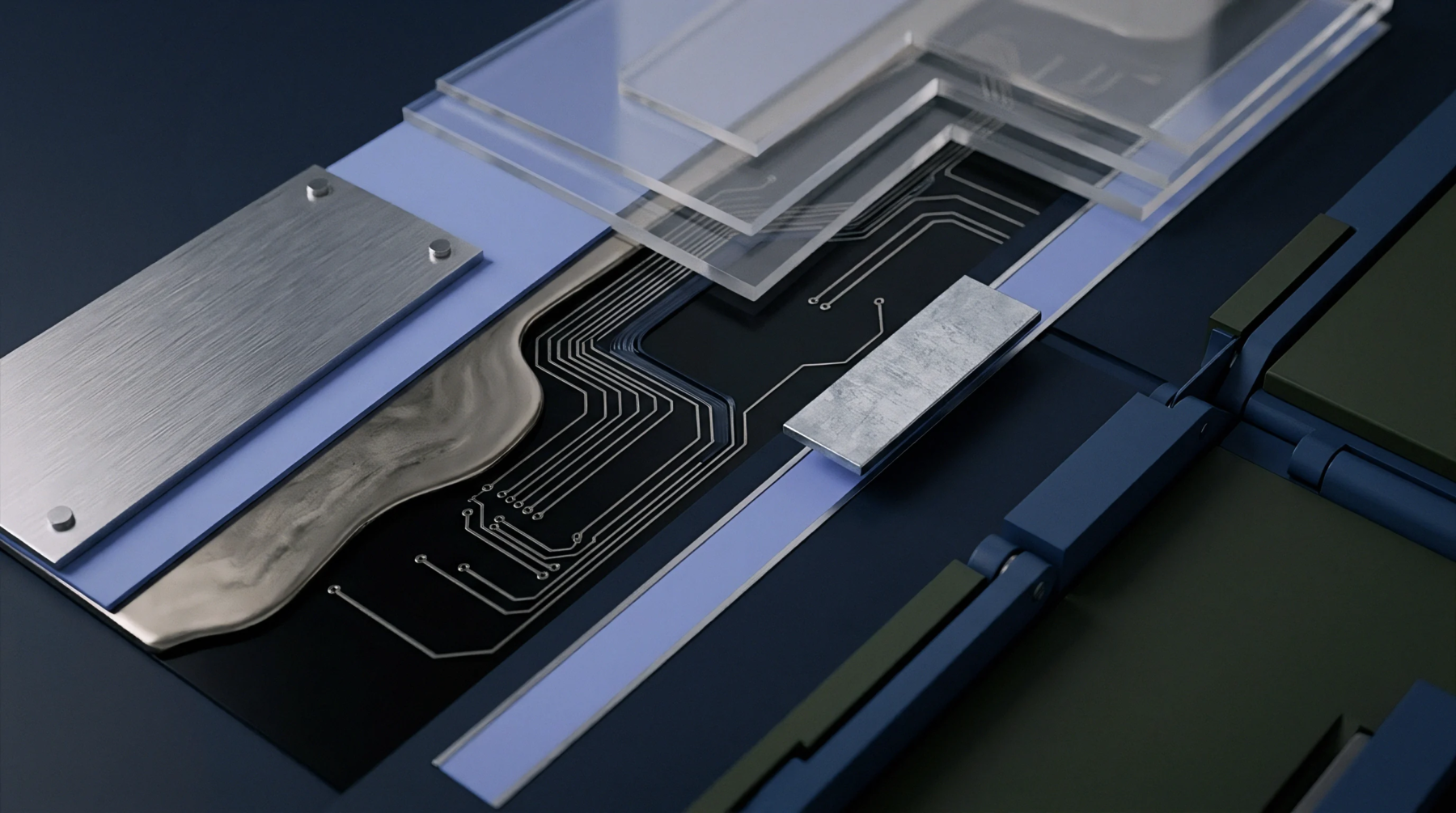
Migration Mechanism
Electrochemical transport of metal ions across a non-conductive substrate under electrical bias produces localized filamentary deposits that bridge adjacent trace conductors. Occurring primarily along moisture films containing flux residues or halo-alkaline contaminants, dendritic growth causes short circuits between high-density conductors. Copper or silver dissolves at the anode, migrates down the potential gradient, and precipitates at the cathode as needle-like structures.
Structural Failure
Electrodeposition along the electric field lines forms thin branching metallic trees that advance towards the opposing conductor. As the metallic filament bridges the clearance gap, electrical resistance drops sharply from gigohms to fractions of an ohm, triggering functional failure in high-impedance circuits. High operating voltages accelerate mass transport, while narrow conductor spacing reduces the critical migration path length required for complete shorting.
Thermal energy generated by initial breakdown currents occasionally fuses tiny filaments, yet residual ionic tracks facilitate rapid regrowth upon subsequent power application. Inspection protocols employ surface insulation resistance testing at elevated temperature and humidity levels to detect early leakage currents prior to physical bridge completion.
Environmental Threshold
Relative humidity thresholds above sixty percent create absorbed aqueous monolayers essential for ion mobility across laminate surfaces. Cleanliness standards like IPC J-STD-001 establish maximum allowable ionic contamination limits to prevent electrolyte formation on assembled circuit cards. No-clean flux formulations must demonstrate non-corrosive behavior through SIR testing under eighty-five degrees Celsius and eighty-five percent relative humidity conditions.
Conformal coatings mitigate risk by forming a hydrophobic barrier, though pinholes or edge coverage defects still permit localized moisture accumulation and subsequent growth.