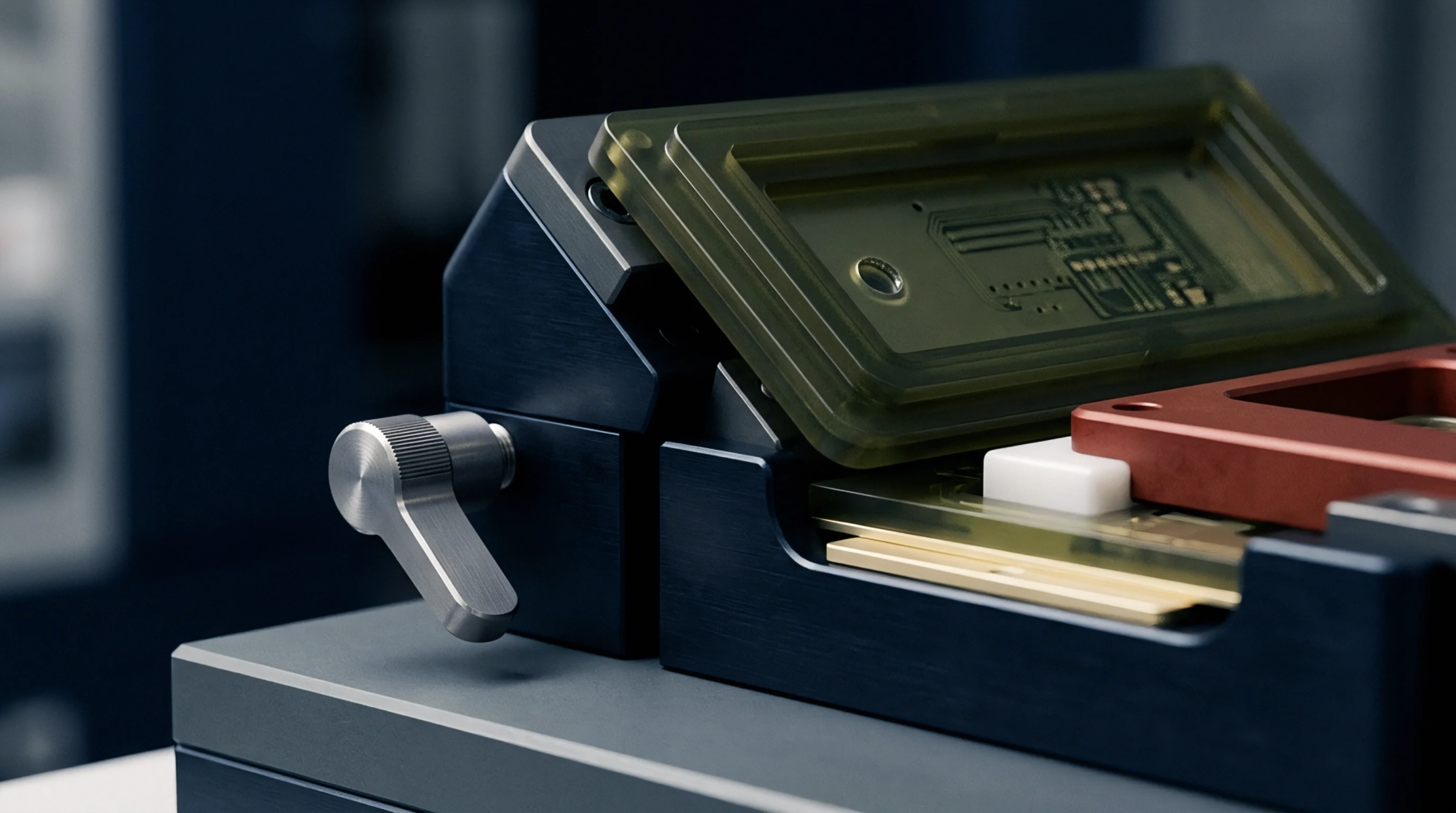
Fixture Configuration
Mechanical platforms provide physical contact interfaces that combine standard in-circuit test probes with dedicated functional connection modules for rapid printed circuit board assessment. These hybrid ict fixtures allow engineers to consolidate electrical continuity checks and power-up verification into one docking event. Vacuum seals pull the populated board against a spring-loaded bed of nails while pneumatic actuators engage high-current or high-speed data pins at precise locations.
The system structure reduces throughput time by eliminating redundant loading cycles for disparate testing phases.
Contact Integration
Precise alignment relies on registration holes drilled during the fabrication stage to ensure pin centers land exactly on defined test pads. Tolerances remain tight to avoid collateral damage to nearby micro-vias or surface mount components during the compression phase. Sensors monitor the vacuum pressure to verify proper seating before any voltage applies to the assembly.
Electrical signals pass through short-path routing to minimize inductance interference during high-frequency signal integrity analysis. Grounding planes within the fixture frame prevent electromagnetic coupling between digital bus lines and sensitive analog circuits.
Deployment Economics
Manufacturing throughput gains justify the higher setup cost for complex boards containing mixed signal architectures. Operators move a single assembly through the test station once to capture both parametric values and operational software status. Reduced cycle times mitigate the capital expenditure required for multiple dedicated test cells on high-volume production lines.
Lower handling frequencies decrease the probability of electrostatic discharge events during the final inspection sequence. Reliability improves as the unified interface maintains consistent pressure profiles across every board in the production lot.