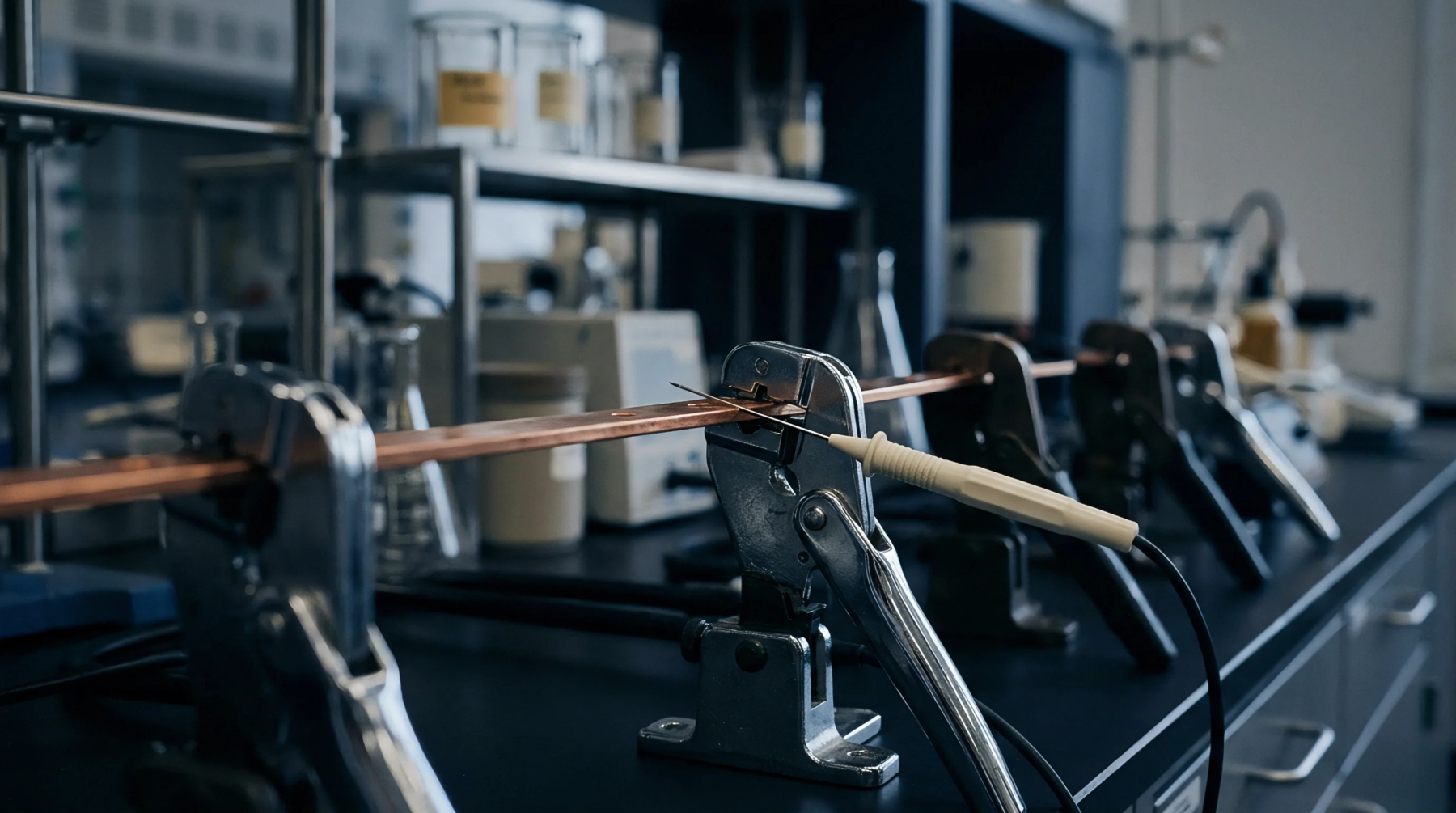
Four-Wire Sensing
Electrical resistance measurement configurations utilizing separate current-carrying and voltage-sensing probe pairs eliminate fixture wire and contact resistance errors. Standard two-wire sensing methods include probe contact resistance in the measured value, rendering low-resistance measurements inaccurate. Performing kelvin sense measurement isolates the voltage drop across the device under test by drawing negligible current through the sensing leads.
The boundary of this technique applies to low-resistance conductor path evaluations and excludes high-impedance insulation testing.
Contact Resistance Cancellation
High currents driven through dedicated force leads generate a measurable voltage drop across the target conductor while high-impedance sense leads measure the potential directly at the contact points. Because the sensing circuit draws negligible current, no voltage drop occurs across the sense probe contact interfaces. Employing kelvin sense measurement enables accurate determination of sub-milliohm values in microvias, power planes and solder joints.
Flying probe units equipped with dual-tip blades perform four-wire measurements on small test pads without requiring separate physical test points. Automated test equipment uses this technique to identify cracked via barrels and thin plating defects that produce small resistance increases. Test accuracy depends on precise physical placement of probe tips to avoid including unwanted trace segments in the voltage measurement path.
Via Integrity Verification
Automated fixtures measure plated through-hole barrel resistance down to micro-ohm levels to detect thin copper plating wall conditions. Identifying small resistance anomalies isolates structural defects before boards undergo thermal stress. Precision four-wire measurements prevent defective power interconnects from entering high-reliability assemblies.