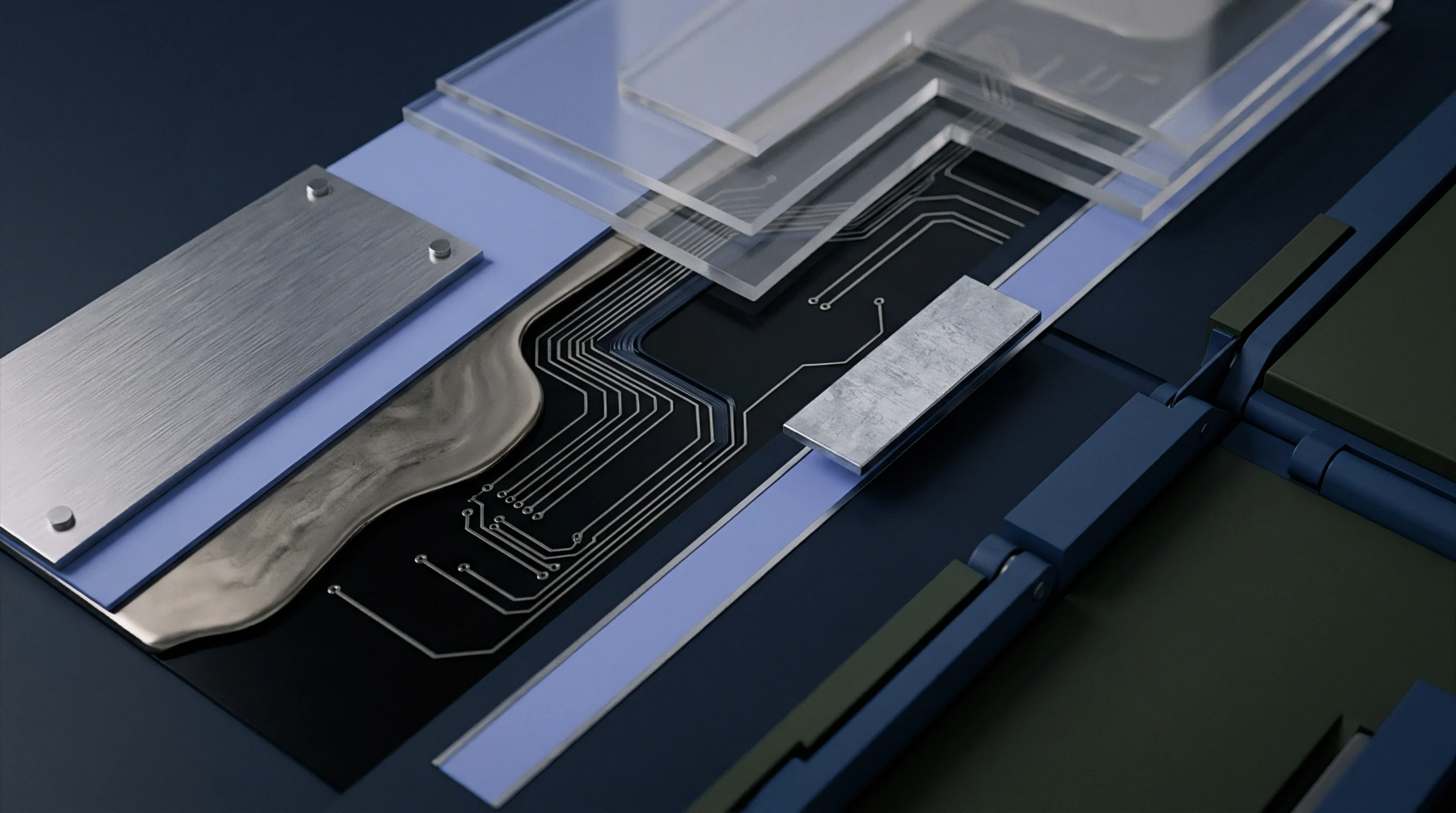
Copper Distribution
The sequential arrangement of conductive layers and dielectric cores forms a microvia stackup inside a multi layer printed circuit board. High density interconnect architectures rely on staggered or stacked laser drilled holes to route signals between internal planes without occupying outer routing channels. Sequential lamination cycles build this vertical pathway by pressing successive subassemblies together before final mechanical drilling and outer layer etching occur.
Fabrication shops measure success by dielectric thickness uniformity between adjacent copper foils and registration accuracy across consecutive pressing steps.
Thermal Stress
Operating temperatures generate significant z axis expansion differentials between plated copper barrels and surrounding epoxy glass resin during reflow soldering or thermal cycling. Barrel cracking occurs when total copper elongation exceeds material fatigue limits under repeated thermal shock conditions. Microscopic cross section analysis reveals whether barrel plating thickness meets minimum requirements along the entire barrel wall, particularly inside buried via structures where electroplating solutions face restricted mass transport.
Residual plating stress accelerates copper fatigue during assembly processes that expose internal layers to peak temperatures exceeding two hundred sixty degrees Celsius.
Electrical Impedance
Signal integrity depends directly on dielectric constant stability and precise conductor width control throughout the entire vertical interconnect path. Capacitance increases when dielectric layers between stacked vias become excessively thin, altering characteristic impedance profiles for high speed differential pairs. Automated optical inspection equipment verifies layer to layer alignment before lamination, while time domain reflectometry testing confirms that finished boards meet specified impedance tolerances.
Manufacturing yields drop sharply if local resin rich areas shift laser drilled targets off center during the initial ablation phase.