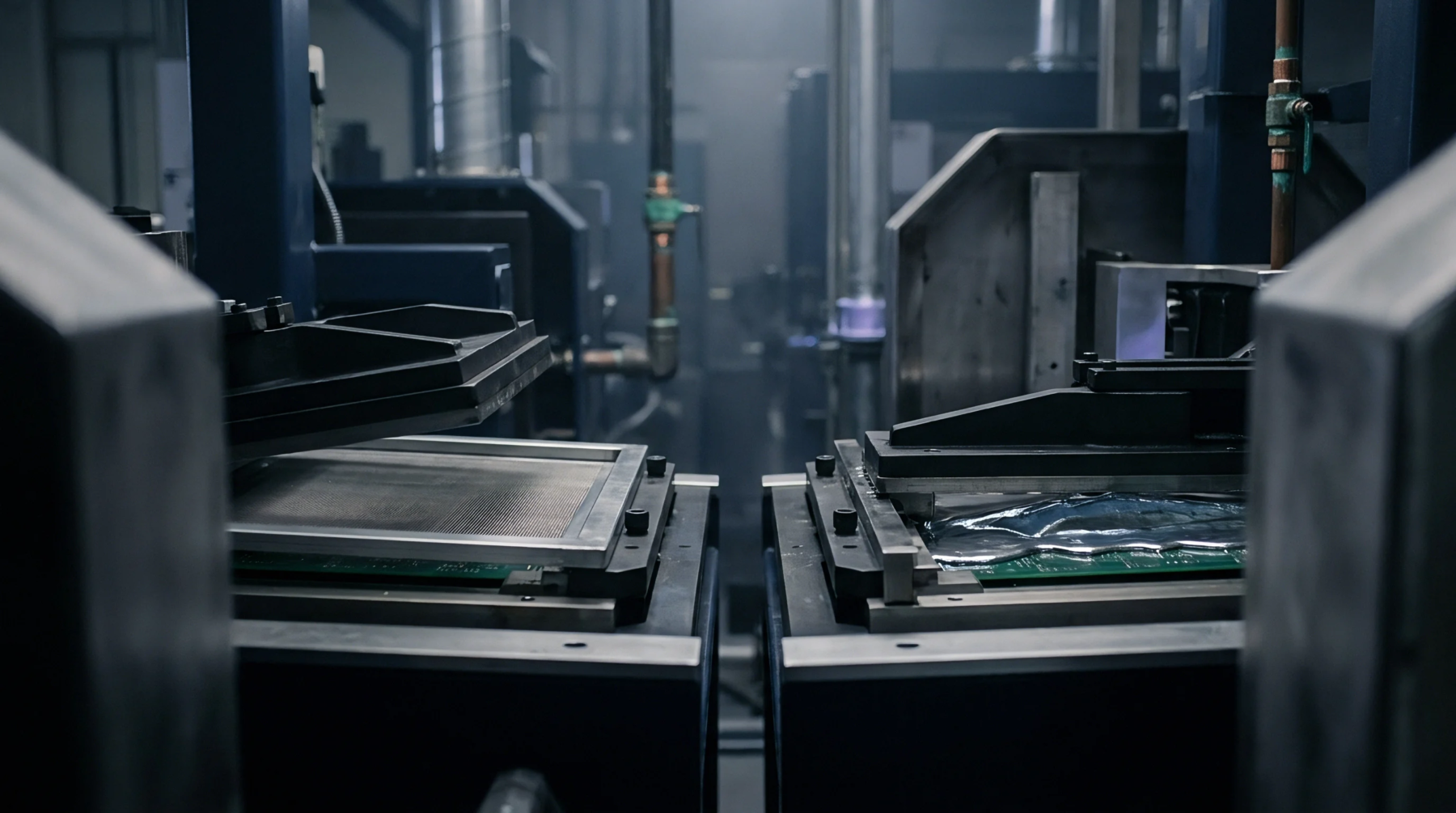
Thermal Distortion
Non-linear deformation describes the permanent geometric warpage occurring in printed circuit board substrates when localized thermal stresses exceed material yield thresholds during reflow soldering. Advanced surface mount technology assembly processes induce this condition through asymmetric copper distribution and uneven heating profiles across multi-layer panels. Optical coordinate measuring machines quantify the resulting out-of-plane variance by scanning grid intersections on the populated board.
Fabrication properties including glass transition temperature dictate how boards respond to thermal gradients before physical damage manifests.
Stress Gradient
Internal mechanical forces accumulate unequally across disparate material boundaries during high temperature exposure. Ceramic chip capacitors and heavy power planes expand at contrasting rates, generating localized shear loads that warp the surrounding laminate structure. Automated optical inspection stations capture shadow moire fringe patterns to reveal these hidden topological anomalies prior to final housing integration.
Subsequent mechanical assembly procedures often lock these residual distortions into place when securing warped boards into rigid metallic chassis enclosures.
Yield Threshold
Board deflection exceeding allowable tolerances compromises solder joint integrity on fine pitch ball grid array packages. Stiffener bars and balanced internal copper planes mitigate excessive bending moments during infrared convection heating cycles. Structural failure occurs when cumulative plastic strain degrades the fatigue life of microscopic interconnects beneath surface mounted components.
Standard acceptance criteria mandate strict out-of-plane flatness limits to guarantee reliable electrical performance throughout the operational lifecycle.