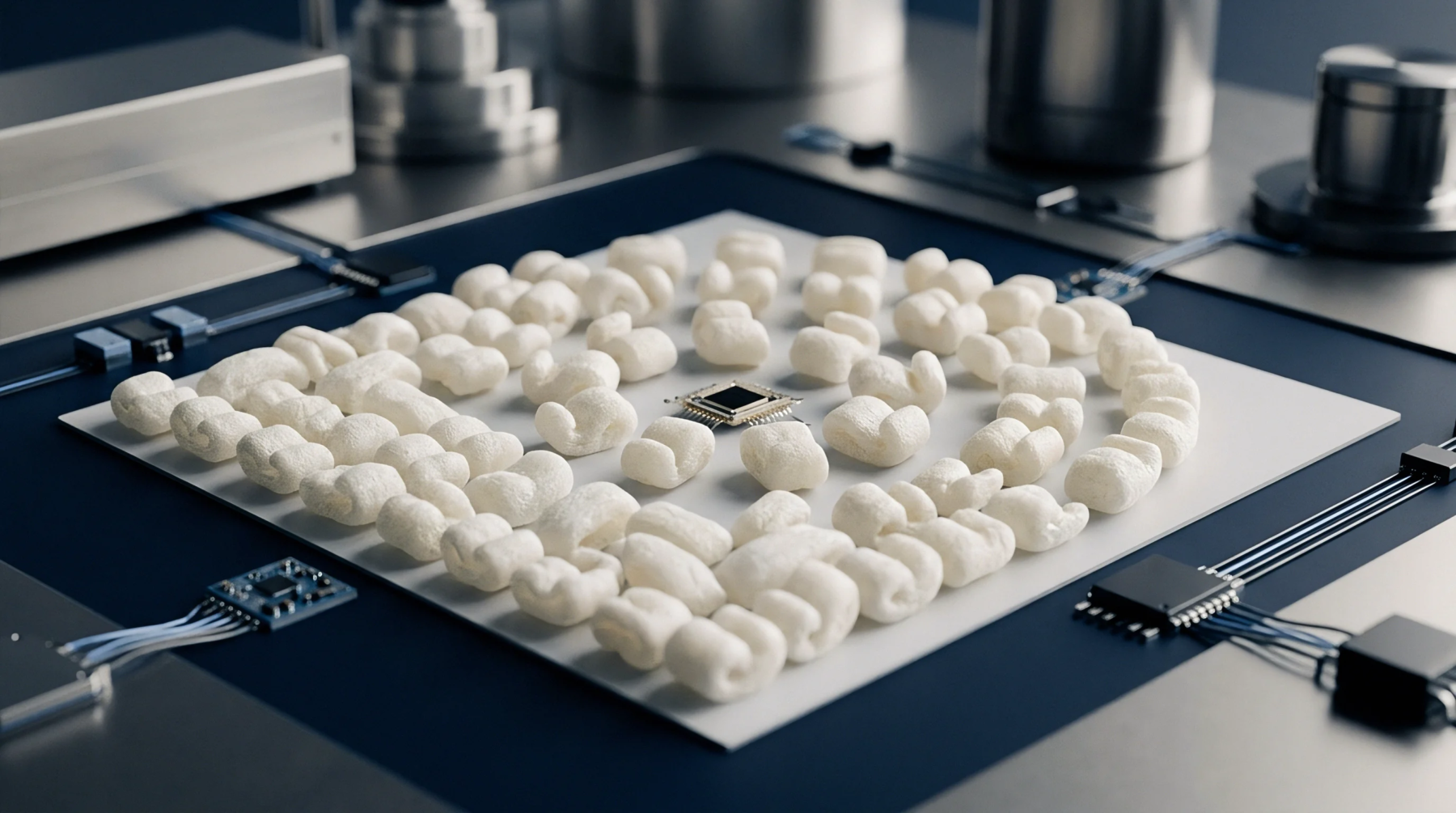
Quantifying Solvent Evaporation Ramp Rates in Reflow
Quantifying solder paste solvent evaporation rates in reflow profiles prevents micro-boiling, solder ball spattering, and excessive voiding beneath BTCs.
Viscosity modification agents govern the flow behavior of specialized printing pastes deposited during surface mount stencil operations. Thixotropic binders provide the necessary shear thinning characteristics that allow heavy metallic formulations to pass cleanly through microscopic aperture walls without slumping or bridging on bare copper pads. Stencil printing requires precise fluid dynamics to prevent solder paste or conductive adhesive from bleeding beyond the defined pad boundaries during squeegee translation.
Shear stress applied by the pressing blade breaks down internal molecular networks temporarily, causing the material to flow like a low viscosity liquid during transfer. Once the mechanical force ceases immediately upon aperture exit, the fluid recovers its higher resting viscosity to hold the deposited geometry stable against gravity prior to thermal reflow. Paste manufacturers formulate these additive systems using high molecular weight polymers or modified clays that respond predictably to mechanical agitation rates.
Squeegee speed and blade angle must align with the specified recovery rate of the material to ensure uniform deposit height across fine pitch components.
Dynamic viscosity reduction during the printing stroke depends heavily on the concentration and dispersion quality of the rheological modifier within the solvent matrix. Shear rates encountered beneath a metal squeegee edge often exceed thousands of reciprocal seconds, demanding rapid structural breakdown from the binder system to maintain smooth material roll. Inadequate shear thinning causes roller slipping or paste dragging, leading to insufficient volume delivery in ultra fine pitch pads and subsequent open joints during thermal processing.
Conversely, excessively slow recovery times allow the wet deposit to slump outward after the snap off phase, bridging adjacent traces and causing catastrophic short circuits on high density printed circuit boards. Thermal stability throughout the ambient shop floor window ensures that paste behavior remains consistent from the first board of a production shift to the final panel. Environmental controls in the assembly room prevent moisture absorption or solvent evaporation from altering the delicate balance between resting stiffness and active shear mobility.
Quantitative verification of paste performance relies on rotational viscometer testing to measure viscosity values across varying rotational speeds and shear stress inputs. Quality engineers establish acceptable tolerance windows for the thixotropic index, calculated as the ratio of low shear viscosity to high shear viscosity, to screen incoming material lots before factory release. Failed batches exhibit erratic slump behavior during automated optical inspection or lead to bridging defects flagged by automated X-ray inspection systems downstream.
Thermal reflow ovens subsequently cure or polymerize the remaining binder matrix, locking the metallic particles into permanent electrical and mechanical connections. Proper selection of the formulation prevents void formation within the joint during the outgassing phase of the volatile solvent components. Final assembly reliability depends entirely on the stability of these chemical systems under standardized manufacturing conditions.
Quantifying solder paste solvent evaporation rates in reflow profiles prevents micro-boiling, solder ball spattering, and excessive voiding beneath BTCs.
Expertise is a utility, not a secret. sentiention™ publishes its working knowledge as open reference: intelligence layer covering the materials it sources, the markets it enters, and the reference that serves both.