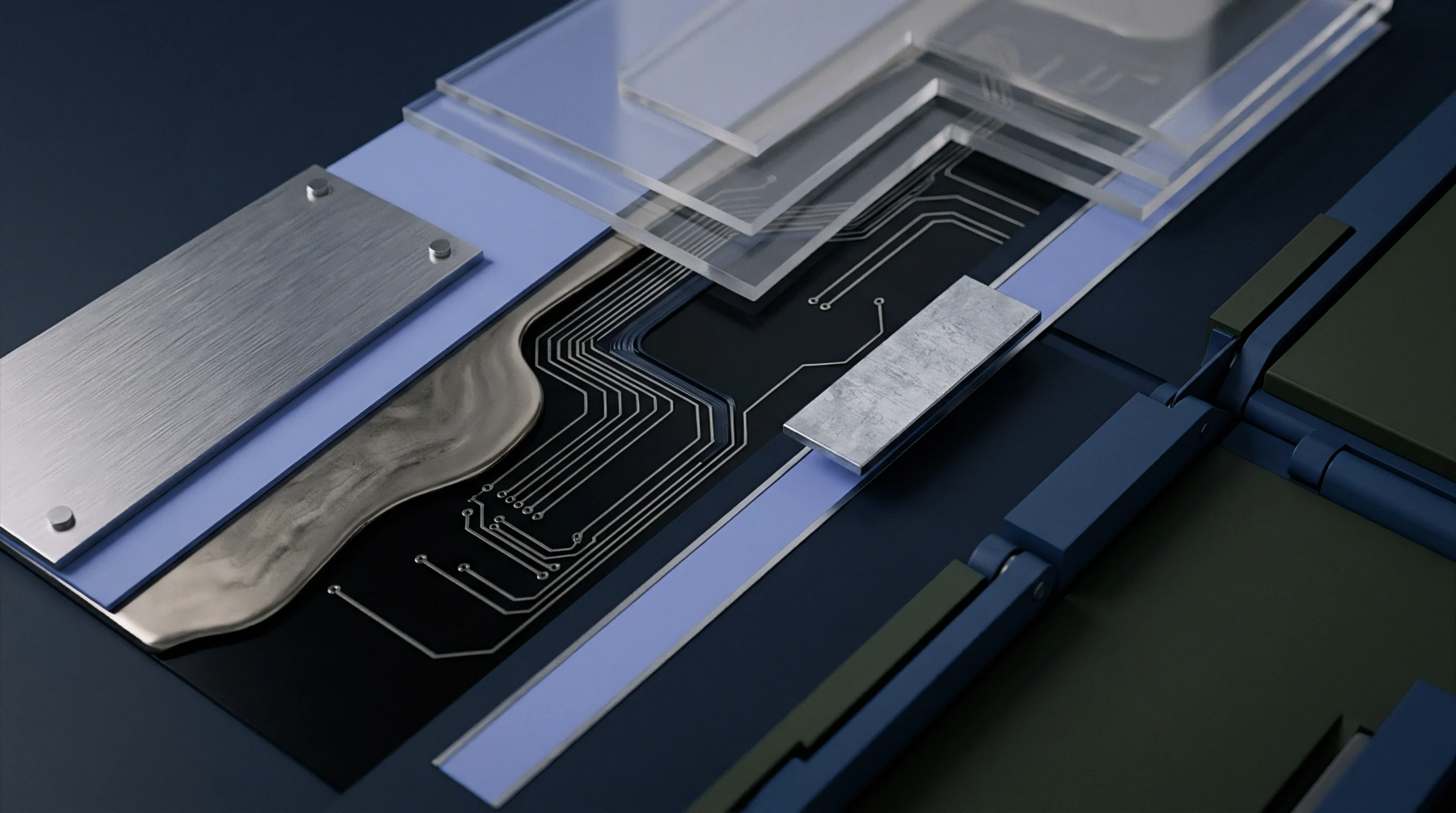
Thermal Load
Vertical deformation force applied during the thermal bonding cycle governs the mechanical integrity of multilayer printed circuit board lamination. When hydraulic presses apply excessive vertical pressure onto unpolymerized prepreg resin, local dielectric thickness collapses beneath heavy copper planes. Manufacturers prevent internal layer starvation by programming multi-stage pressure ramps that pause before resin viscosity drops to its minimum threshold.
Standard cross-section microsections reveal whether glass fabric bundles suffered resin starvation or resin pooling during the pressing operation.
Platen Parallelism
Machine calibration relies on dial indicators placed at each corner of the heated press to verify uniform pressure distribution across large panel formats. If opposing steel platens tilt by fractions of a millimeter during closure, the resulting thickness gradient causes uneven electrical impedance across differential impedance traces. Technicians insert pressure-sensitive Fuji film between stainless steel separator plates to record the actual force map before running production batches.
Hydraulic cylinder misalignment or thermal warping of heavy steel masses introduces localized thickness variations that escape visual inspection entirely.
Dielectric Uniformity
Final circuit performance depends on maintaining precise dielectric spacing between inner layers to prevent capacitance drift in high-frequency applications. Impedance testing using time domain reflectometry measures signal propagation speed, which varies directly with local substrate thickness variations. Signal integrity engineers establish minimum dielectric thickness thresholds to guarantee that finished boards meet controlled impedance tolerances without signal attenuation.
Finished laminate thickness variations alter microstrip transmission line behavior and degrade high-speed data transmission reliability.