Dynamic Deflection
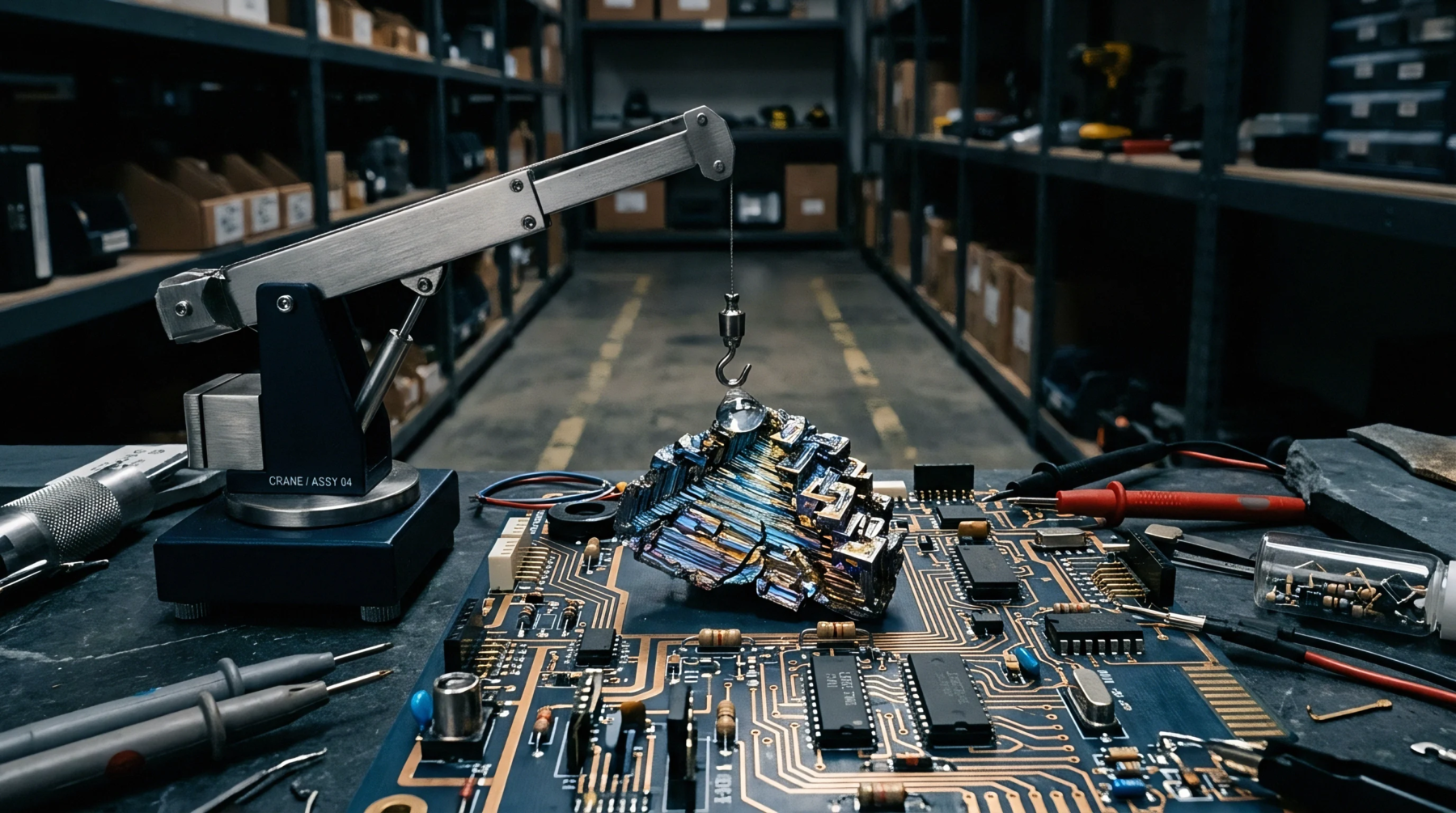
Transverse transient oscillation occurring at the unsupported tip of an overhung pick-and-place boom during rapid deceleration constitutes an inertial error mode known as cantilever beam whip. Structural inertia drives the distal placement head past its commanded coordinate when the main carriage arrests, generating a decaying flexural wave across the beam axis. The phenomenon directly limits placement speed on single-sided support architectures, decaying within tens of milliseconds through internal material friction and servo counteraction.
Mechanical deflection ceases to govern placement quality once the carriage comes to a complete rest and vibrations subside below visual alignment thresholds.
Kinematic Penalty
High-speed surface-mount machines operating with asymmetric axes experience positional displacement proportional to the cube of the arm length and the first derivative of acceleration. Severe cantilever beam whip introduces coordinate drift during flight, skewing the nozzle trajectory right before component drop. Optical inspection systems catch this misalignment at post-placement automated optical inspection as recurring component tilt or terminal edge overhang on passive packages.
Slower deceleration profiles suppress the whip effect but extend production cycle duration, establishing an operational compromise between placement cadence and lateral landing accuracy.
Structural Mitigation
Closed-loop dual-motor drive architectures resolve the oscillation by supporting both ends of the traversing beam across a rigid bridge frame. Machine designers incorporate carbon-fiber reinforced structural skins or internally ribbed composite extrusions to drive the fundamental natural frequency of the arm beyond machine motion bandwidths. Advanced feedforward jerk filtering algorithms actively alter the commanded current curve to inject canceling pulses prior to axis braking.
Dynamic dampening elements located inside the spindle housing dissipate residual transverse flexure before the nozzle releases the component body onto wet solder paste. Resonant frequencies above one hundred hertz routinely isolate the tooling carriage from low-order flexural whipping.