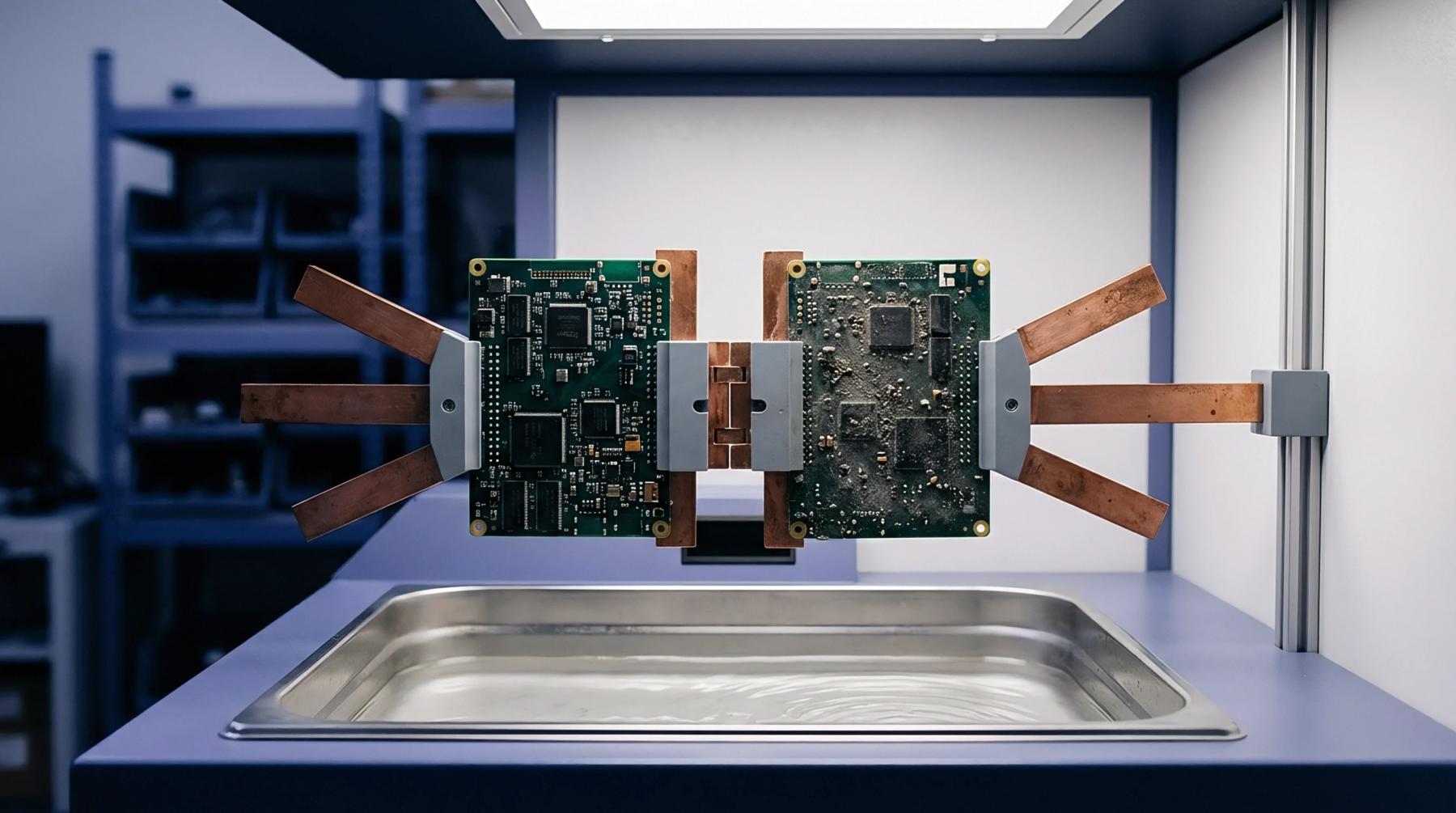
Mechanical Load Profiling
High frequency measurement captures transient surface deformations on printed circuit boards during automated component placement or board depanelization to quantify physical stress. Dynamic strain acquisition tracks how rapidly localized board flexure occurs when rigid nozzles contact delicate components or when mechanical blades separate finished panels from arrays. Sensors mounted near high density connectors monitor how these movements propagate through the substrate to prevent microscopic fracture in solder joints or ceramic capacitor bodies.
Hardware platforms convert analog signals into digital waveforms to map every deflection peak against set safety thresholds. High strain rates correlate with immediate structural failure or latent cracks that appear after thermal cycling in the field.
Measurement Technique
Discrete resistance strain gauges form the primary sensing element bonded directly to target locations on the assembly. These foil devices change electrical resistance as the substrate underneath them undergoes physical stretching or compression during mechanical shock. A dedicated bridge amplifier translates these infinitesimal resistance shifts into usable voltage data that capture events occurring in the microsecond domain.
Sampling frequencies must exceed ten kilohertz to resolve sharp spikes caused by high speed robotic impact. Software analysis then filters background vibration to isolate the specific event signal generated by the manufacturing tool. Technicians calibrate these gauges to ensure accuracy across the entire frequency spectrum.
Process Limitation
Signal integrity relies entirely on the quality of the bond between gauge and board surface. Adhesives failing to cure properly introduce signal damping or phase shifts that mask the severity of the measured event. Surface contaminants such as flux residue or conformal coating inhibit direct contact and skew the collected waveform data.
Automated placement machines demand mounting locations that avoid high voltage traces while remaining close to the point of mechanical contact. Small board sizes further constrain available space for sensor placement. Reliable data output requires consistent application pressure and precise gauge positioning to differentiate harmful impact from standard elastic board motion.
Effective monitoring provides a quantitative basis for adjusting machine force to protect long term solder joint health.