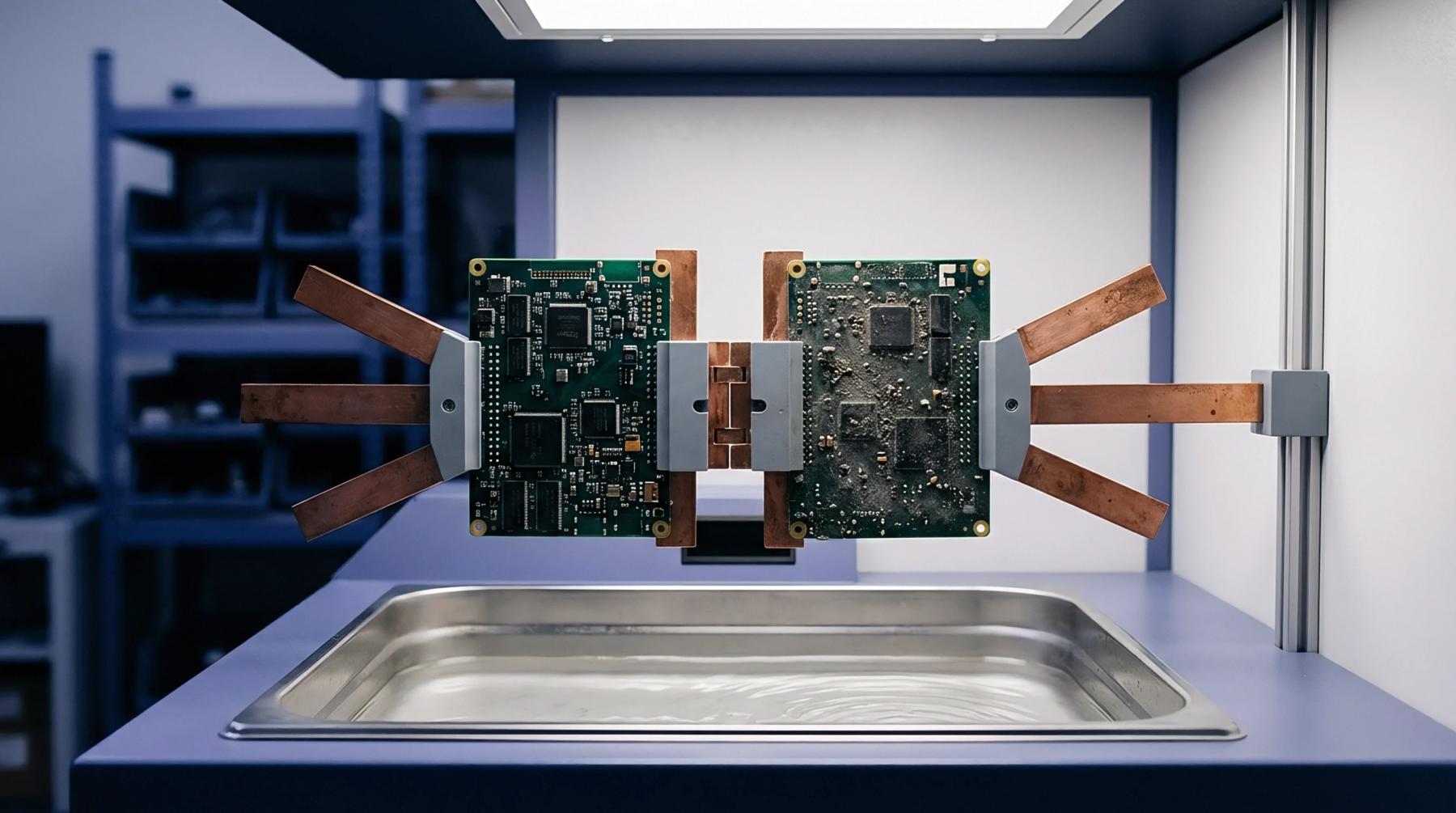
Fixture Engagement
Pneumatic force application defines the mechanical process where an airtight seal develops between a circuit board and its support tool to enable consistent functional test probe contact. Vacuum fixture actuation relies on pressure differentials to pull a board onto the registration pins for stability. Atmospheric pressure outside the chamber pushes against the board surface while a pump creates a low pressure zone beneath the panel.
This negative pressure maintains the board in a static position against the test interface throughout the electrical verification cycle. The force magnitude depends on the seal area and the pump capacity. Seal integrity determines if the board stays flat or shifts during the test procedure.
Failure to hold the board securely leads to intermittent contact issues at the bed of nails interface.
Force Distribution
Mechanical hardware manages the drawdown speed to prevent board warping or surface damage. Vacuum fixture actuation utilizes regulating valves to control the rate of ascent until the desired contact pressure reaches the threshold for stable data collection. High velocity drawdown occasionally creates mechanical stress on sensitive surface mount solder joints.
Engineers adjust flow restrictors to mitigate these transient forces during the initial pull down phase. Uniform clamping force across the board surface ensures that all probe tips hit their designated landing pads with repeatable pressure. Irregular seal gaskets cause uneven seating depths that introduce errors into the test cycle.
Proper alignment requires the gasket to follow the board perimeter without crossing over routed edges or cutouts.
Sealing Integrity
Gasket wear introduces leakage paths that degrade the clamping force over time. Vacuum fixture actuation performs reliably only when the seal remains airtight and free from debris. Operators monitor the drawdown time as a metric of seal health because slow activation indicates pump degradation or a damaged gasket surface.
Maintenance schedules mandate regular visual inspection of the seal perimeter to identify compression set or structural cuts. Compressed air or mild solvents remove flux residue that prevents the rubber from forming a complete vacuum bond. The final test yield depends entirely on this constant clamping pressure for the duration of the entire electrical verification sequence.