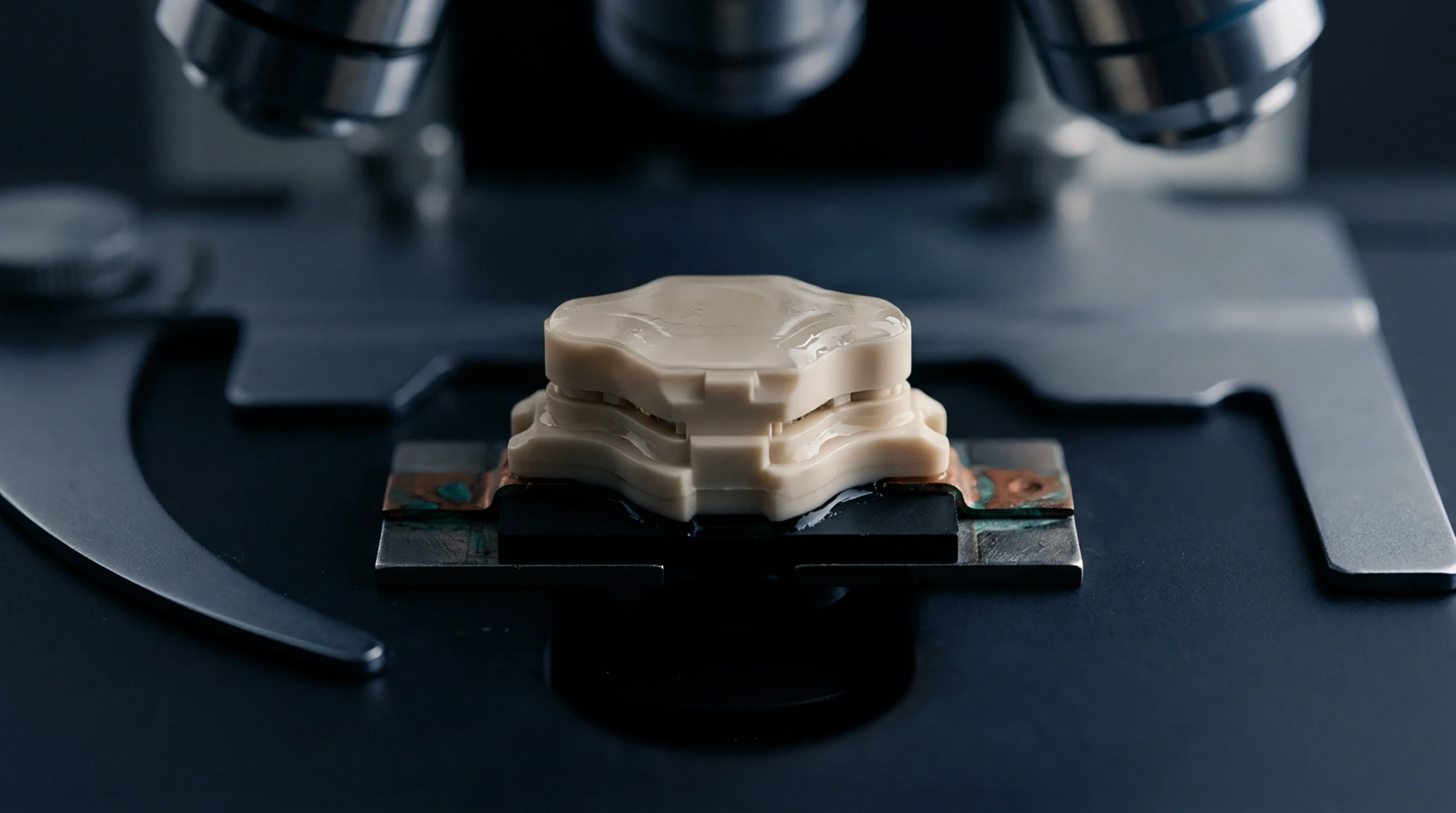
Piezoelectric Material
Piezoelectric ceramics convert mechanical force into electrical energy and electrical signals into physical movement. Lead zirconate titanate is a widely used ferroelectric material that exhibits high piezoelectric coefficients and excellent mechanical stability. It is used in actuators, sensors and ultrasound transducers integrated directly onto circuit boards or housed in sensor assemblies.
The material requires high-temperature sintering during fabrication to develop its characteristic crystalline structure. Once sintered, the material must be polarized under a high electric field to align the ferroelectric domains for active operation.
Transducer Fabrication
Deposition of this ceramic onto substrates is achieved through screen printing, sol-gel methods or sputtering depending on the required thickness. Sol-gel solutions of lead zirconate titanate are spin-coated and annealed to build up the active sensor layer on silicon wafers. This process demands precise temperature control to avoid lead evaporation and maintain stoichiometric balance.
Performance Testing
Impedance analyzers measure the resonant and anti-resonant frequencies of the deposited layer to determine the coupling coefficients of the material. A well-processed layer of lead zirconate titanate shows high capacitance and low dielectric loss at the target operating frequency. Sensors that fail to meet these parameters are rejected due to low sensitivity or high thermal dissipation.