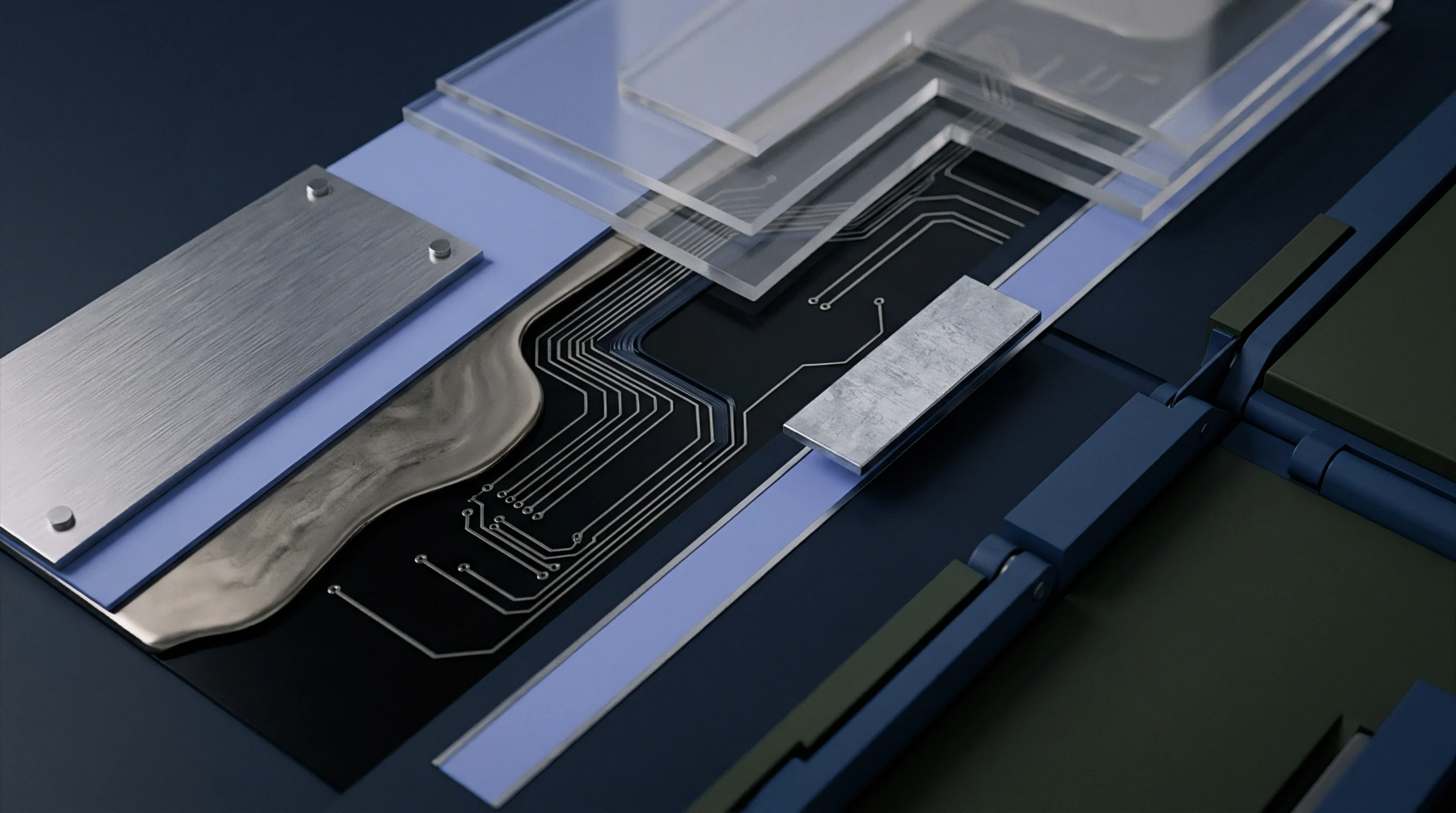
Polymerisation Gradient
Thermal polymerization monitoring governs structural stabilization during printed circuit board lamination, ensuring that resin cure advancement proceeds evenly through high-density multilayer architectures. Chemical cross-linking kinetics dictate how thermosetting matrices transition from a liquid state into a rigid solid under controlled heat and pressure profiles. This transformation prevents voids, delamination, and warpage during subsequent thermal shocks encountered in surface mount technology assembly lines.
Optical inspection methods cannot detect internal incomplete cross-linking, so destructive cross-sectioning and differential scanning calorimetry verify proper conversion rates before a board accepts component placement.
Thermal Profile
Heating ramps drive molecular chain extension within epoxy resin systems, requiring precise dwell times to achieve full solidification without degrading the surrounding glass cloth reinforcement. Temperature uniformity across the press platen prevents localized under-cure conditions that reduce glass transition temperatures and weaken mechanical integrity under thermal stress. Automated controllers regulate platen temperature by tracking thermocouple feedback embedded directly within test coupons placed alongside production panels.
Conversion Rate
Thermoset conversion thresholds dictate mechanical performance during bare board routing and subsequent reflow soldering operations. Incomplete network formation lowers the elastic modulus, leaving the dielectric susceptible to moisture absorption and subsequent blistering when exposed to peak assembly temperatures. Residual exotherm measurements quantify remaining reactive potential, confirming that the lamination cycle reached the specific degree of cross-linking required for reliable electrical isolation in service.