Loop Configuration
Circular transmission lines positioned adjacent to straight feed lines couple electromagnetic energy through narrow proximity gaps without direct galvanic connection. When the mean circumference of the circular loop equals an integer multiple of the guided wavelength, constructive interference produces periodic transmission peaks, defining the basic operation of a ring resonator. Absence of open-ended terminal discontinuities eliminates open-end parasitic losses and fringing capacitances that degrade straight-stub modal measurements.
This closed circular geometry allows broadband extraction of effective relative permittivity and dielectric loss tangent directly from measured transmission scattering parameters.
Characterization Process
High-frequency dielectric extraction requires precise fabrication of the ring resonator coupon on the specific laminate under evaluation. Chemical etching variations in trace width alter the nominal line impedance, shifting transmission frequencies away from theoretical values. Vector network analyzers sweep across target frequency bands, recording transmission parameters at consecutive harmonic peaks.
The loaded quality factor extracted from transmission peaks accounts for conductor roughness losses and dielectric dissipation. By comparing harmonic peaks across multiple orders, engineers separate copper conductor losses from substrate dielectric loss. Dispersive behavior across wide bands emerges without requiring complex de-embedding algorithms.
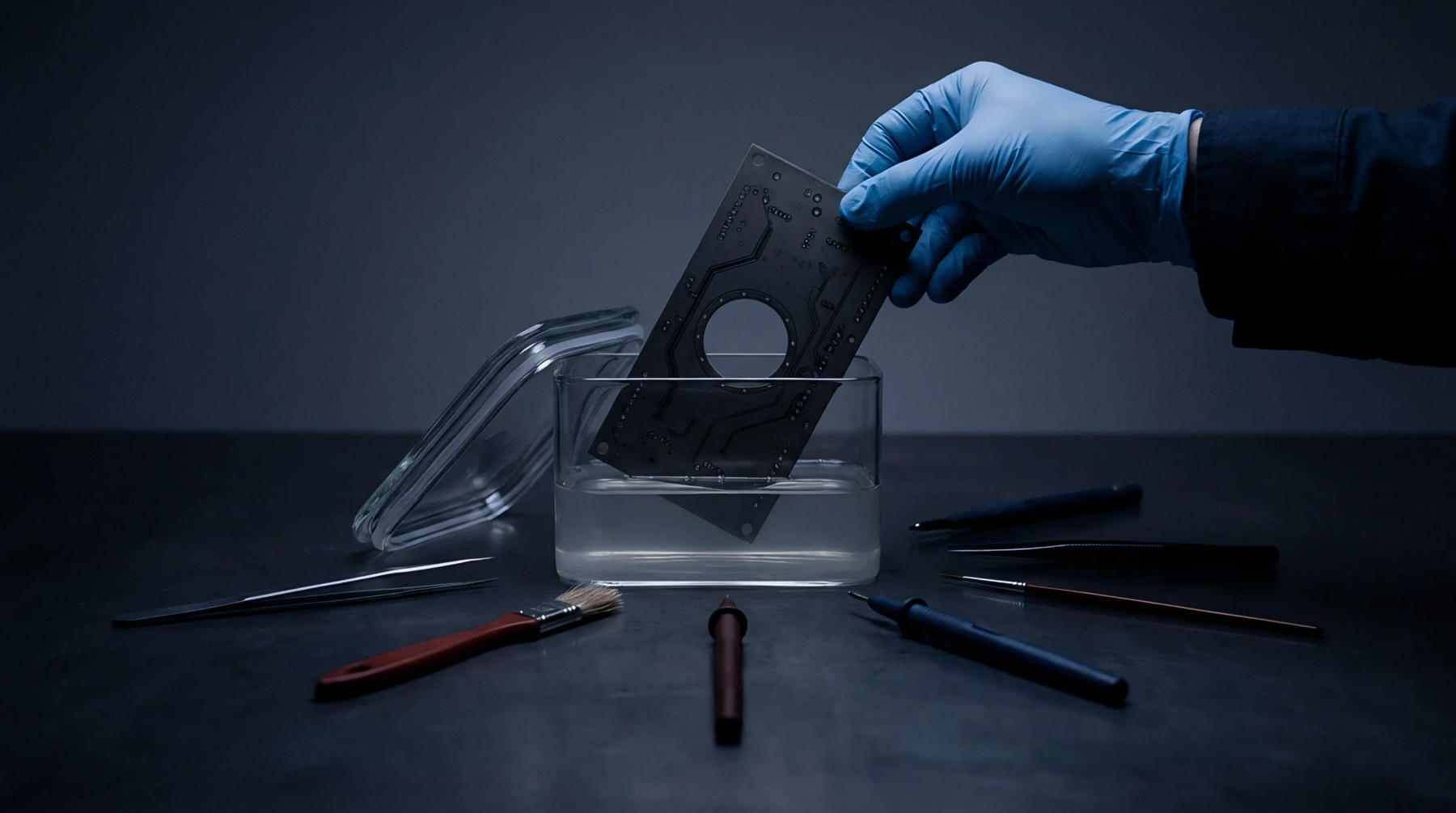
Soldermask must be omitted over the circular ring and coupling gap, as uneven mask thickness introduces permittivity errors into the extracted values.
Quality Compliance
Acceptance testing using IPC-TM-650 Method 2.5.5.5 dictates coupon dimensions and measurement tolerances for material permittivity verification. Microsectioning across the coupling gaps ensures etch tolerances meet drawing specifications without copper undercutting. Fabricators reject material lots when extracted dielectric constant values deviate beyond two percent from the manufacturer catalog baseline.