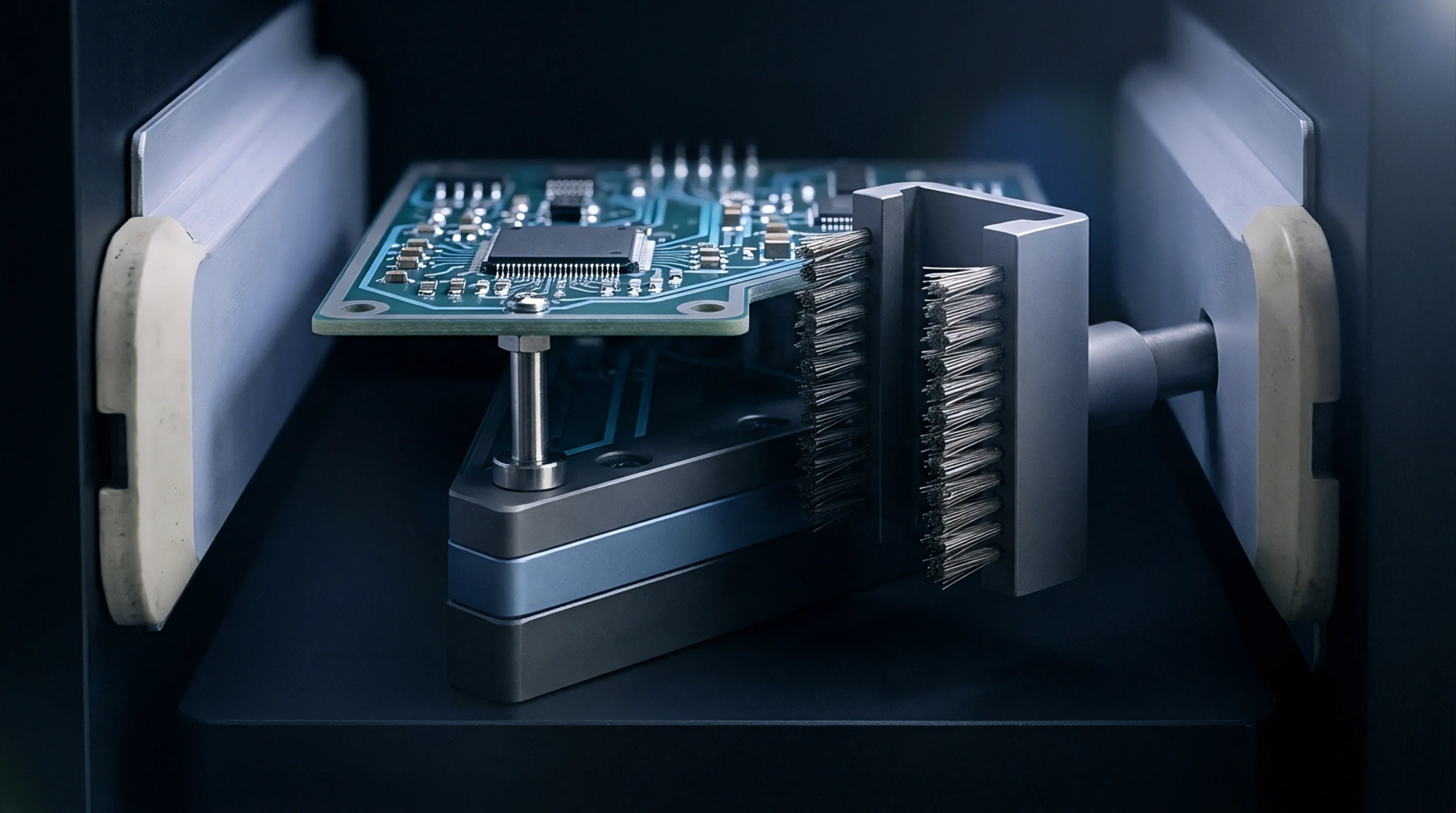
Measuring Fixture
Electromagnetic resonant fixtures utilize a split-post dielectric resonator design to determine the dielectric properties of planar laminates. This measurement tool, called an SPDR cavity, operates by clamping a substrate sheet between two halves of a cylindrical resonant chamber. It offers an exceptionally accurate way to measure the in-plane relative permittivity and loss tangent of board materials at specific gigahertz frequencies.
This method does not require copper plating to be removed from the substrate before testing if unclad laminate samples are used. It has become a standard tool for raw material inspection because of its rapid sample-loading design and high repeatability.
Fixture Operation
Measuring the resonant frequency and quality factor of the empty cavity establishes the baseline performance. Inserting the laminate sample shifts the resonant frequency down and decreases the quality factor due to dielectric losses. High-speed software calculations convert these two shifts directly into permittivity and loss tangent values.
This approach eliminates the need for manual calculations.
Board Fabrication
Board fabricators use this measurement to qualify incoming batches of high-frequency material before launching them into the wet chemistry lines. Knowing the true dielectric constant allows the engineering team to adjust the trace widths on the phototools to compensate for any material drift. This helps avoid out-of-spec board impedance.
This represents a standard step in multi-gigabit board production.