Material Deformation
Mathematical matrices that represent time-dependent and direction-dependent deformation behavior under constant stress describe the long-term mechanical stability of polymer substrates. The viscoelastic creep tensor defines how the epoxy resin in printed circuit boards deforms under continuous mechanical loads. It captures the complex transition between elastic, viscous, and plastic responses across three-dimensional axes over extended operating lifetimes.
This formulation allows engineers to predict the slowly growing deflection of the substrate under the weight of heavy components.
Stress Analysis
Finite element simulations of board-level stress utilize these multi-dimensional coefficients to calculate the redistribution of load over time. Solder joints and laminates experience continuous stress relaxations and deformations when subjected to clamping forces or thermal gradients. Applying the viscoelastic creep tensor to these models reveals how stress concentrates at the interfaces of dissimilar materials during prolonged storage or operation.
This analysis helps determine the long-term reliability of electrical connections by identifying areas that will experience structural degradation before the end of the planned product life. The simulation translates complex physical stresses into predictable strain curves, showing where fatigue is likely to occur first.
Parameter Measurement
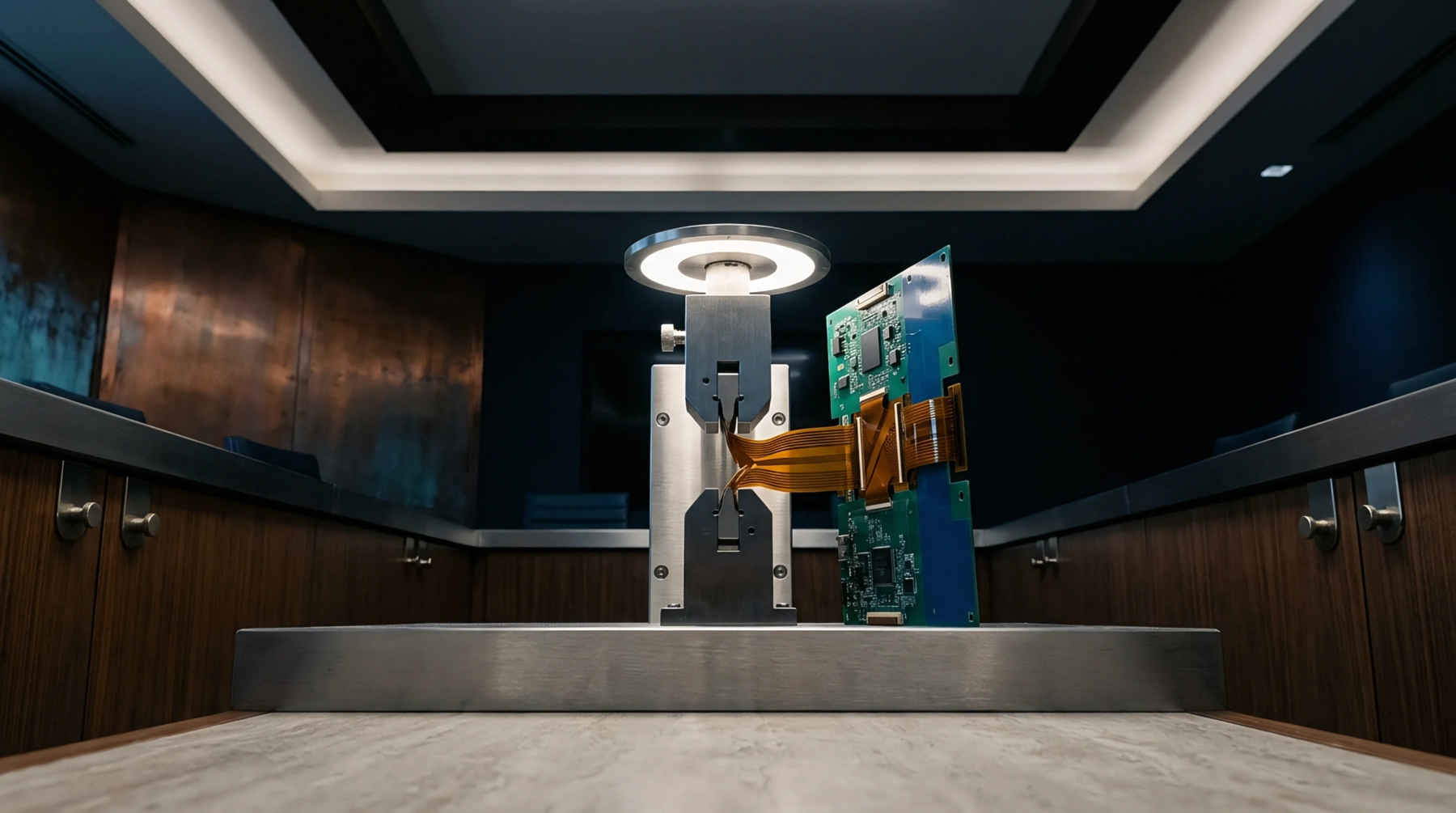
Dynamic mechanical thermal analysis measures the mechanical response of the epoxy matrix under cyclic loads to populate the tensor array. Testing laboratories apply controlled sinusoidal forces at different frequencies and temperatures to isolate the viscous and elastic components of the resin. This testing yields the stress strain relationships needed to solve the mathematical model.