Coalescence Fault
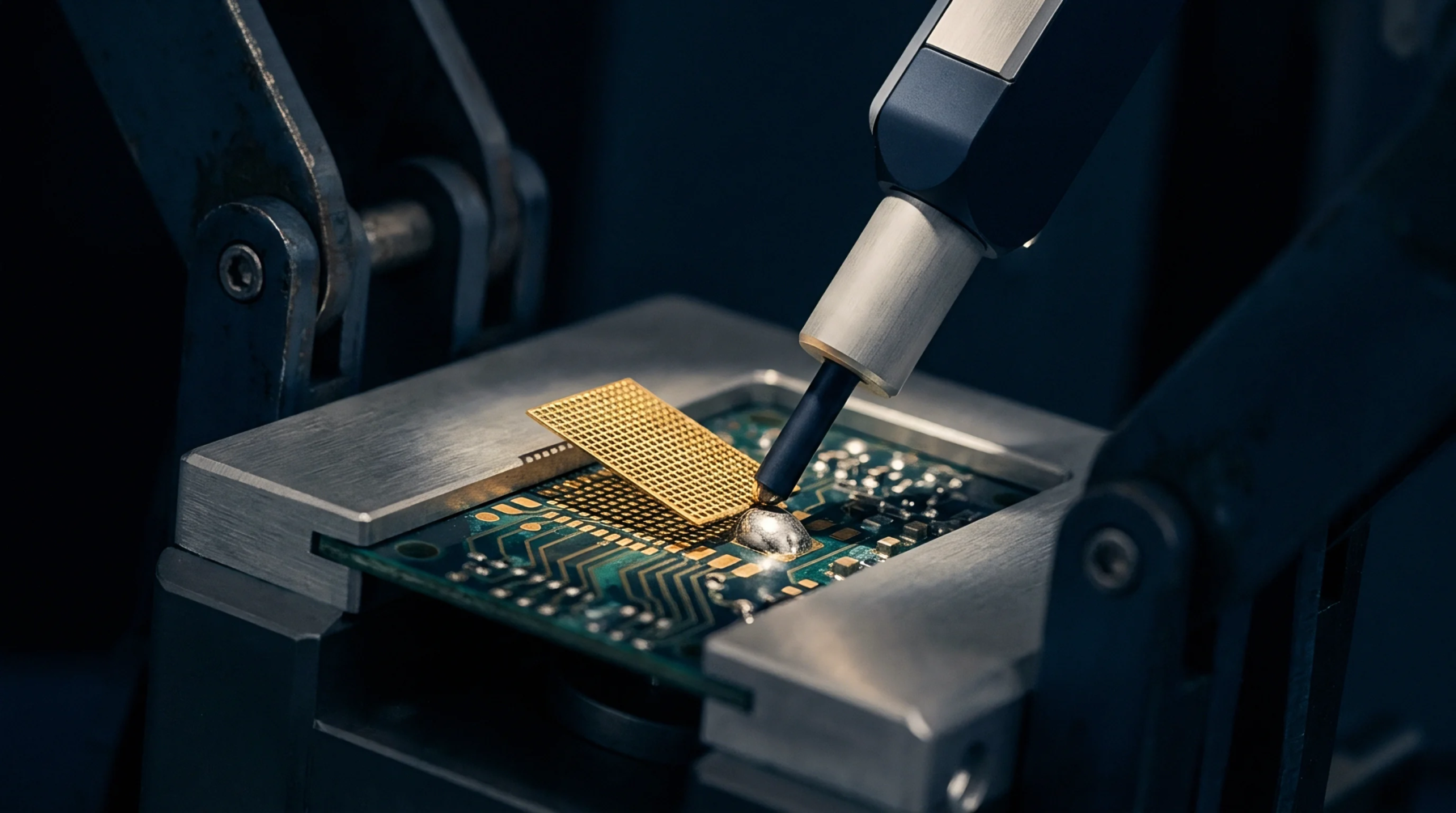
Solder continuity established across adjacent conductors during assembly processes forms an unintended conductive path that violates clearance limits. The occurrence of bridging shorts represents a primary failure mode on high-density circuit assemblies during wave, selective, or reflow soldering operations. Surface tension, excessive paste volume, misaligned component placement, or inadequate flux activity encourage molten alloy to span the gap between neighbouring component terminations or printed copper features.
Such faults breach the separation requirements mandated in standards such as IPC-A-610, turning isolated electrical networks into an active short circuit.
Deposition Mechanics
Solder paste printing precision determines whether volume boundaries collapse during thermal processing. Aperture area ratios below design minimums cause erratic release, while excessive aperture dimensions leave surplus paste deposit that slumps across non-soldermask defined gaps during preheat phases. Component placement force shifts this surplus outwards across adjacent landing patterns.
Surface tension pulls liquid alloy toward wettable metallisation during reflow, but insufficient soldermask web width or missing mask dams leave an unobstructed trail for molten bridges to freeze between adjacent pins. Selective soldering nozzles passing beneath fine-pitch connectors also drag dross or pooled alloy across leads when separation speed and nitrogen purity drift outside qualified windows.
Verification Protocol
Optical systems detect outer conductor bridges before assemblies move to functional verification stages. Automated optical inspection verifies the absence of alloy filaments across lead spaces, cross-referencing package footprints against grey-scale threshold limits. Automated x-ray inspection penetrates perimeter arrays, land grid arrays, and ball grid arrays where optical line of sight is obstructed.
In-circuit testing then routes low-voltage continuity checks through bed-of-nails fixtures to register low-resistance paths across isolated nets. Rework demands flux application and targeted thermal extraction with vacuum wick or miniature desoldering tips to restore native spatial separation without lifting neighbouring copper lands. Repeated shorting at the same site indicates systematic paste transfer variation or warped component mould bodies.