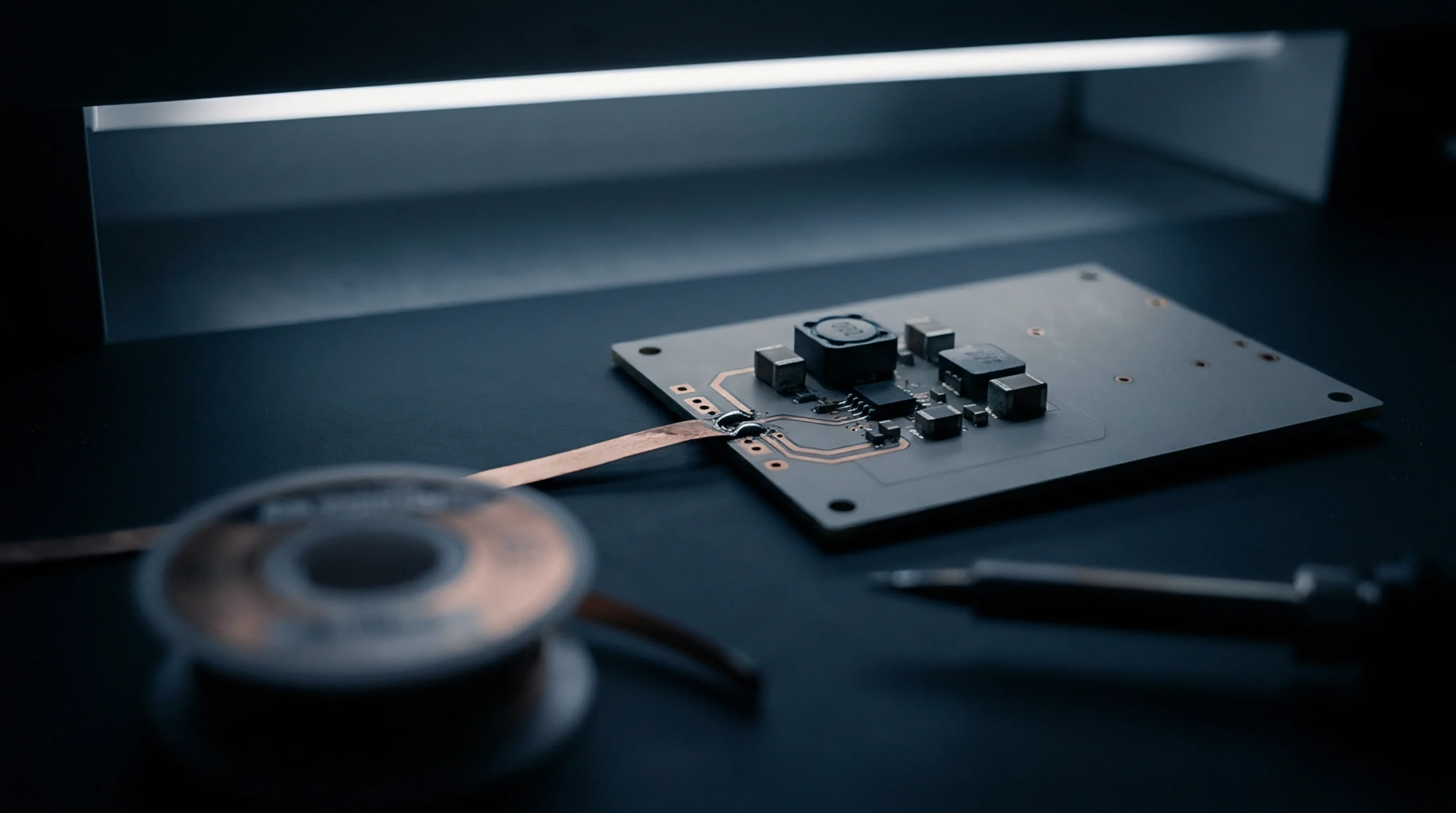
Board Deflection
Planar stability in thin circuit boards represents a core requirement during high-speed surface mount assembly. Under the weight of heavy components or under squeegee pressure, center sag occurs when the middle of the board deflects downward. This deflection leads to non-uniform solder paste deposit thicknesses across the substrate surface.
In solder paste printers, it also causes poor gasket seals between the stencil and the board.
Print Failure
Uneven paste thickness leads directly to open joints and solder bridging during the subsequent reflow phase. When the board sags during paste deposition, the stencil cannot make flush contact with the central pads, causing paste to squeeze out sideways. In addition, when the squeegee passes over the sagged region, it leaves a thicker layer of paste in the center and a thinner layer on the clamped edges.
Such variations in solder volume undermine the quality of fine-pitch ball grid array connections. Boards with high layer counts or dense copper distribution suffer more from this defect due to their increased mass.
Support Method
Mechanical tooling pins and vacuum plates prevent board deflection during the printing and placement processes. Elevating the board center from underneath maintains a level plane throughout the high-speed placement cycle.