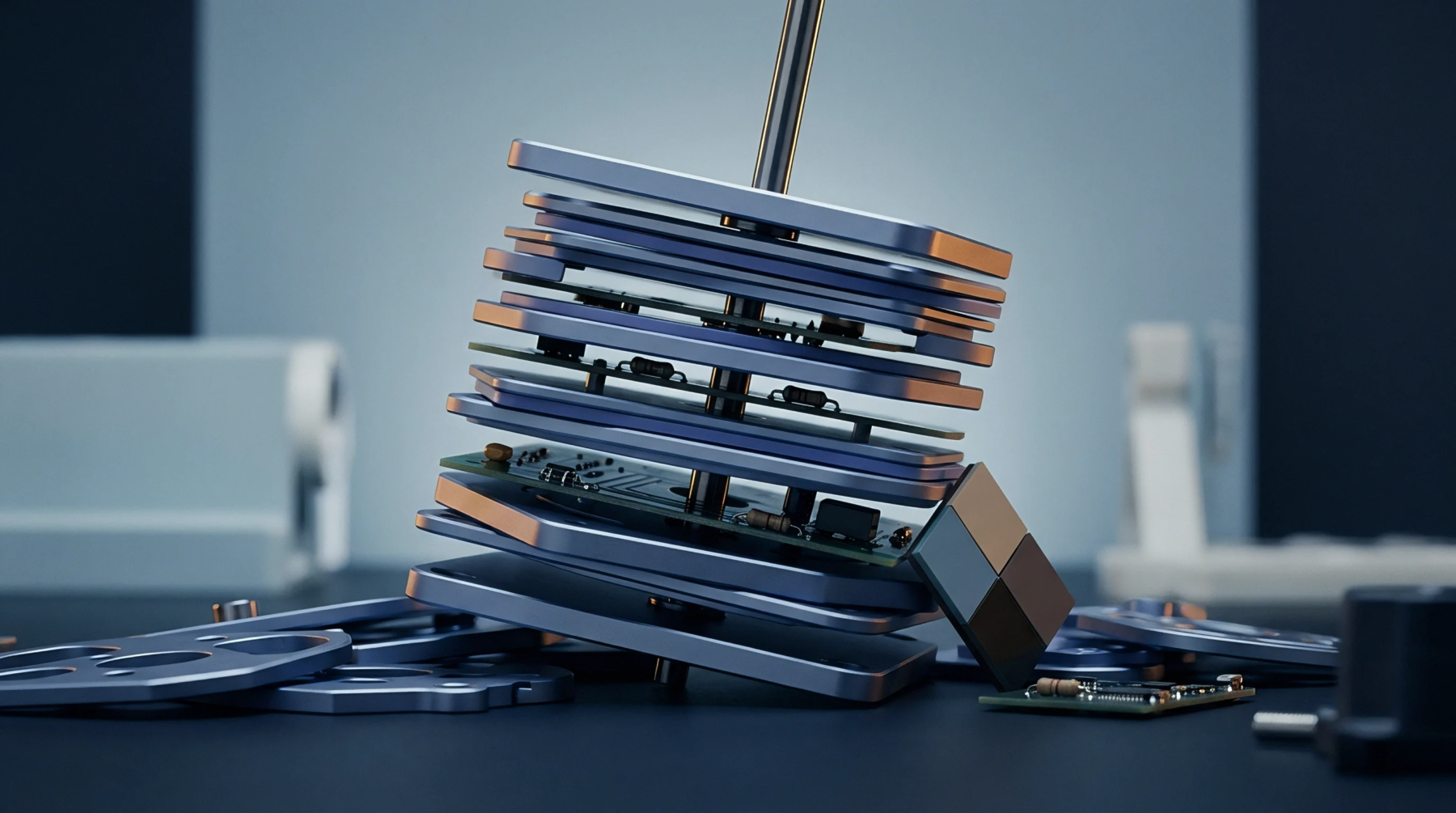
Polymer Densification
Molecular reorganization during the curing of thermosetting resins causes a decrease in material volume as liquid monomers transform into crosslinked solid structures. This chemical shrinkage occurs independently of thermal contraction and remains a primary driver of dimensional instability in rigid base materials. The phenomenon ends once the crosslinking density reaches a plateau.
Volumetric Reduction
Liquid resin occupies more space than the cured polymer because the covalent bonds formed during polymerization pull atoms closer together than the secondary forces present in the unreacted state. In printed circuit fabrication, chemical shrinkage affects the prepreg layers during the press cycle, where the resin must fill the voids between glass fibres and copper features while simultaneously reducing its overall volume. The physical loss of volume is often quantified as a percentage of the initial mass.
If the resin lacks sufficient flow to compensate for this reduction, internal voids or delamination occur at the interface of the copper and the dielectric.
Stress Generation
Internal forces develop when the surrounding glass cloth or copper foil constrains the contraction of the resin. Because chemical shrinkage happens at elevated temperatures during the lamination hold, it interacts with the thermal expansion of the materials to create a complex residual tension field. This buildup of energy leads to bow or twist defects when the panel is removed from the press and cooled to ambient temperature.
The magnitude of the effect depends on the resin chemistry and the rate of the cure reaction.