Physical Threshold
Insulating materials experience permanent structural failure when local electric field intensity surpasses the binding energy of the molecular lattice. Dielectric breakdown mechanics describes the transition from non-conductive stability to conductive arcing through the formation of electronic avalanche paths. Voltage potential exerts stress on covalent bonds within epoxy resins or laminate structures until charge carriers accelerate sufficiently to ionize adjacent neutral atoms.
This ionization creates a feedback loop that generates a localized plasma channel, rendering the substrate permanently conductive at the failure site.
Processing Vulnerability
Fabrication quality determines the specific voltage at which a material eventually fails. Microscopic voids inside prepreg layers or trapped contaminants during the lamination cycle concentrate the local field strength far beyond the nominal dielectric strength of the dielectric breakdown mechanics calculation. Small air pockets possess lower permittivity than the host material, shifting the field load onto the gas phase and triggering premature partial discharge events.
Production controls target the reduction of these structural discontinuities to protect circuit board integrity during high voltage operation.
Failure Consequence
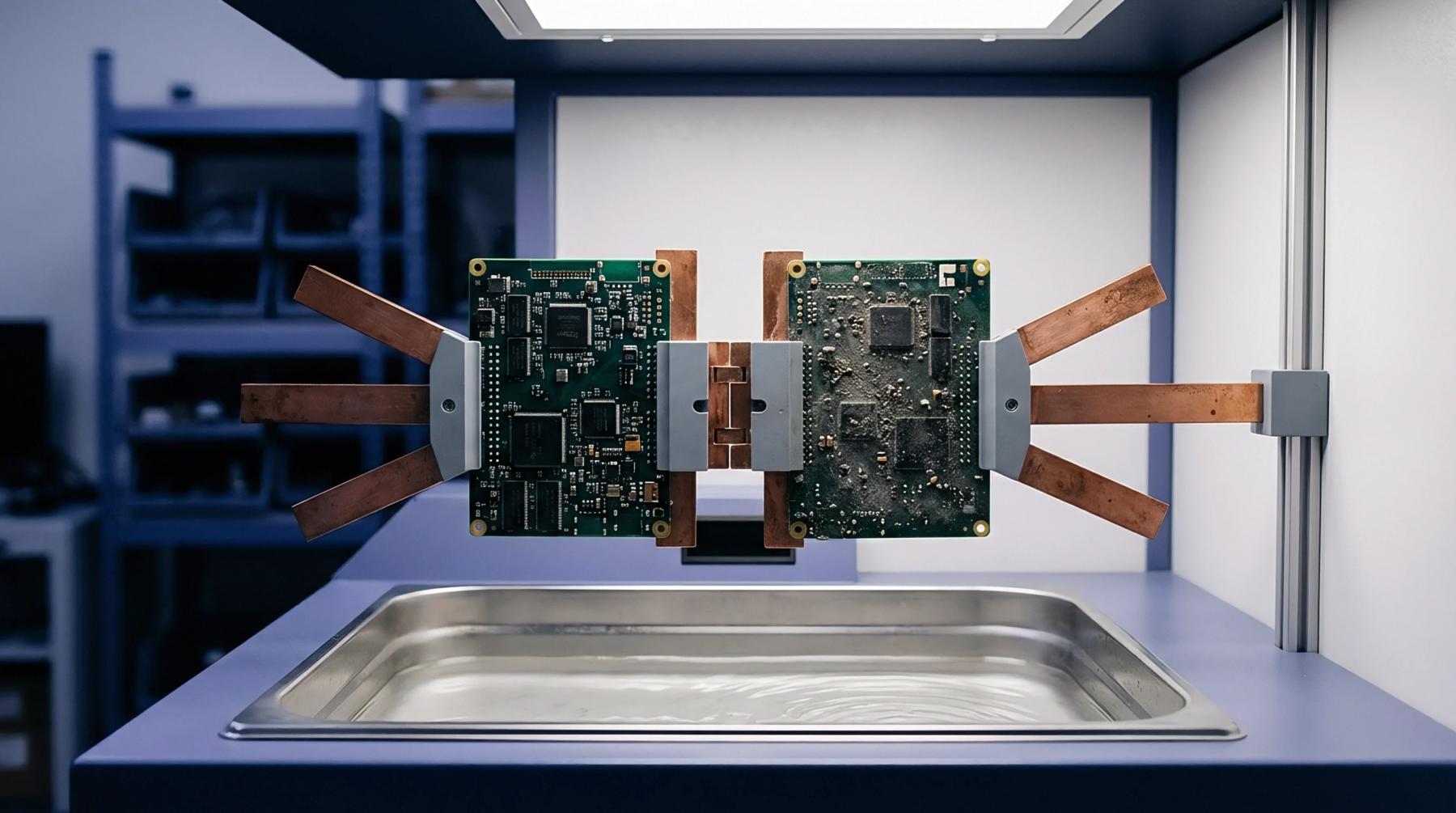
Thermal energy liberated by the sudden current flow through the breakdown path vitrifies or carbonizes the epoxy matrix. Dielectric breakdown mechanics defines the irreversible nature of this charred filament, as the chemical alteration of the insulation ensures the loss of high impedance states across the gap. Circuit boards that suffer this event demonstrate localized burning or conductive tracks that effectively short internal planes, permanently disabling the electronic assembly.
Total system failure follows immediately when the resulting pathway connects power planes or high voltage signal lines.