Bulk Momentum
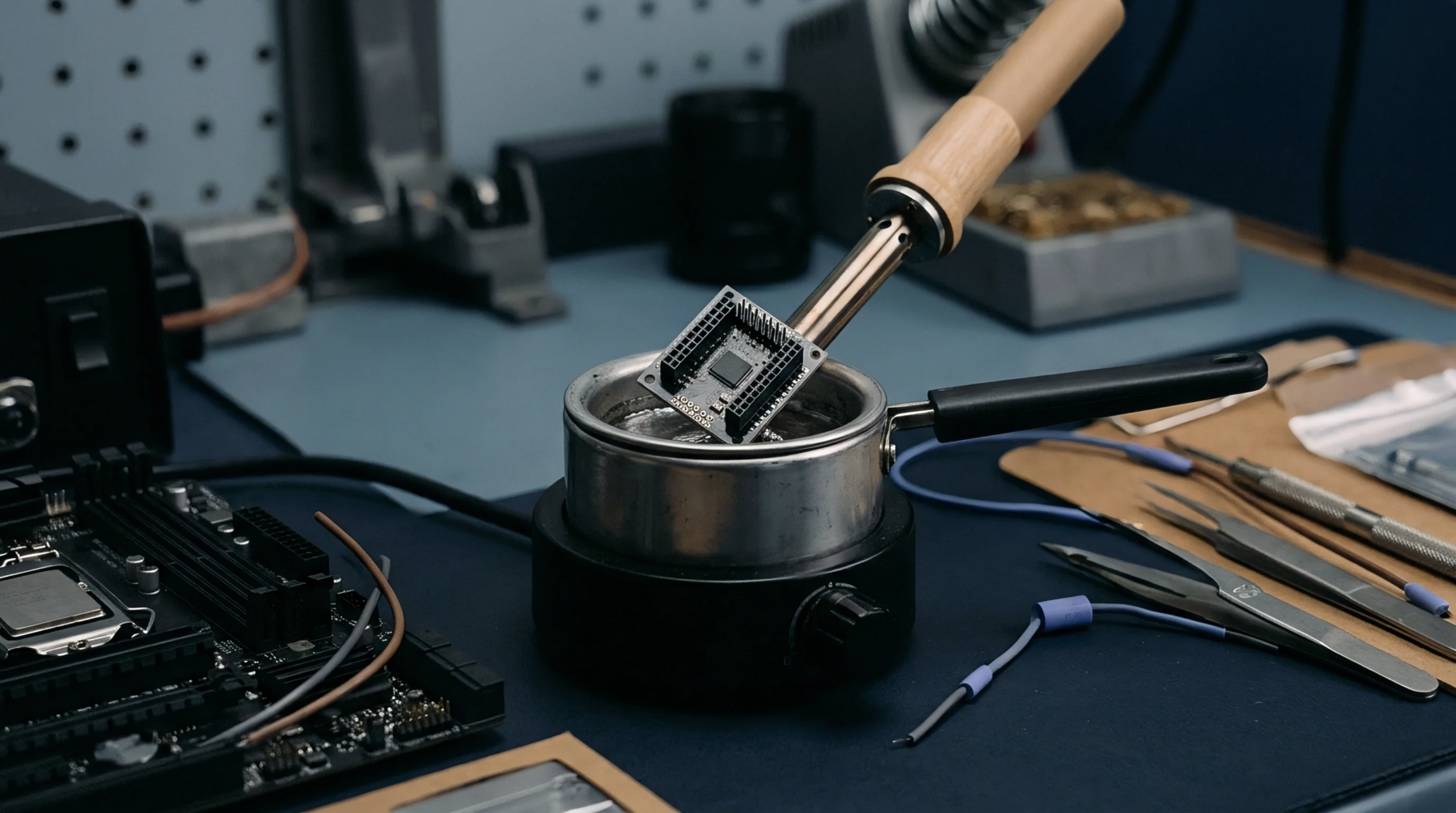
Acoustic momentum dissipation occurring along the central propagation path of an unconfined sound beam establishes long-range circulatory currents within liquid volumes. This hydrodynamic phenomenon, recognized as Eckart streaming, arises when spatial gradients of sound intensity attenuate through viscous absorption across distances substantially larger than the acoustic wavelength. In electronics cleaning equipment and chemical wet benches, the resulting bulk liquid jets transport bulk chemistry toward submerged printed circuit boards.
The phenomenon operates strictly outside the viscous boundary layer, distinguishing it from microscale boundary flows that govern interfacial shear at the board surface.
Hydrodynamic Scale
Beam geometry and bath attenuation coefficients dictate the velocity profile and directional vector of the acoustic jet. High-frequency megasonic transducers set into tank walls project collimated sound beams that launch Eckart streaming velocities reaching several centimeters per second across the open bath volume. These convective streams force fresh deionized water or chemical etchants into the narrow spaces between adjacent panels in a vertical process rack.
Without bulk acoustic circulation, viscous drag and panel carrier geometry create stagnant liquid dead zones that deplete active etch chemistry and elevate localized ionic concentration. Particle counter instruments monitoring wash tank overflow verify that bulk fluid turnover continuously displaces dislodged surface contaminants toward the filtration loop. The acoustic pressure amplitude must remain below the threshold of transient cavitation to avoid pitting ductile copper lands or delaminating thin soldermask bridges.
Contaminant Clearance
Substrate cleanliness standards for surface mount assembly require the complete extraction of ionic residues from dense packaging layouts. Eckart streaming sustains continuous advection that sweeps detached flux debris, dross particulate, and unreacted chemistry out of board regions where natural buoyancy cannot circulate fluid. Inspection methods employing automated optical inspection detect bridging and particulate contamination if acoustic jetting fails to transport dislodged contaminants away from fine-pitch lead spaces before board extraction.
Ultrasonic bath design relies on acoustic power meters to confirm uniform beam projection across the tank working zone. When transducer arrays experience localized failure, non-uniform bulk streaming leads directly to localized chemical under-etching or uneven post-soldering cleanliness scores. Eckart streaming provides the macroscopic convective vehicle that delivers bulk bath renewal directly to the substrate perimeter.