Yarn Flattening
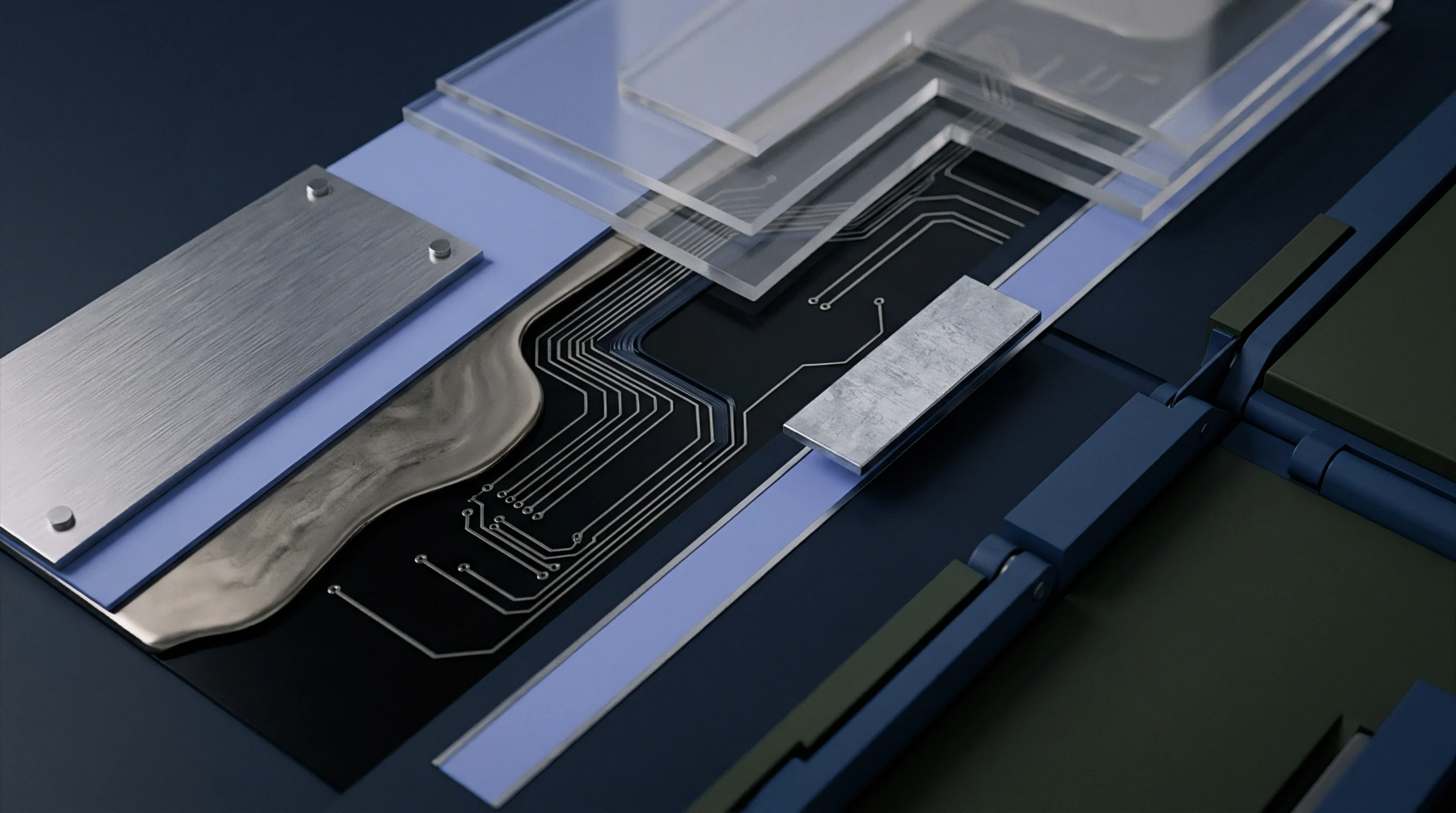
Mechanical yarn spreading processes flatten twisted glass filament bundles into thin ribbon-like profiles for printed circuit substrate reinforcement. Loom processing and chemical sizing treat raw glass yarns, widening each yarn bundle to eliminate open gaps between intersecting warp and fill fibers. This reinforcement architecture is flat weave glass, which replaces traditional cylindrical yarn structures with flattened, rectangular tape configurations.
Standard woven styles create periodic dielectric peaks and valleys, while flattened styles produce an unbroken glass-to-resin ratio across the core. The flattened classification applies specifically to woven fabric reinforcements and excludes non-woven chopped strand mats.
Fiber Distribution
Permittivity variations across high-frequency printed circuit boards decrease when reinforcement fibers distribute uniformly across the dielectric plane. Traditional glass fabrics feature dense yarn knuckles separated by large resin-filled windows. Because E-glass possesses a dielectric constant near 6.6 while epoxy resin measures around 3.8, signals traveling across standard weaves experience periodic velocity shifts.
Utilizing flat weave glass levels this permittivity disparity by spreading the high-dielectric glass filaments across the entire substrate area. High-speed transmission lines achieve predictable propagation delays without needing spatial layout offsets.
Delay Equalization
Phase delay differences between high-speed differential signal pairs drop significantly on substrates built with flattened glass fabrics. Vector network analyzers measure lower phase jitter and reduced differential skew across multi-gigabit serial interconnects. Automated optical inspection verifies that prepreg layers exhibit consistent glass coverage without broken filament bundles or resin voids.
Laminators utilize these flat fabrics in thin core constructions to achieve tighter dielectric thickness control during hydraulic press cycles.