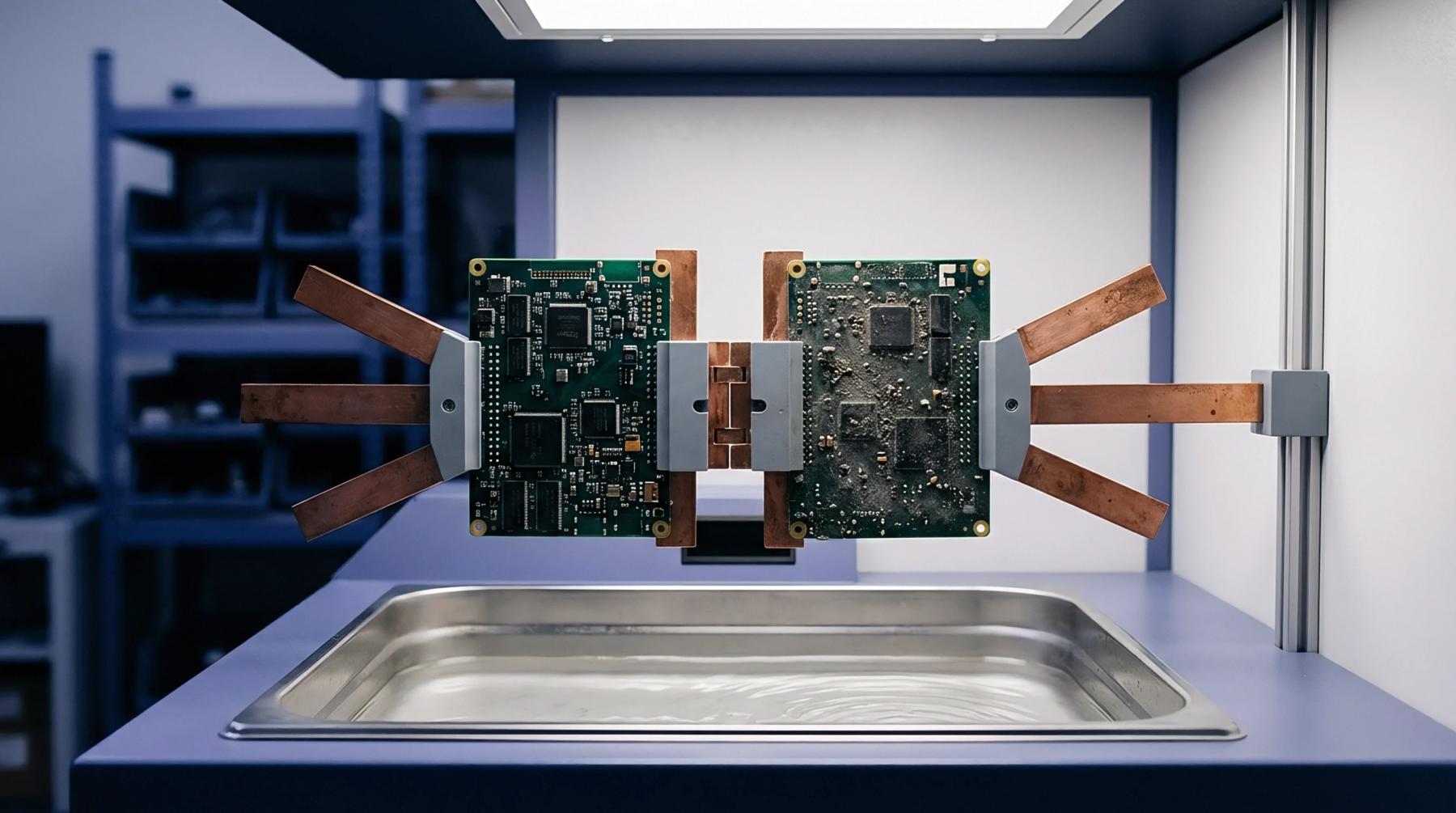
Moisture Resistance
IPC-TM-650 2.6.25 establishes the standard procedure for evaluating the resistance of printed boards to moisture and insulation degradation under condensing humidity conditions. Exposure to high relative humidity challenges the dielectric properties of laminate materials and solder mask layers. Water vapor penetrates polymer matrices, degrading surface insulation resistance and triggering electrochemical migration between adjacent copper conductors.
Testing subjects test vehicles to repeated temperature and humidity cycles inside a specialized chamber, alternating between sub-zero and elevated thermal states while maintaining saturation levels.
Electrical Breakdown
Condensation cycles cause moisture absorption that forces ionic contaminants from manufacturing residues into solution, lowering bulk resistance across dielectric substrates. Measuring leakage current during the final high-humidity phase reveals whether the circuit board maintains adequate electrical isolation between conductors under stress. Low resistance readings indicate localized dendrite formation or resin starvation that permits current leakage across dielectric paths.
Acceptance Threshold
Performance criteria require insulation resistance values to remain above specific megaohm limits following the humidity exposure period to verify dielectric integrity. Boards failing to maintain these electrical thresholds show inadequate material curing or insufficient cleaning protocols during fabrication and assembly operations. Passing specimens demonstrate sufficient moisture barrier properties to prevent short circuits during extended operational deployment in humid environments.