Electromagnetic Surface Damping Selection for PCB Cavity Structures
Select PCB cavity damping by tuning filler permeability to resonant field vectors, keeping dampers three trace heights away to prevent impedance drift.
Free-space electromagnetic test structures configured as semicircular structural arches provide standardized bistatic and monostatic reflectivity evaluations for microwave absorber materials and radar-absorbing coatings. Developed by the United States Naval Research Laboratory, an NRL arch positions transmitting and receiving horn antennas along a calibrated radial perimeter aimed at a central material test platform. The arched geometry maintains constant focal distances between the antenna apertures and the material sample under test across arbitrary incidence angles.
Specimen panels rest on a low-reflection foam pedestal placed at the center of the arch radius. Absorber performance is evaluated by measuring the reduction in reflected signal amplitude relative to a reference metal plate of identical surface dimensions. This non-destructive test method operates across microwave and millimeter-wave frequencies, typically covering bands from two gigahertz past forty gigahertz.
Testing under varying angles of incidence isolates specular reflections from diffuse scattering components across complex substrate treatments.
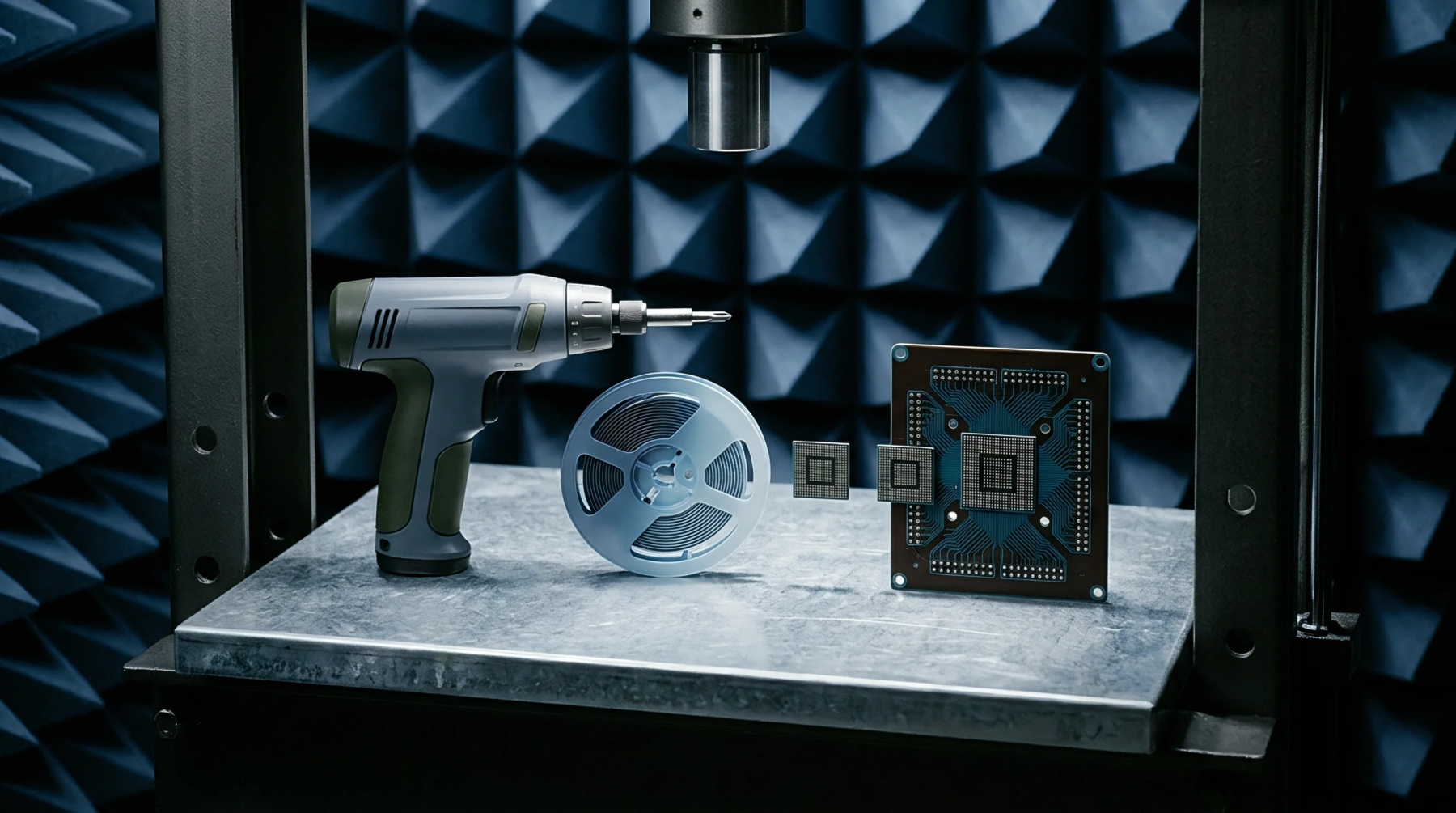
Test accuracy within the arch structure requires complete control over multipath reflections, background scattering, and antenna positioning. Anechoic foam cones line the interior perimeter of the arch frame to absorb stray radiation and prevent laboratory wall reflections from corrupting low-signal returns. Transmitting and receiving horns must possess narrow beamwidths to illuminate only the central specimen area, avoiding diffraction ripples caused by sample edges.
When measuring near normal incidence, transmitting and receiving horns approach one another, introducing antenna cross-coupling that limits the achievable dynamic measurement range. Time-domain gating applied through vector network analyzers isolates the primary sample reflection from early horn-to-horn coupling and late room reflections. Phase alignment across the reference metal plate and the sample requires sub-millimetre height positioning accuracy on the test pedestal.
Misalignments tilt the reflected beam away from the receiving horn, creating false attenuation readings that overestimate material absorption performance. Sample warpage introduces phase variations across the reflected wavefront that distort calculated bistatic reflection coefficients.
Operational validation begins with measuring a solid aluminum or copper reference calibration plate positioned at the arch geometric focal point. This baseline measurement records total signal reflection, representing zero decibels of absorption across the complete frequency sweep. The calibration plate is then replaced with the material specimen, and the network analyzer captures the attenuated reflection profile.
Time-domain filtering removes spurious signals arriving outside the physical time window corresponding to the sample surface location. Background subtraction runs measure the empty test fixture to cancel structural reflections from the foam support pedestal. Precision laser alignment systems verify that antenna line-of-sight paths intersect precisely at the surface plane of the test specimen.
Measurement repeatability audits evaluate angular positioning accuracy across the arch track to hold angular tolerance within one-tenth of a degree. Swept-frequency data graphs reflectivity in decibels across specified microwave bands to verify contract compliance for radar-absorbing electronic enclosures.
Select PCB cavity damping by tuning filler permeability to resonant field vectors, keeping dampers three trace heights away to prevent impedance drift.
Expertise is a utility, not a secret. sentiention™ publishes its working knowledge as open reference: intelligence layer covering the materials it sources, the markets it enters, and the reference that serves both.