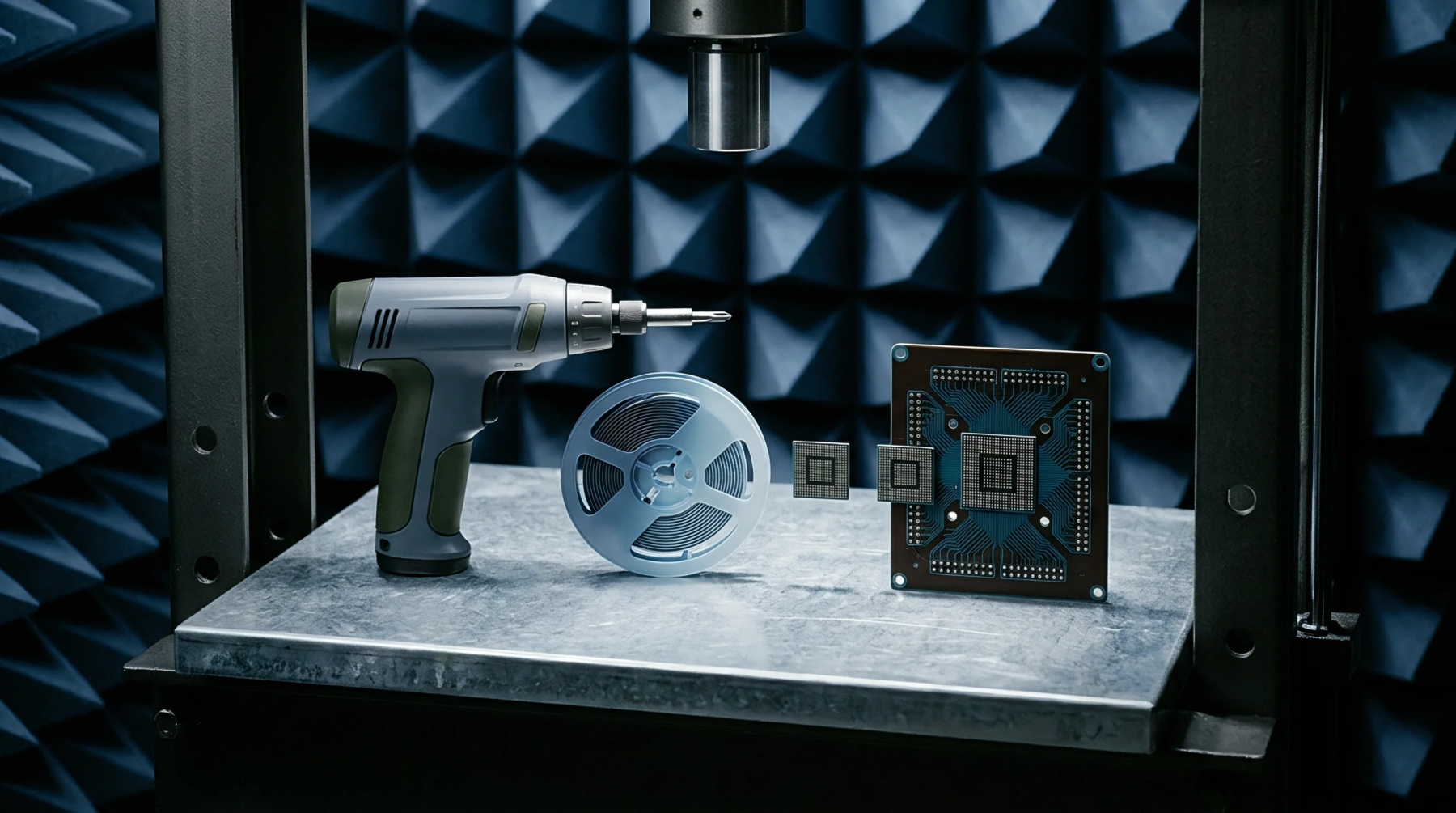
Electromagnetic Surface Damping Selection for PCB Cavity Structures
Select PCB cavity damping by tuning filler permeability to resonant field vectors, keeping dampers three trace heights away to prevent impedance drift.
Ferromagnetic powder material composed of eighty-five percent iron, nine percent silicon, and six percent aluminum yields magnetic cores characterized by low loss and near-zero magnetostriction. Originally developed as an alternative to expensive nickel-based permalloy, sendust possesses high electrical resistivity alongside high magnetic saturation near one Tesla. The unique metallurgical balance between iron, silicon, and aluminum minimizes crystalline anisotropy, allowing magnetic domains to pivot freely under alternating magnetic excitation.
Pulverized alloy particles are insulated with chemical oxide or polymer coatings and pressed under high tonnage into toroidal or E-core shapes. These distributed air-gap compacts exhibit stable relative permeability typically ranging between twenty-six and one hundred and twenty-five. Absence of physical magnetostriction prevents audible hum and acoustic noise generation when inductor cores handle high-frequency switching currents.
Low raw material costs make this alloy an economical choice for power conversion filtering chokes.
Power inductor designs operating between fifty kilohertz and five hundred kilohertz benefit from the low core losses inherent to sendust compacts. Core loss values remain significantly lower than those of powdered iron cores, approaching the efficiency of more expensive iron-nickel-molybdenum alloy cores. The high silicon content increases bulk electrical resistivity, which suppresses intra-particle eddy current losses across elevated switching frequencies.
Magnetization remains linear across wide alternating flux swings, preventing waveform distortion in switch-mode boost inductors and output chokes. Thermal aging does not induce loss increases, because the inorganic insulating layers and alloy particles resist the thermal embrittlement common to organic-bonded iron powders. The material displays a soft saturation curve, gradually shedding inductance as direct current bias rises rather than dropping precipitously.
Excessive compaction pressure during core manufacturing fractures particle insulation boundaries, causing local eddy current loops that generate elevated hot spots during high-current inductor operation.
Production verification requires testing toroidal samples wound with standardized copper coils on calibrated impedance analyzers. Inductance under variable direct-current bias confirms core saturation stability against published procurement datasheets. Core loss density is measured across specific excitation frequencies and peak flux densities using power analyzer fixtures to confirm thermal limits.
Physical dimensions, edge chamfers, and protective parylene or epoxy coating thicknesses are verified using precision optical calipers. Coating dielectric breakdown testing subjects finished toroids to high-voltage potentials, ensuring the outer barrier prevents shorting against winding wire insulation. Destructive mechanical crush tests audit compact mechanical strength, verifying that pressing tonnage and binder curing achieved sufficient structural cohesion.
Cores failing crush specifications exhibit internal microcracking that degrades magnetic permeability and promotes thermal failure under continuous thermal cycling.
Select PCB cavity damping by tuning filler permeability to resonant field vectors, keeping dampers three trace heights away to prevent impedance drift.
Expertise is a utility, not a secret. sentiention™ publishes its working knowledge as open reference: intelligence layer covering the materials it sources, the markets it enters, and the reference that serves both.