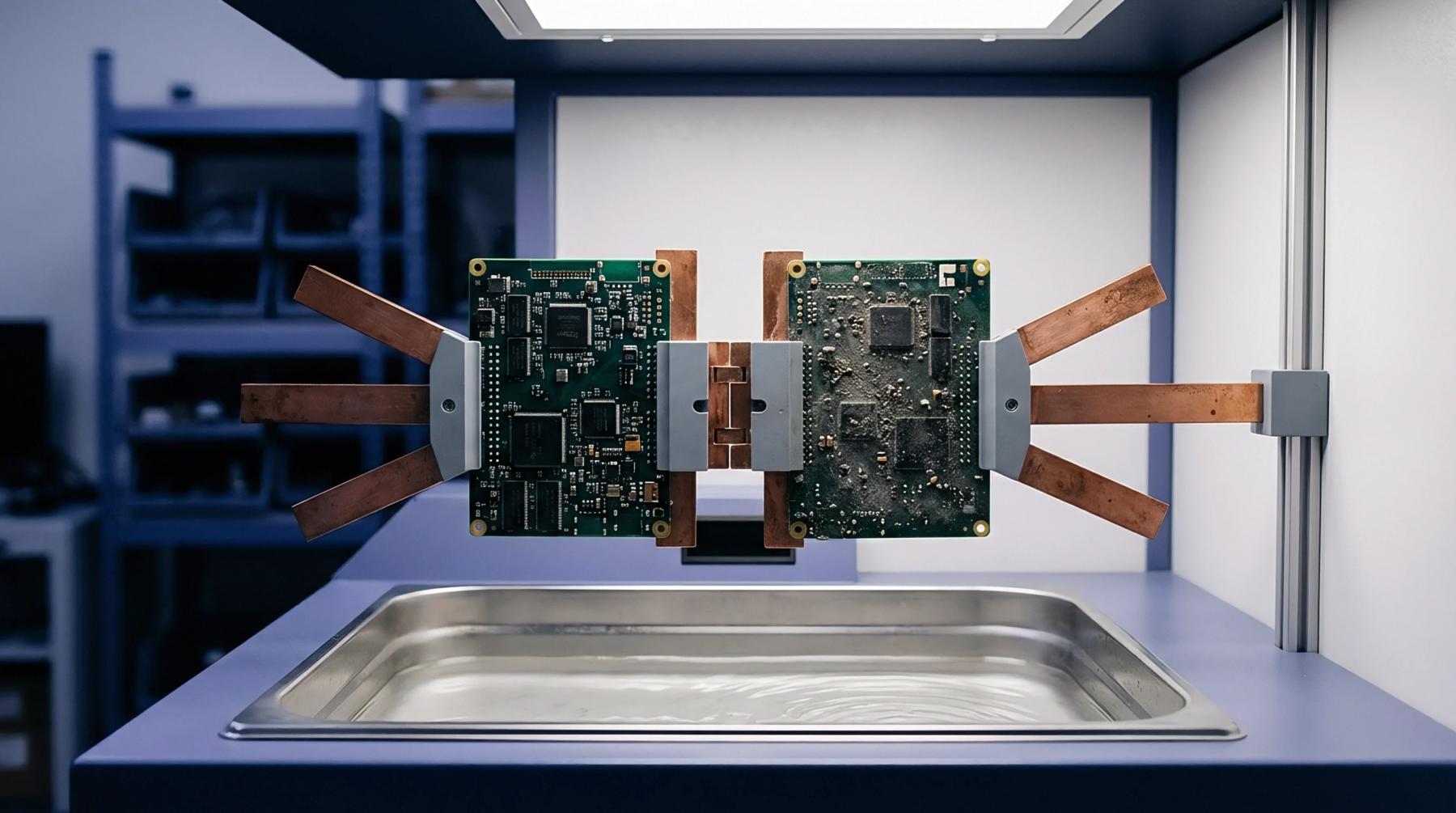
Interface Failure
Chemical finishes applied to glass fibers ensure a strong mechanical bond between the inorganic glass reinforcement and the organic epoxy resin. In humid environments, silane coupling breakdown represents a failure of this adhesion layer, causing separation along the fiber matrix interface. This degradation can lead to hollow pathways along the glass fibers, creating conditions for copper plating solution intrusion or conductive anodic filament growth.
The integrity of this bond is primary to preventing dielectric breakdown in high voltage applications.
Degradation Pathway
Moisture diffusion through the resin matrix introduces water molecules directly to the fiber finish interface. This water reacts with the silane molecules through hydrolysis, breaking the siloxane bonds that secure the resin to the glass. The presence of ionic impurities or thermal stresses during assembly accelerates this chemical breakdown.
When these bonds are broken, the fiberglass fibers are exposed, allowing capillary action to pull moisture and copper ions along the length of the fibers. This path becomes a low resistance channel that can short circuit internal layers under bias.
Prevention Method
Additives in the resin formulation and heat resistant silane structures improve the hydrolytic stability of the coupling agent. Selecting materials with high resin-to-glass adhesion and low moisture absorption rates reduces the risk of this interface failure.