Titanium Insert Oxide Layer Breakdown Rates in High Tin Selective Soldering
Dynamic high-tin solder waves strip titanium oxide passivity via halide attack and erosion, requiring scheduled thermal re-passivation every 500 operating hours.
Film

Native versus Thermally Grown Rutile Structures
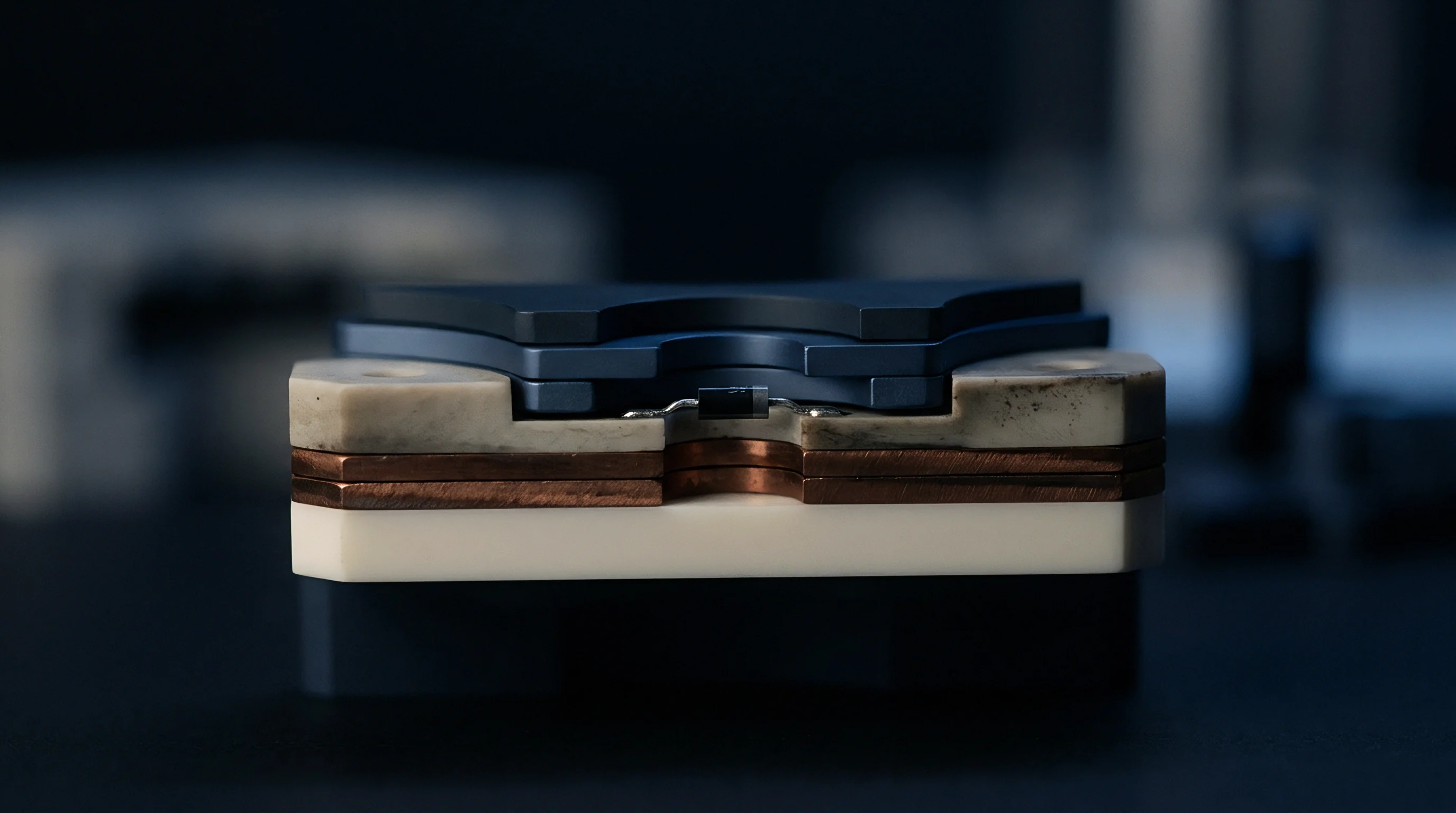
Titanium inserts in selective soldering nozzles, pump impellers, and wave baffles rely on a coherent titanium dioxide surface barrier to keep liquid tin from wetting the base metal. Unalloyed grade 2 and grade 5 titanium grow an amorphous native oxide about 2 to 6 nanometers thick within milliseconds of air exposure at room temperature. That thin oxide cannot handle the sustained thermal and hydrodynamic stress of a pumped solder wave.
At 280 to 310 degrees Celsius in molten SAC305 or Sn99.3Cu0.7, the native oxide dissolves chemically, cracks under differential thermal expansion, and spalls off mechanically.
Thermal oxidation under controlled atmospheres at 550 to 650 degrees Celsius grows a dense, crystalline rutile oxide between 150 and 450 nanometers deep. Rutile crystals resist wetting, and their tetragonal lattice shares little chemical affinity with molten tin, suppressing intermetallic formation. Solder pumps running continuously at 290 degrees Celsius strip an unmodified native oxide within 12 operating hours, while a thermally grown rutile shell maintains non-wetting performance for hundreds of contact hours under moderate hydraulic shear.
Bright metallic wetting on a non-wetting nozzle rim indicates complete oxide removal and imminent flow detachment.
Cohesion Limits and Subsurface Oxygen Diffusion
Thermal growth kinetics dictate the integrity of this protective crust. Temperatures above 700 degrees Celsius during passivation drive oxygen deep into the alpha-titanium substrate rather than concentrating it at the surface. This interstitial dissolution embrittles the titanium boundary layer under the rutile cap, creating a steep microhardness gradient.
Elastic modulus mismatch between the brittle, oxygen-rich substrate and the crystalline oxide leads to subsurface delamination during cyclic thermal shocks.
Selective soldering nozzles cycle continuously between nitrogen-inerted preheating and active pumping. Each cycle exerts stress across the oxide-metal boundary. Once the oxide layer grows beyond 500 nanometers, internal compressive stress causes spontaneous blistering and flaking.
The effective barrier uses a stoichiometric TiO2 surface crust backed by a thin sub-stoichiometric Ti2O3 transition zone, keeping total film thickness strictly between 200 and 350 nanometers.
The protective barrier functions through distinct physical layers:
- Stoichiometric rutile cap forms the external boundary at 150 to 250 nanometers, preventing wetting from high-tin liquid solders.
- Sub-stoichiometric transition zone spans roughly 40 to 80 nanometers, bridging shear stresses between the ceramic cap and metallic substrate.
- Oxygen diffusion tail extends 1 to 2 micrometers into the titanium grain boundaries, improving local adhesion without causing interfacial cracking.
Maintaining the integrity of this layered shell governs the service life of selective soldering components in continuous automotive and aerospace manufacturing environments.
Attack
Intermetallic Dissolution Kinetics in Liquid Tin
Pure tin attacks raw titanium directly once the passive oxide layer perforates, dissolving titanium into binary intermetallics ~ primarily Ti3Sn and Ti6Sn5. The thermodynamic driving force for intermetallic synthesis remains strong between 260 and 320 degrees Celsius. In static liquid tin, unprotected grade 2 titanium dissolves at roughly 0.8 to 1.6 micrometers per hour at 280 degrees Celsius.
Dynamic flow inside a selective soldering nozzle thins the stagnant boundary layer, pushing dissolution past 3.5 micrometers per hour.
Tin atoms diffuse through breached crystal boundaries to form a porous Ti6Sn5 reaction layer at the interface. Because this intermetallic phase adheres poorly to the titanium matrix, fluid shear from the solder wave tears these crystals away. That exposes fresh titanium to chemical dissolution, creating a cycle of localized gouging and cavitation pits along the nozzle bore.
At 295 degrees Celsius, unprotected grade 2 titanium dissolves into SAC305 at 1.4 micrometers per hour under a 12 millimeter per second flow velocity.
The rate of dissolution depends heavily on alloy composition, fluid velocity, and local thermal gradients across the nozzle assembly.
| Solder Alloy Composition | Bath Temperature (Celsius) | Wave Velocity (mm/s) | Oxide Penetration Rate (nm/h) | Substrate Dissolution (um/h) |
|---|---|---|---|---|
| Sn96.5Ag3.0Cu0.5 (SAC305) | 270 | 8 | 0.35 | 0.82 |
| Sn96.5Ag3.0Cu0.5 (SAC305) | 295 | 15 | 1.45 | 2.85 |
| Sn99.3Cu0.7 (Lead-Free) | 280 | 10 | 0.58 | 1.24 |
| Sn99.3Cu0.7 (Lead-Free) | 310 | 20 | 2.10 | 4.10 |
| Sn99.0Cu0.7Ni0.05Ge0.01 (SN100C) | 280 | 10 | 0.42 | 0.95 |
| Sn99.0Cu0.7Ni0.05Ge0.01 (SN100C) | 305 | 18 | 1.68 | 3.15 |
Erosion Cavitation and Hydrodynamic Shear
Solder pots pump liquid alloy through narrow titanium nozzles to form mini-waves between 2.5 and 10 millimeters in diameter. Fluid velocity inside the nozzle orifice ranges from 8 to 25 millimeters per second depending on target wave height. Near the internal discharge lip, abrupt changes in flow direction create localized turbulence and shear stresses above 45 Pascals.
These shear forces tear microscopic fragments from the rutile crust at pinhole defects. Film breakdown follows linear kinetics under dynamic flow, unlike the parabolic growth seen during atmospheric thermal oxidation. Once cavitation removes the outer 50 nanometers of oxide, high-tin solder wets the crater floor and accelerates wall erosion.
Craters expand outward at three to five times the baseline corrosion rate, distorting the wave profile and causing bridging or insufficient hole fill on through-hole boards.
Several metallurgical factors determine the severity of this breakdown process:
- Bulk tin concentration governs the chemical potential driving titanium dissolution, with alloys above 99 percent tin proving most aggressive.
- Nickel and germanium micro-additions in alloys like SN100C slow dissolution by precipitating protective intermetallic phases at grain boundaries.
- Hydraulic boundary layer thickness controls mass transport of dissolved titanium away from the reaction front into the bulk pot.
- Localized temperature spikes from poorly calibrated nozzle heaters accelerate interfacial diffusion following Arrhenius behavior.
Whether specific ceramic barrier coatings or sub-surface laser nitriding treatments can arrest this intermetallic degradation across 5,000 continuous line hours remains an open debate among selective soldering machine manufacturers.
Flux

How Organic Activators Disrupt Titanium Passivity?
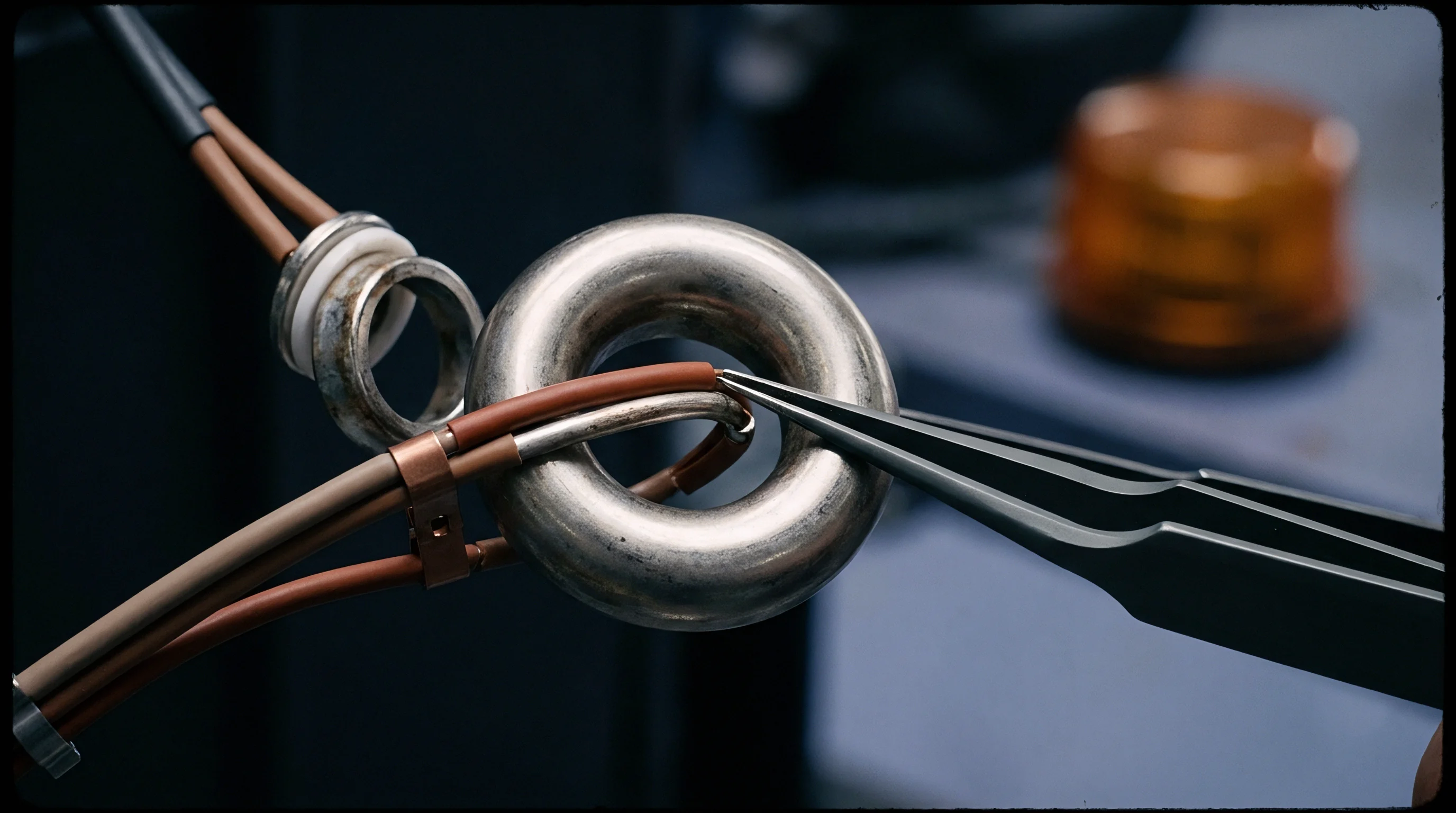
Selective soldering systems apply flux using drop-jet or ultrasonic spray heads before circuit assemblies cross the wave. While targeted spraying limits residue on the board, atomized droplets drift onto the nozzle assembly. Commercial alcohol-based and water-soluble fluxes contain dicarboxylic acids ~ such as adipic, succinic, and glutaric acids ~ paired with halogenated activators like amine hydrochlorides or hydrobromides.
At operating temperatures between 270 and 310 degrees Celsius, halogenated activators decompose, releasing reactive bromide and chloride ions onto the nozzle surface. These ions displace lattice oxygen in titanium dioxide, forming volatile titanium tetrachloride and titanium tetrabromide complexes. This chemical stripping strips away the non-wetting ceramic shield, allowing molten tin to contact and wet the titanium substrate directly.
Under IPC-J-STD-001 Section 3.1.2, solder bath contamination exceeding 0.05 percent titanium voids batch qualification across Class 3 assemblies.
Atmospheric Blanketing and Oxide Reformation Kinetics
Selective soldering chambers maintain nitrogen blankets with residual oxygen levels between 15 and 50 parts per million. While inerting suppresses dross and improves through-hole barrel fill, it starves the titanium surface of oxygen needed for self-healing passivity. In ambient air, mechanical scratches or chemical pits on titanium re-oxidize almost instantly.
Inside an inerted tunnel, oxygen replenishment falls below the rate needed to rebuild damaged rutile lattices. Flux acids strip the oxide faster than the background atmosphere can restore it, accelerating barrier breakdown compared to soldering in open air despite the reduction in tin dross.
Selective flux classifications demonstrate distinct levels of chemical attack against titanium inserts:
- ORL0 water-based organic fluxes show low corrosivity at room temperature, but their organic acid residues rapidly etch titanium oxides above 260 degrees Celsius.
- ROL0 rosin-based compositions form an encapsulating resin barrier that limits direct halide attack, extending nozzle life at the cost of more frequent cleaning.
- ORM1 halogenated formulations cause localized micro-pitting along nozzle lips within 40 operating hours, requiring frequent refurbishment.
Aggressive flux chemistry inevitably consumes protective oxides when line parameters permit excessive spray overspray.
Bore

Orifice Geometry Alterations and Fluid Instability
The precision of selective soldering depends heavily on the geometric stability of the nozzle orifice. A standard 4-millimeter outer diameter nozzle machined from grade 5 titanium starts with a 0.50-millimeter wall thickness held to plus or minus 0.02 millimeters. As high-tin solder dissolves the inner and outer surfaces, wall thinning alters wave dynamics.
Non-uniform oxide breakdown causes uneven wetting along the outer lip, pulling the solder meniscus to one side.
This tilted meniscus causes wave height variations exceeding 0.6 millimeters, altering contact with the board underside. Solder can jump component keep-out zones and bridge adjacent surface-mount terminations. Microsections of degraded nozzles show uneven wall loss, with the heaviest thinning concentrated along the high-velocity discharge lip.
Active dross extraction reveals titanium debris long before dimensional inspection detects orifice widening.
A wall loss of just 0.08 millimeters degrades laminar discharge, creating turbulence that pulls in nitrogen bubbles and leaves solder beads on printed wiring assemblies.
| Nominal Nozzle Bore (mm) | Initial Wall Thickness (mm) | Permissible Wall Loss (um) | Wave Height Variance at Limit (mm) | Estimated Run Time to Limit (Hours) |
|---|---|---|---|---|
| 1.5 | 0.30 | 35 | 0.25 | 180 |
| 3.0 | 0.45 | 50 | 0.40 | 340 |
| 4.0 | 0.50 | 65 | 0.55 | 520 |
| 6.0 | 0.60 | 80 | 0.65 | 780 |
| 10.0 | 0.80 | 110 | 0.80 | 1,150 |
Pot Contamination and Intermetallic Debris Accumulation
Dissolved titanium accumulates in the mini-solder pot. The solubility limit of titanium in pure tin at 300 degrees Celsius is roughly 0.015 weight percent. Once bath contamination passes this limit, needle-like Ti6Sn5 intermetallics precipitate throughout the liquid solder alongside slowly accumulating trace iron.
These suspended crystals act as nucleation sites, increasing solder viscosity and reducing capillary draw inside plated through-holes.
Contaminated solder pots generate heavy dross that clogs internal pump impellers and flow rectifiers. Pump motors draw more current to push through fluid resistance, accelerating gear wear. If scheduled pot dumps are missed, intermetallic needles lodge in narrow channels, causing intermittent wave drops and open joints on multi-layer connector pins.
Line yields drop quickly, driving up manual inspection and costly touch-up work across production lots.
Schedule
Preventive Rotation and Replacement Windows
Preventive maintenance schedules should reflect empirical wear curves rather than arbitrary calendar dates. Tracking active run hours in machine management software allows nozzles to be rotated out before dimensional erosion destabilizes wave geometry. On lines running SAC305 at 290 degrees Celsius with ORL0 water-soluble flux, a 4-millimeter titanium nozzle typically provides 450 to 500 pumping hours before oxide depletion leads to unacceptable wetting.
Higher temperatures for heavy copper backplanes shorten operational life significantly. Running a 315-degree wave to overcome thick ground planes drops nozzle life below 220 hours. First-article inspections after nozzle swaps verify wave stability before production resumes, while operators check for silvery solder clinging to nozzle exteriors at shift changeovers to spot passivity breakdown early.
Refurbishment and Re-Passivation Workflows
Worn nozzles with minimal wall thinning can be stripped and re-passivated to restore the rutile barrier through a set process:
- Immerse the nozzle in an ultrasonic bath of hot organic acid stripper to dissolve adhering tin and intermetallics without attacking the titanium base metal.
- Polish inner and outer discharge surfaces with non-metallic micro-abrasive media to clean pits down to bare titanium.
- Verify outer and inner orifice diameters with an optical coordinate measuring machine to confirm tolerances remain within 0.02 millimeters of specification.
- Degrease components in electronic-grade isopropyl alcohol and dry with filtered clean dry air.
- Passivate in an atmospheric furnace, ramping at 10 degrees Celsius per minute to 600 degrees Celsius and holding for 90 minutes to grow a uniform rutile crust.
Although titanium components are sometimes assumed to remain immune to molten solder throughout a machine’s lifecycle ~ with erosion attributed solely to flux misapplication ~ continuous exposure systematically degrades unprotected surfaces over time.