Thermal Mapping
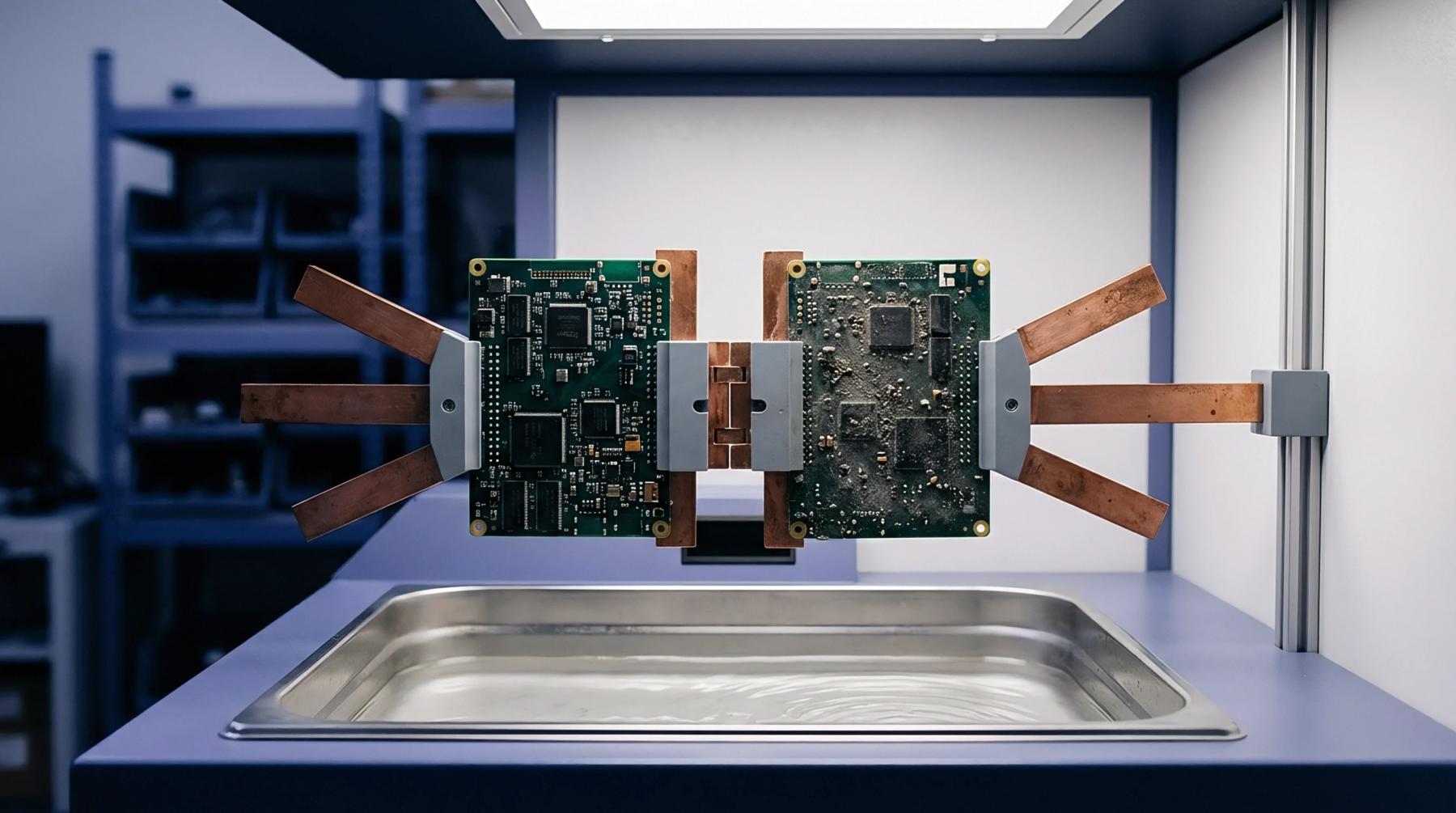
Circuit board production requires thermal profiling equipment to record mechanical deformation during reflow soldering operations. A triaxial strain gauge rosette solves the challenge of measuring principal stresses across multiple intersecting vectors simultaneously on fragile laminate surfaces. Surface mount assembly houses undergo severe temperature gradients that create differential expansion between copper traces and glass epoxy substrates.
Soldering ovens reach peak temperatures exceeding two hundred degrees Celsius, which causes rapid thermal expansion and subsequent board warping. Technicians bond this bonded foil sensor directly to critical component pads on the printed circuit board assembly before passing the hardware through the convection tunnel. Three distinct sensing grids arranged at specific angular orientations capture orthogonal and shear deformation components in a single localized footprint.
Mechanical Stress
Automated pick and place machines exert high insertion forces that frequently crack underlying ceramic capacitors during board population. A triaxial strain gauge rosette isolates these mechanical shock loads by recording dynamic strain waveforms during panel separation and depaneling routing operations. Strain relief algorithms depend on precise rosette data to calibrate cutter feed rates and minimize edge chipping on high density multilayer boards.
Mechanical bending tests apply controlled loads to finished assemblies until solder joint fracture occurs, verifying the structural integrity of ball grid array packages. Signal conditioning amplifiers convert the raw millivolt output from each grid into engineering units representing microstrain per meter. Calibration procedures compensate for transverse sensitivity errors inherent in foil grid geometries before engineers evaluate the final stress tensor.
Residual Load
Structural integrity verification demands accurate measurement of locked in residual stresses left behind after press fit pin insertion and wave soldering processes. A triaxial strain gauge rosette calculates maximum principal stress magnitudes and their angular orientations relative to the printed circuit board reference edges. Destructive relaxation techniques such as hole drilling release surrounding mechanical energy, allowing the rosette to measure the resulting localized displacement field.
Manufacturers use these empirical stress maps to optimize thermal profiles and prevent premature fatigue failure in field environments subjected to vibration. Finite element analysis models rely entirely on empirical rosette data to validate simulated boundary conditions and ensure reliable electronic hardware performance.