Thermodynamics of Solvent Swelling in Flexible Insulation Polymers
Polymer swelling in flexible insulation follows Flory-Huggins thermodynamic mixing rules, where solvent uptake plasticizes matrix networks, shifting dielectric stability and mechanical flex thresholds.
Swell
Flexible polyimide dielectric films exposed to industrial ester fluids expand when chemical potential gradients drive solvent molecules into polymer free volume spaces. The penetration process disrupts non-covalent interchain forces, altering the mechanical lattice and expanding physical dimensions along processing axes. In flexible circuit substrates and wire insulation jackets, volumetric enlargement alters conductor spacing, shifts trace impedance, and creates localized shear stresses at rigid-to-flex boundary junctions.
The thermodynamic driving force behind this volumetric expansion depends on the free energy of mixing, where solvent activity dictates the extent of fluid uptake until internal elastic resistance balances osmotic pressure.
Solubility parameter matching defines the initial thermodynamic affinity between the liquid phase and the polymer matrix. When Hildebrand solubility parameters of the solvent closely match those of the polyimide or fluoropolymer insulation, chemical potential depression accelerates absorption. Dispersive, polar, and hydrogen-bonding components of the Hansen solubility parameter space determine whether a solvent acts as a aggressive swelling agent or a benign contact fluid.
In high-density flexible interconnects, small molecular volume solvents like acetone or methylene chloride penetrate interstitial spaces rapidly, whereas bulky synthetic ester lubricants exhibit slower absorption kinetics due to steric hindrance within the polymer network.
Solvent activity dictates volume expansion.
| Polymer Matrix | Solvent Phase | Temperature (Celsius) | Interaction Parameter Chi | Volumetric Expansion (Percent) |
|---|---|---|---|---|
| Kapton HN Polyimide | Methyl Ethyl Ketone | 23 | 0.48 | 1.82 |
| Kapton HN Polyimide | Methyl Ethyl Ketone | 60 | 0.38 | 4.15 |
| Fluorinated Ethylene Propylene | Toluene | 23 | 0.62 | 0.74 |
| Fluorinated Ethylene Propylene | Toluene | 70 | 0.49 | 2.10 |
| Polyether Ether Ketone Flex | Isopropanol | 23 | 0.85 | 0.12 |
| Polyether Ether Ketone Flex | Methylene Chloride | 23 | 0.31 | 6.40 |
Volumetric expansion of polyimide insulation reaches four percent when solvent interaction parameters drop below zero point three five at sixty degrees Celsius.
Dimensional changes caused by fluid ingress generate mechanical strain within sub-surface insulation layers. In multi-layer flexible printed circuits, isotropic volume growth in the dielectric substrate is constrained by bonded copper foils, transforming volumetric expansion into out-of-plane z-axis swelling and severe in-plane compressive stress. The resulting mechanical imbalance leads to micro-cracking of insulation coverslips, delamination at polyimide-adhesive interfaces, and trace fracturing under cyclic thermal exposure.
Polyimide films with higher initial crystallinity resist volume expansion by limiting available amorphous free volume for solvent occupancy.
Polymer crosslinking density acts as the primary mechanical counterweight to solvent-induced volume growth. Linear polyimides undergo substantial dimensional distortion when exposed to polar solvents, whereas highly crosslinked thermoset insulation formulations restrict network extension through covalent interchain bonds. Measuring volumetric changes through precision optical metrology provides critical baseline data for evaluating dielectric stability under chemical stress profiles.
A polyimide film absorbing less than one percent fluid mass during initial qualification testing maintains structural bond strength through subsequent chemical wash operations.

Entropy
Mixing mechanics inside crosslinked polyimide and fluoropolymer backbones balance conformational state counts against enthalpy of dissolution. Liquid molecules entering the polymer matrix increase configurational randomness, generating a favorable thermodynamic drive toward dilution. Counteracting this entropic gain, the restriction of polymer chain configurations during network extension creates a negative elastic entropy change.
Equilibrium absorption occurs at the exact state where the positive entropic gain of mixing matches the loss of elastic entropy caused by chain stretching.
Free Energy Balances and Network Strain
Thermodynamic equilibrium during fluid penetration is expressed through the Flory-Huggins free energy equation, combining enthalpic interaction terms with configurational mixing variables. The overall free energy change per unit volume determines whether solvent absorption proceeds spontaneously. High crosslink density limits the available conformational states of polymer chains, suppressing the entropic gain of mixing and establishing a hard ceiling on fluid absorption capacity.
Crosslink density sets network resistance.
When the Flory-Huggins interaction parameter Chi drops below zero point five, the solvent acts as a favorable thermodynamic medium, driving aggressive fluid uptake. Enthalpic interactions between polar solvent molecules and carbonyl groups on polyimide chains lower the net heat of mixing, further driving the dissolution force. The polymer network stretches until the internal strain energy density balances the chemical potential of the external solvent phase.
Glass Transition Plasticization and Dielectric Losses
Solvent molecules residing inside the flexible dielectric matrix act as plasticizers, increasing macromolecular mobility and depressing the glass transition temperature. A polyimide insulation layer with an unexposed glass transition temperature of three hundred fifty degrees Celsius experiences a reduction down to one hundred eighty degrees Celsius upon absorbing five percent solvent mass. This plasticization softens the matrix, reducing tensile modulus and increasing high-frequency dielectric losses.
Plasticization reduces glass transition temperature.
- Blistering Delamination Interfacial vapor pressure generation during thermal exposure drives dielectric separation along copper-clad boundary lines.
- Dielectric Leakage Growth Solvated ionic impurities migrating through expanded amorphous channels trigger severe insulation resistance degradation.
- Solder Resistance Breakdown Residual solvent trapped inside the polymer network vaporizes during reflow processing, causing catastrophic coverlay blowouts.
- Trace Shear Fracturing In-plane volumetric expansion differential between copper traces and plasticized polyimide induces fatigue cracking at solder pads.
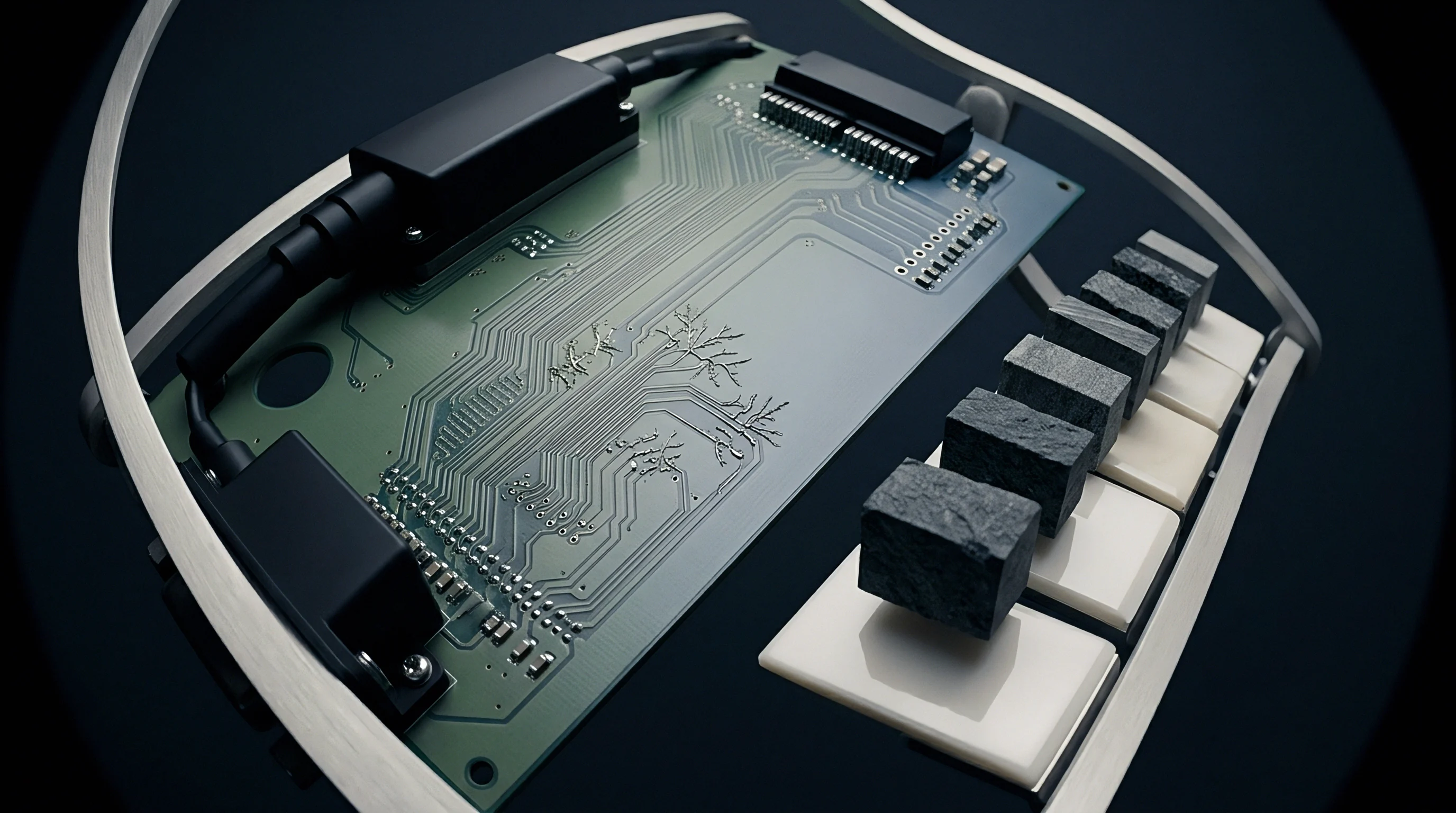
- Dendritic Growth Acceleration Absorbed polar solvent molecules facilitate moisture condensation paths that accelerate copper migration across narrow conductor gaps.
Compliance with IPC-TM-650 Method 2.3.4 forces lot rejection when dimensional hysteresis exceeds contract tolerance after chemical exposure.
Material suppliers frequently claim that brief solvent exposure produces no permanent degradation because physical dimensions revert upon ambient drying. This position ignores microscopic network damage, residual internal stress redistribution, and persistent structural plasticization that permanently lowers the thermal rating of flexible insulation layers.

Equilibrium
Solvent diffusion reaches steady-state mass uptake when chemical potential equality across the polymer surface matches internal osmotic pressure. Reaching this balanced chemical state requires extended immersion testing under controlled thermal conditions, where mass change plateauing signals complete saturation. Accurate evaluation of the saturated state enables precision calculation of network parameters, including average molecular weight between crosslinks and effective solvent interaction factors.

Can Flory Rehner Formulas Predict Polyimide Network Density?
Applying the Flory-Rehner equation to measured swelling ratios yields precise values for crosslink density in flexible insulation polymers. The mathematical relation links the polymer volume fraction in the swollen state to the molar volume of the solvent and the interaction parameter Chi. Determining these variables requires rigorous gravimetric measurement before immersion, at peak swelling, and after complete vacuum drying.
Osmotic pressure forces backbone displacement.
Consider a flexible polyimide film sample weighing exactly 1.0000 gram with an initial density of 1.420 grams per cubic centimeter. Immersing the coupon in methyl ethyl ketone (molar volume of 89.6 cubic centimeters per mole) at 23 degrees Celsius yields a saturated weight of 1.1450 grams. After complete drying under vacuum at 110 degrees Celsius, the dry polymer weight measures 0.9920 grams, revealing a small fraction of extractable low-molecular-weight oligomers.
The volume fraction of polymer in the swollen network calculates to 0.854, corresponding to an effective average molecular weight between crosslinks of 4,250 grams per mole under an assumed interaction parameter Chi of 0.45. Straining this calculation across varying cure temperatures demonstrates that insufficient thermal processing increases crosslink spacing by twenty-eight percent, doubling solvent absorption capacity.
| Substance / Fluid | Dispersion Parameter (MPa^0.5) | Polar Parameter (MPa^0.5) | Hydrogen Bonding Parameter (MPa^0.5) | Total Hildebrand Parameter (MPa^0.5) |
|---|---|---|---|---|
| Kapton Polyimide Matrix | 18.5 | 8.2 | 7.4 | 21.5 |
| PTFE Insulation Matrix | 13.3 | 1.6 | 1.8 | 13.5 |
| Acetone Cleaning Solvent | 15.5 | 10.4 | 7.0 | 19.9 |
| Isopropyl Alcohol | 15.8 | 6.1 | 17.4 | 23.5 |
| Toluene Processing Solvent | 18.0 | 1.4 | 2.0 | 18.2 |
Unfilled fluoropolymer films relax faster under chemical load than filled polyimide substrates.
Stress-Strain Shifts under Chemical Saturation
Physical saturation alters the stress-strain constitutive response of flexible insulation materials, lowering yield stress while increasing elongation at break. Saturated polyimide exhibits a rubbery plateau at operating temperatures where it previously demonstrated stiff viscoelastic behavior. Tensile strength measurements conducted on chemical-saturated insulation coupons reveal modulus drops exceeding forty percent compared to unexposed baseline samples.
Hansen solubility parameters govern swell.
Changes in mechanical modulus directly impair the flexural endurance of dynamic flexible circuits subjected to continuous bending cycles. Reduced mechanical stiffness leads to trace buckling, while increased elongation promotes permanent housing distortion during assembly positioning. Testing mechanical properties immediately following fluid saturation yields true operational limits rather than post-drying recovery values.
Per IPC-2223 Section 5.3.2, raw dielectric films specified for dynamic flex applications must demonstrate dimensional change under 0.15 percent following automated solvent wash cycles to prevent conductor strain fatigue.


Diffusion
Mass transport through flexible dielectric sheets follows Fickian kinetics until solvent concentration gradients disrupt interchain hydrogen bonds. Initial transport rates scale linearly with the square root of immersion time, allowing early-stage mass uptake measurements to project long-term saturation levels. Once local solvent concentration crosses critical plasticization thresholds, polymer chain relaxation rates accelerate, triggering a shift toward non-Fickian Case II transport mechanics where sharp swelling fronts migrate through the dielectric volume at constant velocity.
Non-Fickian Case II Transport and Polymer Relaxation
Case II transport introduces severe localized stress fields within flexible insulation layers due to the sharp boundary separating the glassy dry core from the rubbery swollen outer zone. Internal stress concentration along this moving boundary line triggers micro-fracturing and structural crazing within polyimide dielectric sheets. When the characteristic relaxation time of polymer backbones matches the characteristic diffusion time of solvent molecules, anomalous transport behavior dominates mass ingress kinetics.
Chemical exposure degrades electrical integrity.
Thermal cycling shifts absorption limits.
Determining diffusion coefficients requires non-linear curve fitting of fractional mass gain against square-root time profiles. Temperature dependence follows an Arrhenius relationship, where activation energy for diffusion reflects the energy required to create temporary interstitial pathways within the polymer lattice. Higher activation energy indicates tighter molecular packing and superior resistance to chemical penetration.
- Dry the flexible dielectric test coupons at 105 degrees Celsius under vacuum for four hours to establish absolute baseline dry weight.
- Record initial dry mass on a calibrated analytical balance with a sensitivity of zero point zero one milligrams.
- Submerge coupons in target chemical solvent tanks held at specified operating test temperatures inside sealed thermal chambers.
- Extract coupons at pre-determined log-spaced time intervals, blot surface liquid rapidly with lint-free wipes, and weigh within ten seconds to minimize evaporative loss.
Solvent absorption accelerates dielectric loss factor increases before physical dimensional changes register on optical micrometers.
Environmental Test Chamber Screening Protocols
Reliability screening protocols employ elevated temperature immersion to accelerate solvent diffusion during qualification cycles. Testing insulation samples at sixty degrees Celsius reduces required exposure duration from weeks to hours, compressing batch release timelines. Accelerated screening profiles must avoid exceeding the depressed glass transition temperature of the solvated polymer, preventing unrepresentative failure modes from corrupting quality records.
Solvent ingress lowers insulation breakdown voltage.
Monitoring real-time capacitance shifts during fluid immersion offers a highly sensitive method for tracking transport kinetics. Solvent penetration alters the effective relative permittivity of the insulation layer, providing continuous electrical data that correlates directly with gravimetric mass uptake curves without disturbing the sample environment.
How do non-uniform crosslinking gradients across multi-layer flexible laminates alter internal swelling front dynamics during prolonged exposure to synthetic ester oils?

Compliance
Batch acceptance verification for flexible printed circuit insulation demands chemical resistance evidence verified under operational thermal profiles. Relying on simple material data sheets leads to severe field failures, as generic chemical compatibility ratings rarely account for simultaneous mechanical stress, thermal cycling, and chemical exposure. A complete qualification file mandates batch-specific verification data covering mass gain, dimensional distortion, dielectric strength retention, and dynamic flex mechanical life after exposure.
Verification Dossiers and Standard Test Methods
Standardized test methods establish consistent baseline conditions for evaluating insulation resistance to operational fluids. ASTM D543 defines protocols for chemical resistance testing of plastics, while IPC-TM-650 Method 2.3.4 addresses solvent resistance of flexible printed wiring materials. Executing these standard procedures requires precise control over solvent purity, fluid temperature, immersion duration, and post-exposure conditioning environments to yield reproducible baseline metrics.
Flory Huggins parameters predict mixing entropy.
Crosslink breakdown causes catastrophic delamination.
| Test Parameter | Governing Standard | Test Environment | Pass / Fail Acceptance Threshold |
|---|---|---|---|
| Chemical Resistance Mass Gain | ASTM D543 | 23 C, 24-Hour Immersion | Mass Gain Less Than 1.5 Percent |
| Solvent Resistance Flex Coverlay | IPC-TM-650 2.3.4 | Isopropanol Wash at 50 C | Zero Delamination, Zero Blistering |
| Dielectric Withstand Voltage | MIL-STD-202 Method 301 | Post 48-Hour Chemical Exposure | Greater Than 1500 Volts AC RMS |
| Insulation Resistance Retention | IEC 60811-404 | Mineral Oil Exposure 70 C | Minimum 500 Megaohms at 500V DC |
Quality assurance programs require verified documentation supporting every production batch destined for high-reliability applications. Comprehensive technical files combine physical test records, material traceability declarations, and chemical compatibility assessments. Buyers must scrutinize supplier documentation for incomplete exposure data or omitted thermal stress steps that obscure long-term failure risks.
Economic Penalties of Unscreened Insulation Swelling
Inadequate chemical screening generates catastrophic financial liabilities when defective flexible assemblies enter commercial service. Field failures in aerospace, automotive, or industrial control systems incur massive costs covering warranty replacements, root-cause failure investigations, production line shutdowns, and customer contract penalties. Unscreened swelling leads to electrical short circuits, signal degradation, and mechanical separation, compromising entire system reliability.
Uncontrolled swelling causes trace cracking.
Inadequate verification voids batch conformance declarations.
Unscreened batches generate costly warranty claims.
- Batch Traceability Records Verified raw material lot numbers linked directly to specific chemical wash and lamination production runs.
- Gravimetric Test Certificates Certified laboratory measurements reporting pre-immersion and post-immersion sample weights under standardized ambient conditions.
- Dimensional Metrology Scans Optical measurement files proving dielectric thickness variation remains within allowable drawing tolerances following fluid immersion.
- Dielectric Strength Validation Electrical test reports verifying post-exposure voltage breakdown limits meet specified safety margins.
- Microsection Inspection Cuts Polished cross-sectional microphotographs confirming zero internal interface separation or adhesive blistering along copper boundaries.
Skipping qualification steps on incoming flexible substrate lots reduces initial unit test costs by roughly twelve hundred dollars per batch, but a single field failure resulting from solvent-induced coverlay delamination triggers full batch recalls that routinely consume over two hundred thousand dollars in field service, legal fees, and administrative scrap costs.