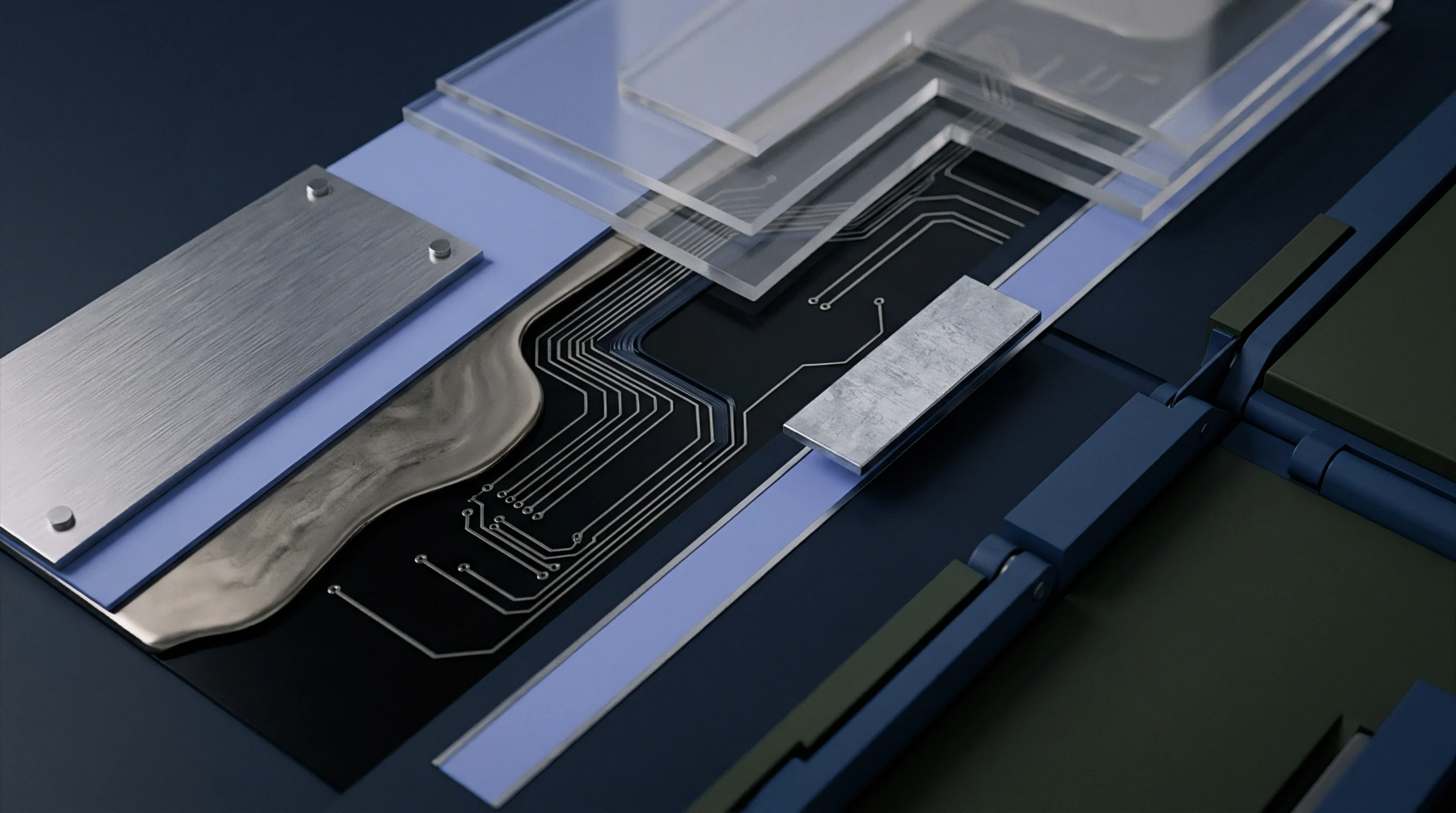
Viscoplastic stress
A viscoplastic mathematical formulation provides the means to simulate the rate-dependent deformation of solder materials under joint thermal and mechanical loading. Applying the anand constitutive model allows engineers to predict the finite element response of electronic packages during temperature cycling tests. This formulation lacks an explicit yield surface, which simplifies numerical convergence during complex structural simulations of printed circuit assemblies.
Evolution Equation
The internal state variable within this formulation represents the isotropic resistance to plastic flow. In the anand constitutive model, the flow equation relates the inelastic strain rate to the current stress state and temperature through a hyperbolic sine function. This mathematical structure allows the prediction of steady-state creep under constant loading.
Solder Characterization
Determining the nine material constants required for this formulation involves performing multiple isothermal uniaxial tension or compression tests across a wide spectrum of strain rates and temperatures. For tin-silver-copper alloys, these parameters dictate how the material hardens or softens under cyclic shear strains. Hardness values and microstructure determine the evolution of the internal state variable, which limits the strain rate under high-temperature conditions.
Electronic hardware design relies on these specific parameters to estimate the fatigue life of solder interconnects in severe automotive environments.