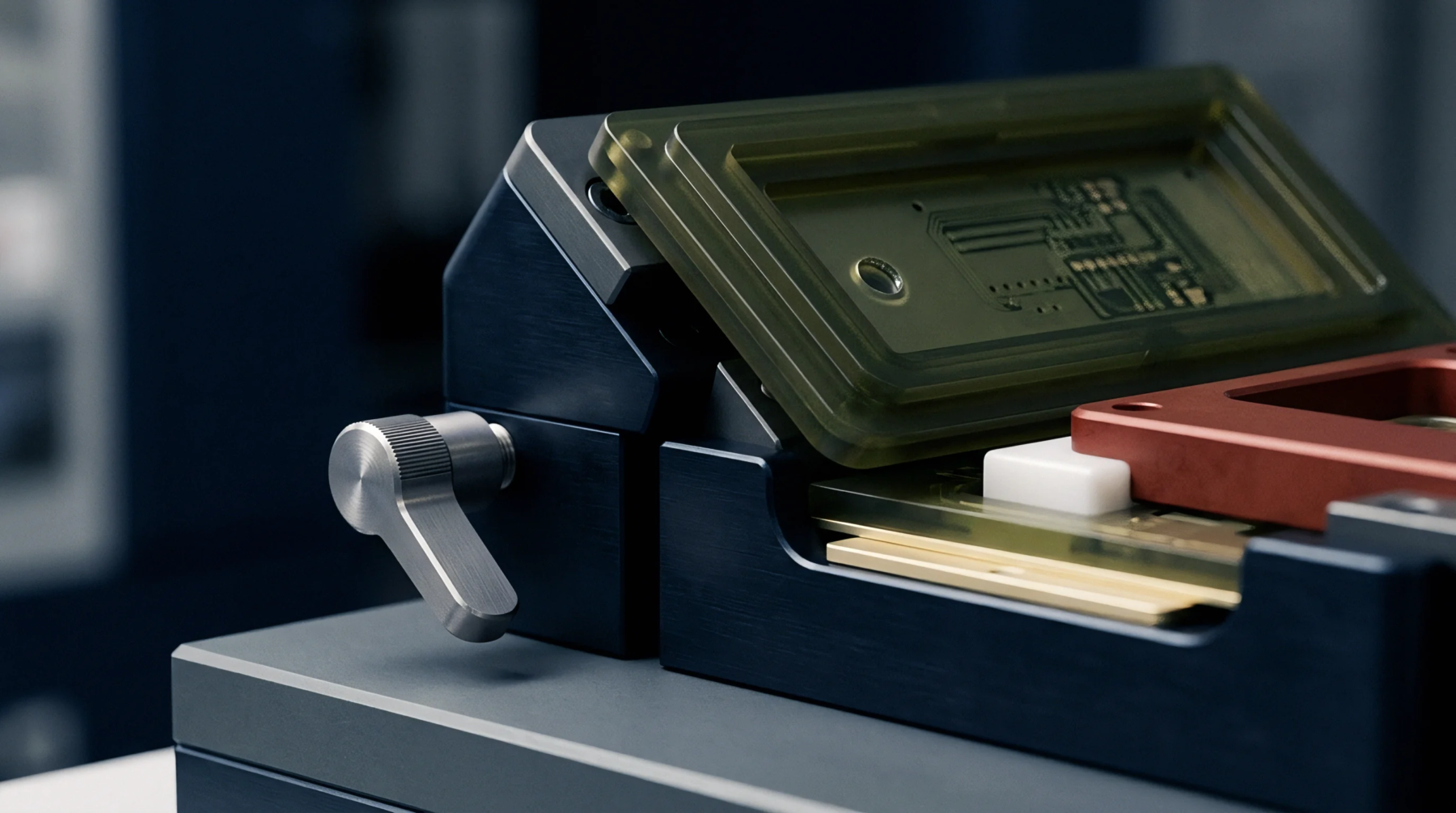
Test Fixture Extraction
Subtraction of signal degradation caused by physical circuit board test fixtures from overall measured data isolate the standalone performance metrics of high-frequency printed circuit board assemblies. The execution of fixture de-embedding converts aggregate scattering parameters into individual mathematical blocks, allowing software algorithms to negate lead-in transmission line effects, via discontinuities, and connector interfaces. Signal characterization standards, such as IEEE 370, define rigorous operational requirements for constructing reference test coupons to achieve reproducible fixture extraction.
Calibration structures, such as 2x thru lines or short-open-load-thru networks, must reside on the same manufacturing panel as the active design to ensure matched laminate thickness, copper roughness, and dielectric constant values. The procedure establishes an analytical boundary at the exact terminal pins of surface-mount components, discarding the parasitic electrical characteristics of the intermediate test card.
Calibration Coupon Implementation
Test board designers incorporate dedicated characterization traces alongside functional routing to capture the transfer functions of test board access channels. The 2x thru coupon represents two symmetric test fixtures connected back-to-back, split computationally into two mirror-image half-fixtures during software analysis. Imperfections in coupon manufacturing, including trace etching variations or localized glass weave skew, directly inject calculation errors into de-embedded differential balance measurements.
Time-domain gating techniques isolate fixture reflections, yet physical calibration structures remain essential for wideband phase and amplitude compensation beyond twenty gigahertz. High-performance launch connectors introduce parasitic capacitive discontinuities, which the extraction process isolates and removes from downstream assembly measurements. Without accurate structural extraction, printed circuit board losses appear erroneously elevated, leading to false rejections of high-speed channel assemblies.
Automated vector network analyzer software imports raw Touchstone files and yields modified S-parameter blocks representing purely the device under evaluation.
High-Speed Validation Constraints
Signal integrity analysis falters when fixture de-embedding is applied to highly coupled or non-uniform transmission lines. Asymmetrical fixture layouts induce mode conversion between differential and common modes, confounding straightforward mathematical cancellation. High substrate loss tangents dampen resonance signatures, but under-designed fixtures with high return loss produce mathematical singularities during scattering matrix conversion.
Causality errors surface when measured data truncation generates non-physical time-domain steps preceding the actual test pulse. Quality checks require that fixture insertion loss curves remain smooth and monotonic prior to launching the de-embedding routine. Verification routines evaluate post-extraction return loss, expecting flat line profiles through the lower frequencies.
Assemblies tested without rigorous mathematical isolation routinely fail high-frequency compliance envelopes due entirely to fixturing artefacts.