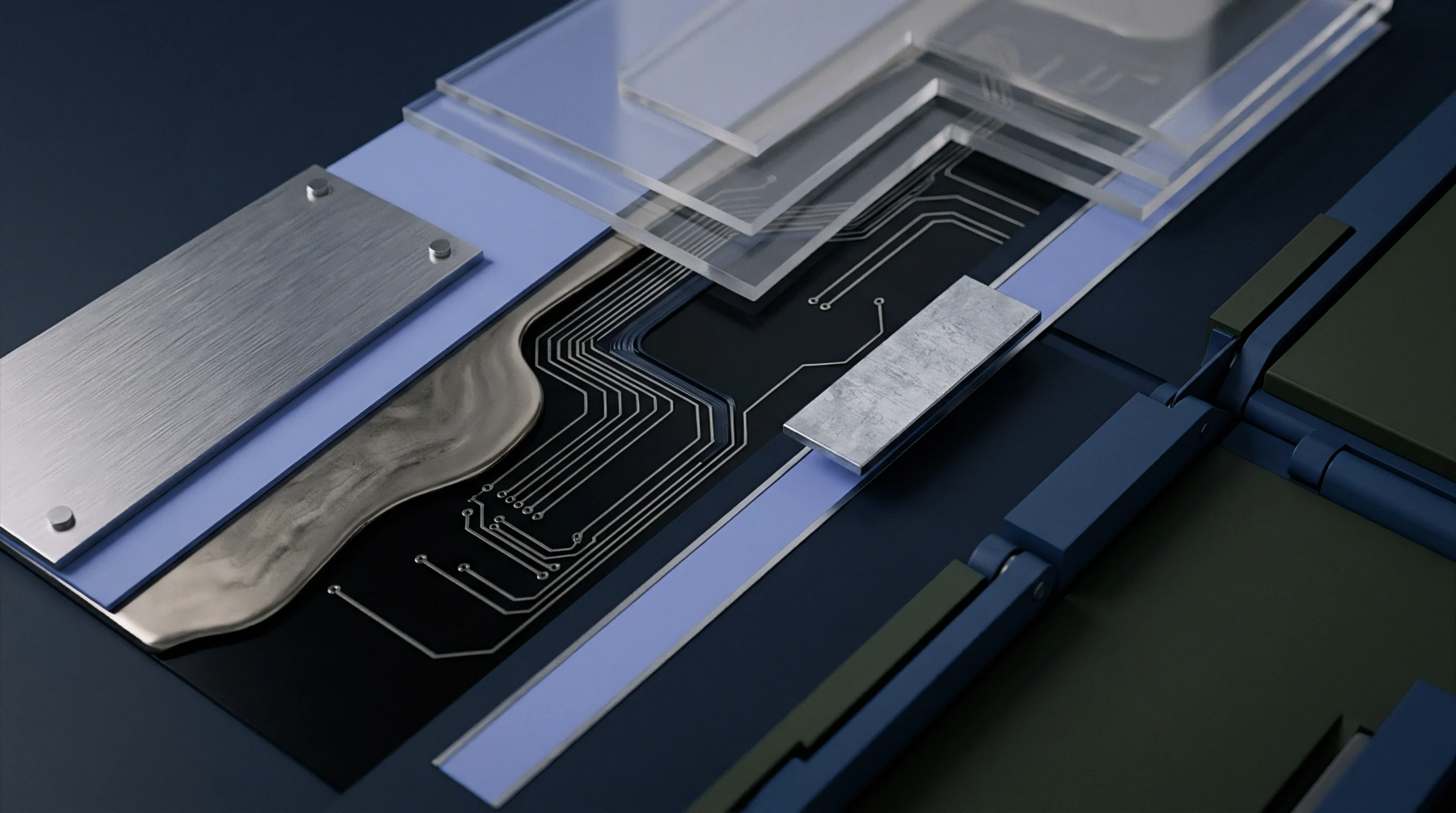
Bonding Mechanism
Compression through atmospheric force provides the uniform pressure required to join adhesive layers across a surface. Vacuum pressing utilizes a flexible membrane and a sealed chamber to remove interstitial air, ensuring the evacuation of voids between a substrate and a top layer. This differential pressure allows mechanical contact to persist during the entire cure cycle, preventing delamination while maintaining dimensional stability.
External atmospheric pressure replaces the need for mechanical clamps or heavy jigs by applying an even load across complex geometries and uneven surfaces.
Lamination Application
Production of high frequency boards requires precise material integration where traditional flat platens fail to account for irregularities in the copper foil. Vacuum pressing manages the delicate interfaces of multi-layer circuits by removing trapped gases before the resin reaches its gel point. This method reduces the incidence of trapped air pockets that threaten dielectric integrity during high speed signal propagation.
Controlled heat application occurs simultaneously with pressure maintenance, driving the polymer flow into micro-vias while ensuring the structural consistency of the stackup.
Material Constraint
Successful execution depends upon the seal integrity of the containment bag and the rate of air extraction from the workspace. Pressure drop across the laminate surface remains limited by the pump capacity and the porosity of the auxiliary breather fabrics. Operators verify the efficacy of the seal by monitoring the gauge reading after the system reaches a steady state.
Uniform density throughout the finished assembly indicates a correct pressure distribution across the entire panel surface.