Multi Frequency Phase Unwrapping Correction under Convective Oven Optical Turbulence
Multi-frequency phase unwrapping in reflow ovens requires adaptive pitch ratios and laminar gas shielding to suppress convective noise and fringe order jumps.
Plume
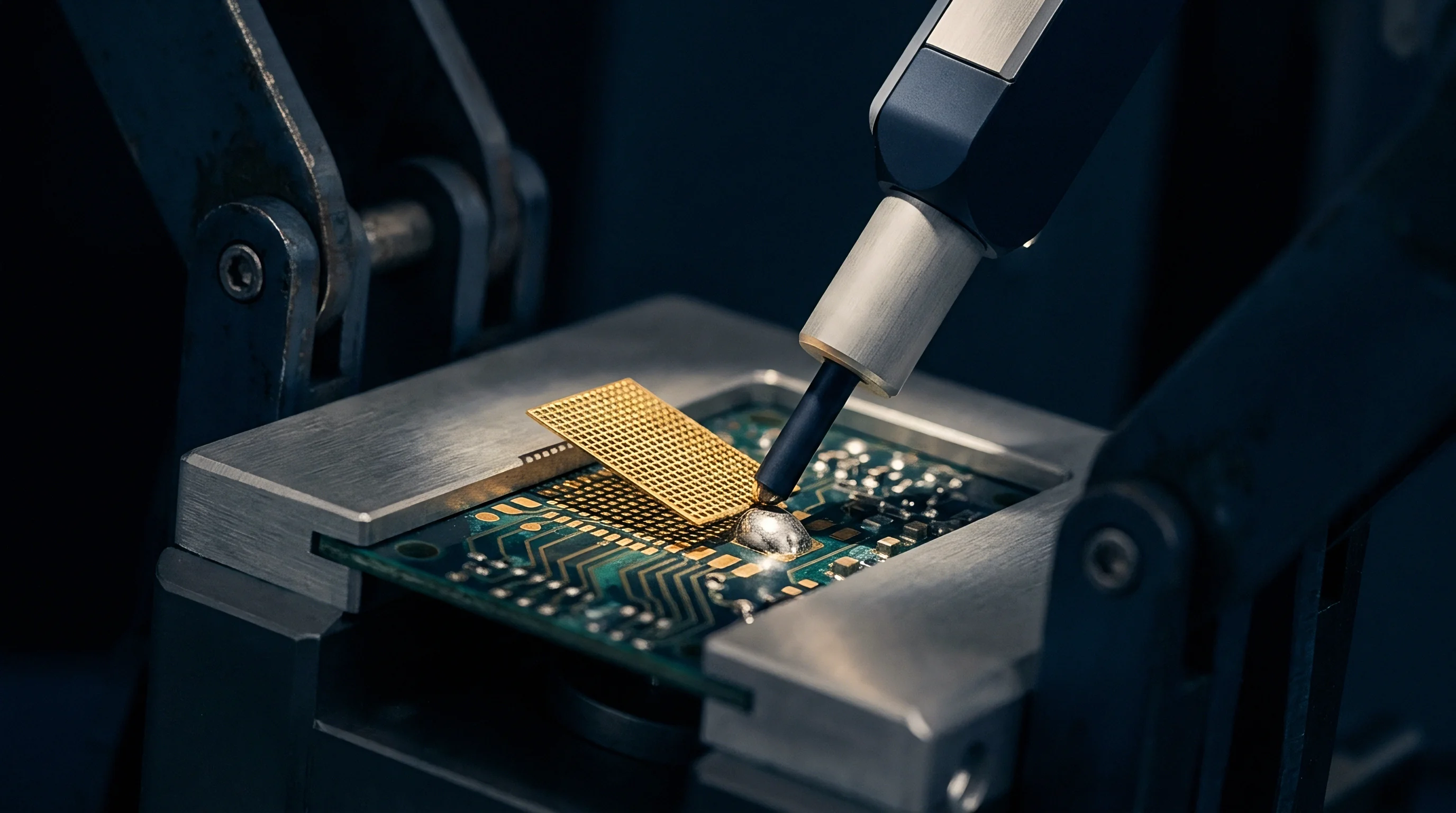
Gas density variations inside a convective reflow oven alter the local refractive index of the gas along the optical projection path. Hot nitrogen or air forced through heater bank nozzles at velocities between 1.5 meters per second and 2.8 meters per second creates localized temperature gradients exceeding 25 degrees Celsius across a 20-millimeter vertical layer above the printed circuit board. According to the Gladstone-Dale relation, the refractive index of a gas varies linearly with its mass density.
For dry nitrogen at a projection wavelength of 450 nanometers, the refractivity constant equals 0.226 cubic centimeters per gram. Thermal fluctuations in the convective atmosphere generate spatial refractive index gradients on the order of 1.2 times 10 to the negative fifth power per millimeter.
Thermal convection distorts optical wavefronts. When a structured light projector projects high-frequency spatial fringe patterns through quartz viewports into active reflow zones, these refractive gradients bend the optical rays. Ray deflection alters the phase recorded by the imaging camera.
Over a 300-millimeter optical path angled at 45 degrees to the board surface, refractive index turbulence shifts spatial fringes by 1.8 to 5.4 micrometers. This physical displacement creates temporal phase jitter between 0.15 radians and 0.48 radians across sequential pattern frames.
A convective thermal gradient of 18 degrees Celsius per millimeter across a 400-nanometer optical projection path introduces 0.42 radians of RMS phase jitter at 1.8 meters per second gas velocity.
Refractive gradients deflect projected rays. Phase noise scales directly with the physical height of the gas plume and the temperature delta between the oven atmosphere and the optical entry window. In the preheat and peak reflow zones, violent convective mixing converts uniform spatial phase shifts into non-Gaussian temporal phase noise.
Phase measuring profilometry systems rely on static optical path lengths to compute height profiles from phase offsets. Refractive turbulence violates this assumption by introducing dynamic phase shifts that mask surface height changes on fine-pitch component leads and ball grid array packages.
| Oven Thermal Zone | Gas Velocity (m/s) | Temp Gradient (C/mm) | Refractive Index Delta | RMS Phase Jitter (rad) |
|---|---|---|---|---|
| Preheat (150 C) | 1.5 | 8.5 | 5.2 x 10^-6 | 0.14 |
| Soak (180 C) | 1.8 | 12.0 | 7.8 x 10^-6 | 0.22 |
| Peak Reflow (245 C) | 2.5 | 28.5 | 1.8 x 10^-5 | 0.48 |
| Cooling (130 C) | 2.8 | 15.0 | 9.4 x 10^-6 | 0.29 |
The Gladstone-Dale constant for nitrogen at 450 nanometers rests on published gas refractometry data at standard atmospheric pressure; temperature fluctuations over 30 degrees Celsius alter this value by less than 0.8 percent. Atmospheric density shifts corrupt the spatial baseline, inducing systematic height measurement drift across long production runs when thermal convection profiles remain uncorrected.
Pitch
Phase measuring profilometry calculates surface height from wrapped phase values restricted to the interval between negative pi and positive pi. Reconstructing absolute surface topography over large step heights requires multi-frequency phase unwrapping. By projecting two or more spatial fringe frequencies with wavelengths designated as lambda one and lambda two, the system constructs a synthetic beat wavelength equal to the product of lambda one and lambda two divided by their absolute difference.
The synthetic wavelength spans the maximum surface height variation of the component package without phase ambiguity.
Integer fringe order calculation forms the core of temporal phase unwrapping. The algorithm assigns integer fringe orders to each pixel by comparing high-frequency wrapped phase values against the synthetic phase. When optical turbulence introduces temporal phase noise into individual frame acquisitions, phase noise propagates directly into the fringe order calculation.
If phase noise on a high-frequency projection frame exceeds a critical threshold, the rounding function assigns an incorrect integer order. Integer fringe jumps create artificial spikes. A single integer fringe order misassignment at a spatial wavelength of 400 micrometers generates a discrete, artificial height error of 282 micrometers on a flat substrate surface.
Phase noise multiplies across synthetic wavelengths. Multi-frequency algorithms assume that phase errors remain small relative to the ratio between synthetic and base wavelengths. Under convective oven optical turbulence, high gas velocities create localized phase noise spikes that break this assumption.
Unwrapped phase maps exhibit severe height tearing near the package edges and within solder joint interconnections.
- Fringe order hopping produces step-function height errors equal to integer multiples of the fundamental spatial projection wavelength across smooth surfaces.
- Synthetic noise amplification increases surface height variance by a multiplier proportional to the ratio of the synthetic wavelength to the fundamental spatial wavelength.
- Edge phase tearing occurs where high spatial height gradients combine with turbulent refractive index shifts, corrupting package coplanar calculations.
- Phase unwrapping saturation occurs when turbulence-induced phase noise exceeds pi radians, causing the unwrapping algorithm to drop fringe orders entirely across broad image regions.
Equipment vendors frequently claim that high-resolution multi-pitch projection eliminates thermal distortion by increasing spatial frequency count, ignoring the mathematical reality of phase noise propagation through tight synthetic wavelengths.
Noise
Algorithmic phase correction under severe thermal turbulence requires noise-resilient carrier selection paired with temporal modulation filtering. Standard heterodyne unwrapping calculates synthetic phase directly from single-frame phase differences at each spatial frequency. High-speed inline 3D profiling cameras operating at 250 frames per second allow temporal accumulation over multiple fringe periods.
Averaging eight to sixteen phase frames per phase step attenuates atmospheric turbulence noise occurring at gas eddy turnover frequencies between 20 Hertz and 120 Hertz. Frame averaging attenuates high frequency turbulent jitter.
Can Synthetic Wavelengths Resolve Turbulent Phase Jumps?
Selecting synthetic wavelength ratios strictly proportional to the localized standard deviation of thermal refractive noise prevents integer fringe jump propagation across un-passivated surface topographies. Consider an optical configuration projecting base spatial wavelengths of 360 micrometers, 400 micrometers, and 450 micrometers at a projection angle of 45 degrees. The primary synthetic wavelength formed by the first two pitches equals 3.60 millimeters, yielding a synthetic scaling factor of 10 relative to the base wavelength.
If convective turbulence introduces an RMS phase jitter of 0.35 radians, the synthetic phase noise variance increases to 0.495 radians. The ratio of noise to the unwrapping threshold reaches 0.787. Because this value exceeds 0.5, integer rounding fails, resulting in a 100 percent probability of fringe order hopping on flat substrate surfaces.
Inserting an intermediate projection pitch of 380 micrometers restructures the unwrapping sequence. The intermediate synthetic wavelength equals 6.84 millimeters, reducing the scaling factor between adjacent stages to 4.75. The normalized noise ratio drops to 0.374, falling below the decision threshold.
Intermediate wavelengths suppress integer rounding errors. Adaptive fringe order rounding functions apply a noise-weighted probability window around integer transitions, preventing isolated phase spikes from shifting the baseline height calculation.
Similar wave-front distortion problems occur in optical diagnostic instrumentation for high-speed gas turbine combustion, where rapid density fluctuations corrupt laser interferometry lines of sight. In SMT reflow profiling, the target surface remains mechanically rigid while the optical medium fluctuates, simplifying spatial filtering requirements.
Precise refractive index variance across high-speed dual-wave convective blowers varies between 1.2 times 10 to the negative fifth power and 4.8 times 10 to the negative fifth power depending on nozzle duct geometry; line buyers must measure localized fringe variance directly on site.
Whether phase unwrapping algorithms can dynamically adapt synthetic frequency ratios in real time to compensate for unpredictable nitrogen flow surges during high-convection profile switches remains unresolved.
Passage
Integrating optical phase profiling systems directly into convective reflow oven chambers requires physical thermal isolation and active gas stream management. Optical access ports cut into the top of preheat, peak reflow, and cooling zones require double-glazed fused silica viewports. Heated quartz elements prevent chemical deposition.
Internal window surfaces held at 180 degrees Celsius prevent flux vapor condensation, which otherwise coats optical glass with opaque rosin residues within four hours of continuous board processing.
Active laminar air knives mounted beneath the viewports stabilize the optical boundary layer. Pressurized nitrogen delivered at 0.35 bar through a 0.5-millimeter slit creates a uniform, horizontal gas sheet across the underside of the quartz window. Laminar gas sheets flatten boundary layer refraction.
The laminar flow shears off rising thermal plumes, maintaining a constant refractive index within the optical viewing cavity.
- Purge the optical sensor enclosure with dry nitrogen for twenty minutes to achieve internal atmosphere stabilization.
- Heat the fused silica viewport windows to 180 degrees Celsius using internal resistive heating elements to eliminate flux condensation.
- Activate the lower laminar air knives at 0.35 bar supply pressure to establish a uniform boundary layer gas shield.
- Run a ceramic calibration master panel through the reflow zone at operating profile temperatures to record residual atmospheric phase distortion matrices.
- Subtract the residual thermal phase distortion matrix from live board inspection phase maps prior to multi-frequency unwrapping calculations.
Thermal expansion shifts sensor baseline positions. Structural mounting frames supporting projector and camera optics experience thermal drift when exposed to radiant oven heat. Water-cooled aluminum mounting plates hold optical alignment within 2.5 micrometers relative to the conveyor rail reference axis.
| Parameter | Ambient SPI System | Convective Reflow 3D System | Unit |
|---|---|---|---|
| Projection Wavelength | 450 | 405 / 450 / 520 | nm |
| Camera Frame Rate | 60 | 250 – 500 | fps |
| Viewport Glass Type | N/A | Synthetic Fused Silica | Material |
| Gas Boundary Control | None | Laminar Nitrogen Air Knife | Type |
| Thermal Stabilization | Passive Air | Closed-Loop Liquid Cooled | Method |
IPC-9850 placement and optical alignment guidelines dictate spatial calibration verification under full thermal equilibrium to prevent optical axis drift during reflow cycle operation.
Purging optical viewports with laminar nitrogen at ambient temperature stabilizes the optical refractive boundary layer far more effectively than increasing camera frame exposure times.
Dossier
Adding real-time multi-frequency phase correction algorithms to inline 3D optical reflow metrology alters production line economics. Standard board takt time targets on high-volume SMT lines range from 18 to 25 seconds per panel. Acquiring forty-eight individual phase images per inspection site across three projection frequencies at 250 frames per second consumes 192 milliseconds of raw acquisition time per camera field of view.
Algorithmic computation adds 85 milliseconds of processing latency per frame set. Total inspection overhead stays well inside board transport takt limits, preventing line starvation.
Uncorrected optical false calls stop SMT lines. Convective turbulence across fine-pitch BGA components introduces false height variations up to 120 micrometers when standard phase unwrapping is used without refractive noise correction. Inspection false reject rates (FRR) on uncorrected systems reach 1,200 parts per million, causing frequent line stops.
Operator manual verification costs $240 per line hold hour in direct labor and lost capacity. Corrected multi-frequency unwrapping algorithms reduce optical false reject rates below 15 parts per million on surface-mount package lines.
| Correction Strategy | Compute Time (ms) | False Reject Rate (ppm) | Line Downtime Risk | Landed Cost Factor |
|---|---|---|---|---|
| Uncorrected Dual-Pitch | 42 | 1,250 | High | 1.00 |
| Temporal Averaged Dual-Pitch | 110 | 340 | Medium | 1.08 |
| Tri-Pitch Adaptive Heterodyne | 197 | 14 | Low | 1.15 |
| Quad-Pitch with Air Knife Shield | 277 | 4 | Negligible | 1.22 |
Process yield hinges on verified height thresholds. Optical qualification prevents expensive false rejects.
- False call ceiling clauses must specify a maximum allowable optical false reject threshold of 15 parts per million calculated across 10,000 consecutive reflow package inspections.
- Thermal equilibrium duration mandates that optical verification checks take place only after the oven operates at target profile temperatures for at least 45 continuous minutes.
- Viewport maintenance interval defines the maximum allowable operational period between optical window cleanings, set to a minimum of 120 production hours.
- Escape rate caps mandate zero non-detections for package coplanarity defects exceeding 80 micrometers above nominal substrate height.
Real-time optical phase correction adds microsecond processing latency per panel, yet saves thousands in secondary rework on high-density BGA packages.
According to standard assembly equipment qualification terms, equipment suppliers must demonstrate an optical inspection false call rate below 15 parts per million under active reflow convection conditions before final line sign-off.