Homogeneous Layer Extraction Protocols for Multi-Layer Plating Assemblies under IEC 62321
Verify multi-layer plating compliance under IEC 62321 using selective chemical stripping to isolate surface finishes from substrates before chemical digestion.

Strata
Multi-layer plating stacks in electronic hardware complicate restricted substance verification under IEC 62321. Standard electroplated finishes place thin metallic films over copper traces or nickel-plated substrates. An ENIG stack, for instance, deposits 3 to 6 micrometers of nickel-phosphorus under 0.02 to 0.05 micrometers of immersion gold, whereas an ENEPIG deposit adds an intermediate 0.05 to 0.15 micrometers of electroless palladium.
IEC 62321-2 defines a homogeneous material as a unit of uniform composition throughout that cannot be mechanically disjointed by unscrewing, cutting, crushing, grinding, or abrasive processes. Whenever plating layers exceed the analytical spot depth of test equipment, classification disputes between test laboratories and component buyers quickly follow.
Mechanical disjointing breaks down once a layer is thinner than what micro-milling or scraping tools can cleanly isolate. If an immersion gold layer measures only 30 nanometers, scraping the surface inevitably pares away underlying copper substrate and distorts mass-fraction calculations. Because laboratories measure total analyte mass against total sample mass, dragging heavy substrate material into the weighed sample dilutes the calculated concentration of regulated metals by orders of magnitude, disguising a non-compliant surface treatment as an artificially compliant result.
| Plating Structure | Layer Sequence | Nominal Layer Thickness | Isolation Protocol | Dilution Risk Factor |
|---|---|---|---|---|
| ENIG (Electroless Nickel / Immersion Gold) | Au over Ni-P on Cu | Au: 0.03 µm, Ni: 4.0 µm | Selective Chemical Stripping | High under mechanical scraping |
| ENEPIG (Nickel / Palladium / Gold) | Au over Pd over Ni-P on Cu | Au: 0.05 µm, Pd: 0.1 µm, Ni: 3.5 µm | Chemical Layer Dissolution | Extreme under mechanical scraping |
| Passivated Zinc over Steel | Cr(VI)/Cr(III) film over Zn on Fe | Film: 20–100 nm, Zn: 8.0 µm | Boiling Water / Alkaline Extraction | Moderate under total digestion |
| Electrolytic Matte Tin | Pure Sn over Cu barrier | Sn: 8.0–12.0 µm, Cu: 2.0 µm | Direct Mechanical Scraping | Low when depth controlled |
Boundary verification turns on whether a layer counts as an independent material under regulatory surveillance. European market surveillance authorities test surface strata directly through chemical extraction or micro-XRF depth profiling. If a passivation film on a threaded fastener contains hexavalent chromium above 0.1 percent by weight of that isolated film, the entire part breaches RoHS directives regardless of the steel core’s mass.
Test reports that average analyte mass across total component weight fail legal scrutiny during import audits.
Standard test reports averaging cadmium or lead content across an entire component core mask non-compliant surface finishes and trigger immediate customs rejections.
Engineers specifying multi-layer stacks map layer boundaries before dispatching production coupons to accredited laboratories. Cross-sectional micro-analysis combined with scanning electron microscopy and energy-dispersive X-ray spectroscopy defines true layer transitions prior to chemical digestion. Omitting layer isolation protocols in test requisitions frequently prompts laboratories to run total component dissolutions, erasing the physical evidence needed to hold plating vendors accountable for restricted substance escapes.
Selecting an isolation method depends on substrate rigidity, coating chemistry, and nominal thickness. Thin metallic overcoats demand reagents that selectively dissolve the target metal without attacking underlying barrier plates or core copper. When chemical selectivity cannot be maintained, quantitative depth-profiling spectroscopy replaces wet chemical digestion as the primary compliance verification route.
The unresolved boundary question centers on whether sub-50-nanometer flash platings constitute distinct homogeneous layers or superficial surface contaminants under enforcement guidelines.
Abrasion
Mechanical extraction isolates individual plating layers from substrates using abrasive action, precision micro-milling, or cryogenic delamination. IEC 62321-2 details mechanical preparation steps intended to reduce samples to uniform powders or flakes. On platings thicker than 10 micrometers, tungsten carbide micro-cutters mounted on high-speed spindles strip surface layers in 2-micrometer passes.
Fine depth control prevents the cutter from gouging the substrate interface, ensuring no base metal enters the abraded sample.
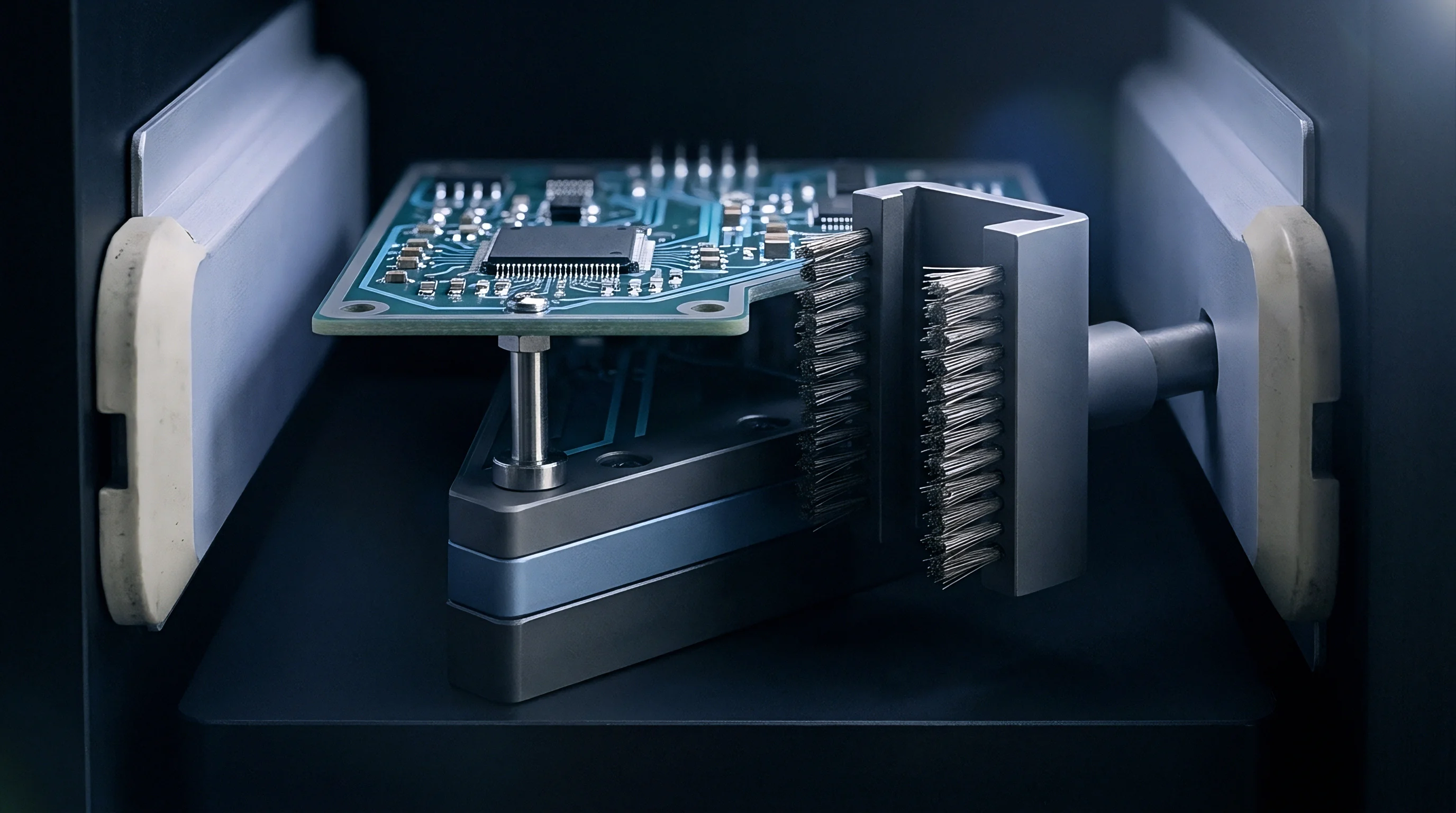
Micro-scraping with diamond-tipped scalpels under 40x optical magnification handles medium-thickness deposits such as matte tin overcoats or electrolytic lead-free solders. The operator mounts the sample in a rigid vise, drawing low-force linear strokes to shave continuous metallic ribbons from the surface. The collected ribbons transfer directly to an analytical microbalance accurate to 0.01 milligrams.
Gathering sufficient sample mass for inductively coupled plasma optical emission spectrometry, however, demands scraping expansive surface areas, raising the odds of tool slip into the underlying base metal.
- Cryogenic Thermal Shock Delamination uses thermal expansion mismatches between brittle plating intermetallics and ductile substrates to crack surface layers cleanly.
- Diamond-Tipped Micro-Scraping removes continuous thin metal ribbons under optical alignment to yield concentrated metallic samples without chemical contamination.
- Controlled Tungsten Carbide Milling takes uniform structural passes off thick platings while tracking depth down to the micron across flat coupons.
- Precision Precision Surface Grinding collects fine particulate matter from hard ceramic or chromium deposits using high-purity quartz abrasive disks.
Cryogenic fracture leverages differing thermal expansion coefficients between organic substrates, metallic barriers, and brittle surface finishes. Submerging the assembly in liquid nitrogen at -196 degrees Celsius embrittles interfacial intermetallics. A targeted mechanical blow against the frozen assembly then shears the plating cleanly off the copper traces, yielding flat flakes ready for analysis without tool contamination, provided the part geometry is rigid enough to generate sufficient shear strain at the interface.
Abrasive quartz grinding disks extract particulate matter from hard coatings like industrial chromium or nickel-tungsten alloys. Technicians use quartz wheels rated at 99.99 percent purity so that abrasive grit shedding into the sample introduces no lead, cadmium, or mercury. The resulting mixture of quartz dust and plating powder undergoes total acid digestion; the acids break down the metallic constituents while leaving an inert quartz residue that is filtered out prior to spectroscopic analysis.
Tool material choices directly dictate sample contamination levels during mechanical micro-milling of thin metallic finishes.
Mechanical separation becomes impractical once layer thickness falls below 2 micrometers. Attempting to scrape a 0.1-micrometer palladium layer yields a sample overwhelmed by underlying nickel and copper substrate. The resulting analyte mass reflects tool depth drift rather than true layer composition.
Below this threshold, mechanical preparation produces invalid data, leaving selective wet chemical extraction as the only viable route.
Hand-scraping yields can fall short when thin gold platings flake unpredictably off the nickel underlayer during preparation.
Digestion
Selective wet chemical extraction separates multi-layer plating stacks by leveraging differences in thermodynamic oxidation potential across constituent metals. IEC 62321-5 and IEC 62321-7-1 establish acid digestion and boiling water extraction protocols for quantifying restricted substances. Liquid reagents dissolve specific surface layers sequentially, capturing target analytes in solution while leaving lower strata intact.
Maintaining tight process parameters keeps reagents from etching base metals, preserving accurate concentration calculations per unit mass of isolated plating.
Hexavalent chromium extraction from passivation films on zinc or aluminum coatings follows the boiling water procedure in IEC 62321-7-1. The technician submerges 50 square centimeters of surface area in boiling deionized water for exactly ten minutes, leaching hexavalent chromium ions into solution without stripping the underlying zinc. Reacting the cooled extract with 1,5-diphenylcarbazide in acidic conditions forms a red-violet complex quantified by UV-Vis spectrophotometry at 540 nanometers.
If hexavalent chromium concentration exceeds 0.10 micrograms per square centimeter of surface area, the coating fails regulatory limits.
| Target Layer | Reagent Matrix | Temperature Range | Substrate Stop Layer | Selectivity Ratio |
|---|---|---|---|---|
| Immersion Gold (Au) | Potassium Iodide / Iodine Solution | 20–25 °C | Electroless Nickel (Ni-P) | 150:1 |
| Electroless Palladium (Pd) | Dilute Nitric Acid / Ammonium Persulfate | 35–40 °C | Nickel-Phosphorus Layer | 80:1 |
| Pure Matte Tin (Sn) | Methanesulfonic Acid / Hydrochloric Acid | 20–30 °C | Copper Intermetallic (Cu6Sn5) | 220:1 |
| Nickel Barrier (Ni-P) | Nitric Acid / Hydrogen Peroxide Matrix | 50–60 °C | Laminate Base Resin / Glass | 500:1 |
Selective stripping of immersion gold over nickel-phosphorus relies on aqueous potassium iodide and iodine solutions. Iodine selectively oxidizes metallic gold into soluble complex iodides while the nickel barrier passivates under a stable oxide film. Monitoring extraction rates with quartz crystal microbalances confirms that gold dissolution halts cleanly upon reaching the nickel boundary.
Rinsing the remaining coupon with high-purity water isolates the liquid extract containing the gold-borne analytes for ICP-OES analysis.
Alkaline digestion under IEC 62321-7-2 extracts hexavalent chromium from organic coatings and complex polymer matrices without oxidizing trivalent chromium or reducing hexavalent ions. The digestant ~ 0.5 M sodium hydroxide and 0.28 M sodium carbonate ~ is heated to 90–95 degrees Celsius for 60 minutes. Magnesium chloride and a phosphate buffer stabilize the ionic balance to prevent valence changes during digestion.
Temperature control is critical: exceeding 95 degrees causes thermal reduction of hexavalent species, producing false-negative compliance results.
- Substrate Area Measurement determines exact plated geometry using optical coordinate measuring systems to establish surface area denominators for concentration calculations.
- Selective Reagent Dosing introduces precise volumes of controlled acid or chelating agents formulated to react only with the target outer plating layer.
- Thermal Bath Stabilization keeps extraction solution temperatures within 0.5 degrees Celsius during the reaction window to prevent kinetic over-etching.
- Extract Quenching and Filtration halts chemical activity through rapid cooling and 0.45-micron membrane filtration prior to instrument injection.
- Gravimetric Substrate Verification weighs the dry remaining coupon to confirm that overall mass loss matches the calculated layer mass.
Acid digestion of barrier layers such as nickel-phosphorus requires microwave-assisted closed-vessel digestion per IEC 62321-5. Concentrated nitric acid mixed with fluoroboric acid dissolves nickel alloys under elevated temperature and pressure (200 degrees Celsius at 30 bar). Closed fluoropolymer vessels prevent the escape of volatile analytes, particularly mercury and arsenic compounds.
The resulting digestate is diluted volumetrically prior to atomic emission analysis.
Inconsistent digestion timing allows chemical reagents to breach barrier layers, leaching underlying copper trace materials and invalidating calculated analyte concentration ratios.
IEC 62321-5 Clause 7.2 dictates exact acid mixture ratios and temperature ramps to achieve complete dissolution without precipitating insoluble lead sulfates or metastannic acid.

Screening
Energy-dispersive X-ray fluorescence spectrometry serves as the primary non-destructive screening protocol under IEC 62321-3-1. XRF analysis identifies regulated elements—lead, cadmium, mercury, total chromium, and total bromine—within multi-layer stacks before committing samples to destructive chemical digestion. The instrument directs a primary X-ray beam at the plating surface, exciting core electrons within metal atoms and measuring the energy spectrum of characteristic secondary X-rays emitted during electronic relaxation.
Small-spot XRF instruments equipped with polycapillary X-ray optics focus photon beams down to spot diameters below 30 micrometers. This spatial precision allows targeting individual surface mount pads, micro-vias, and connector pin platings without capturing adjacent solder mask or epoxy laminate. However, X-ray penetration depth varies directly with primary beam voltage and target material density.
A 50 kV X-ray beam penetrates up to 10 micrometers into pure tin but less than 1 micrometer into high-density gold plating, creating spectral depth artifacts in multi-layer assemblies.
Fundamental parameters algorithms process secondary spectral peaks to calculate layer thickness alongside elemental composition. The software models the sample as a stack of discrete strata, fitting theoretical fluorescence intensities against observed spectral peak areas. Peak overlaps present severe analytical challenges: the lead L-alpha line at 10.55 keV overlaps directly with the bismuth L-beta line, while the arsenic K-alpha peak interferes with lead L-beta detection.
Uncorrected spectral overlaps produce false-positive lead detection in bismuth-doped lead-free solder platings.
Screening decision thresholds established in IEC 62321-3-1 categorize samples into pass, fail, or inconclusive zones. For lead screening in metallic coatings, a result below 700 milligram per kilogram yields an immediate pass decision. A result exceeding 1300 milligram per kilogram triggers batch rejection or redesign.
Values falling between 700 and 1300 milligram per kilogram represent the inconclusive gray zone, requiring mandatory physical layer extraction and quantitative wet chemical digestion per IEC 62321-5.
XRF screening flags inconclusive results when spectral depth exceeds layer boundaries, requiring wet chemical digestion to confirm true elemental compliance.
Variable plating thickness creates measurement drift during automated XRF screening runs. When gold plating thickness varies across a single circuit board panel due to non-uniform current density during electroplating, primary beam attenuation changes proportionally. Thinner gold layers allow greater excitation of underlying nickel and copper, shifting the relative intensity ratios of secondary lines.
Laboratories must recalibrate XRF spectral models against cross-sectioned reference standards matching the exact substrate and plating matrix of the test batch.
XRF screening that detects 1100 milligram per kilogram lead due to underlying bronze substrate excitation through an abnormally thin tin finish forces inconclusive flags and shipment rejections.

Dispute
Commercial friction arises when test reports generated by component vendors contradict market surveillance findings published by regulatory authorities. Vendors routinely submit screening reports based on whole-component XRF scans, claiming compliance based on low average analyte concentrations. Market surveillance laboratories enforce homogeneous material separation down to individual plating strata using micro-extraction protocols.
When an enforcement agency detects 1800 milligram per kilogram of hexavalent chromium in a 50-nanometer conversion film on a structural chassis, the importer faces product recalls, customs holds, and legal sanctions despite holding vendor-supplied compliance certificates.
Technical documentation files mandated under EN IEC 63000 require importers to evaluate the quality and trustworthiness of vendor conformity declarations. Relying on unverified self-declarations or generic test reports voids the legal presumption of conformity. The buyer must demonstrate that test protocols matched the physical reality of the plating assembly, proving that homogeneous layer separation was attempted or correctly ruled out through documented engineering evaluations.
Dispute resolution protocols hinge on analytical sample retention and repeatable extraction workflows. When a batch is impounded at a port of entry, duplicate retain samples from the original production lot undergo re-testing at an independent accredited laboratory under ISO/IEC 17025. The referee laboratory must employ chemical stripping or depth-profile ICP-MS matching the exact layer geometry of the contested hardware.
If the referee laboratory confirms localized non-compliance within a single plating layer, rework costs, freight demurrage, and customs penalties fall entirely on the plating subcontractor under standard quality agreements.
Contractual liability protection requires buyers to integrate detailed analytical test requirements directly into procurement specifications. RFQs must state that compliance verification follows IEC 62321 layer isolation protocols rather than total bulk dissolution. Specifying exact extraction methods eliminates vendor excuses regarding analytical method divergence when market authorities audit landed product batches.
A buyer who omits explicit layer extraction specifications from purchase contracts absorbs all financial exposure when border authorities reject non-compliant surface platings.