Export Control Classification Procedures for Custom Test Fixtures
Export control classification of custom test fixtures requires mapping target board jurisdiction, operating frequencies, and embedded firmware against ECCN 3B002 or USML entries.

Jurisdiction
Cross-border movement of custom electronic test tooling depends entirely on the design purpose of the primary circuit under test. When a custom test fixture interfaces with a printed circuit board assembly destined for defense systems, the fixture falls under the International Traffic in Arms Regulations administered by the United States Directorate of Defense Trade Controls. Defense origin dictates control.
Standard commercial in-circuit test fixtures and functional test beds fall under the Export Administration Regulations overseen by the Bureau of Industry and Security. Determining which agency holds statutory authority over a fixture forms the baseline of export compliance prior to hardware fabrication.
The jurisdiction determination process follows a strict Order of Review. Engineers start by assessing whether the custom fixture or its specialized target interface components meet the definition of defense articles under the United States Munitions List. Category XI(c) of the USML explicitly controls electronic systems, equipment, and components specially designed for military applications, including testing equipment specifically configured to evaluate military electronics.
If a custom test fixture evaluates a board designed for a military platform, the fixture itself inherits ITAR jurisdiction unless the hardware consists exclusively of standard off-the-shelf commercial test equipment operating without modification.
Test tooling custom-built to evaluate defense electronics remains subject to munitions controls even when built from commercial structural hardware.
For custom fixtures evaluating dual-use or purely commercial printed circuit assemblies, the evaluation moves to the Commerce Control List under 15 CFR Part 774. The primary mechanism determining classification under the Export Administration Regulations revolves around the legal concept of specially designed items codified in EAR Part 772.1. A custom test interface board, bed-of-nails fixture, or specialized probe card designed solely for a specific commercial integrated circuit or printed circuit assembly falls under dual-use jurisdiction.
The technical parameters of that target assembly then dictate whether the fixture receives a specific Export Control Classification Number or defaults to EAR99 status.
| Regulatory Body | Control List Entry | Target Item Classification | Licensing Mechanism |
|---|---|---|---|
| Department of State (DDTC) | USML Category XI(c) | Defense articles, military avionics, specialized radar PCBAs | DSP-5 permanent export license or DSP-73 temporary export license |
| Bureau of Industry and Security (BIS) | ECCN 3B002 | Advanced semiconductor devices, high-speed automated test equipment | Specific export license based on Commerce Country Chart destination |
| Bureau of Industry and Security (BIS) | ECCN 3B992 | General commercial IC test equipment, standard wafer probe cards | No License Required for most non-sanctioned destinations |
| Bureau of Industry and Security (BIS) | EAR99 | Basic functional test beds, generic low-frequency ICT fixtures | No License Required except for embargoed entities or end-users |
Evaluating multi-use test equipment requires analyzing the structural and electrical independence of the fixture. When a fixture chassis contains generic commercial signal generators, digital multimeters, and programmable power supplies mounted into a rack, those individual sub-instruments retain their standalone classification. However, the custom interface panel, internal wiring harness, and custom pin-block that route signals to the target board constitute a separate custom assembly.
Incorrect jurisdictional assignment under ITAR instead of the EAR exposes exporters to severe regulatory enforcement, operational asset seizures, and statutory fines that accumulate on a per-shipment basis.
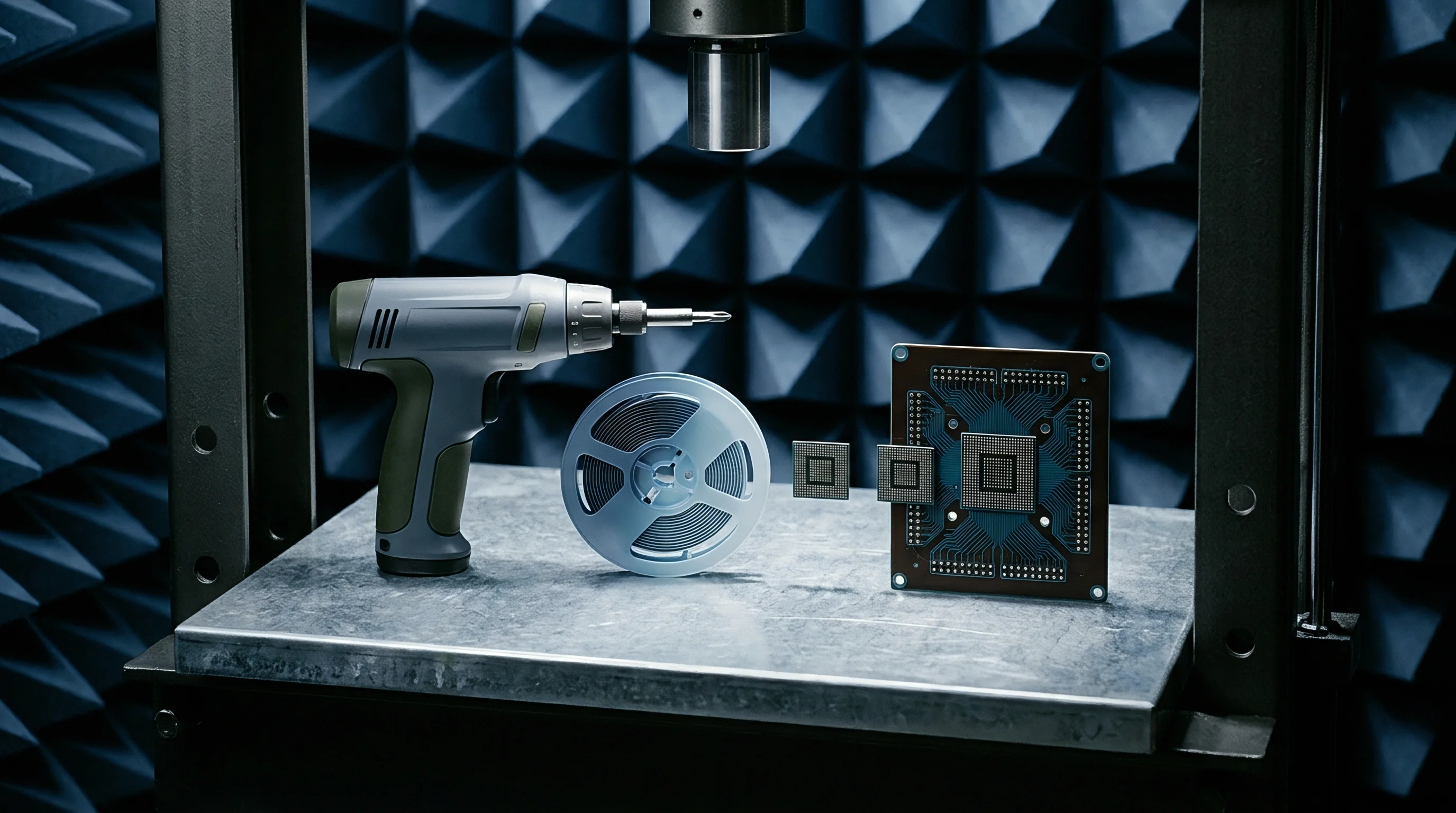
Parameters
Technical evaluation of test equipment centers on performance thresholds defined within trade control lists. Export Control Classification Numbers categorize semiconductor test hardware based on raw performance limits rather than market intent. Pin count alters classification status.
Signal frequency dictates export licensing. ECCN 3B002 controls equipment designed for testing finished or unfinished semiconductor devices, establishing distinct boundaries based on frequency, bandwidth, and test rate capabilities.
Custom load boards, high-speed probe cards, and automated test equipment interface heads designed for high-frequency integrated circuits often breach dual-use parameters. For instance, testing radio frequency devices operating above 31.8 GHz moves interface hardware into Controlled items under ECCN 3B002.a. Custom fixtures incorporating active electronics, such as impedance-matching amplifiers or high-speed serializer-deserializer converter chips mounted directly on the fixture substrate, must be evaluated against component-level controls in ECCN 3A001.
Hardware specifications fix the regime.
ECCN 3B002 covers equipment designed for testing finished or unfinished semiconductor devices, placing specialized high-frequency probes under dual-use export licensing rules.
Firmware embedded within custom test fixtures creates an additional layer of classification complexity. Fixtures utilizing on-board Field Programmable Gate Arrays to generate high-speed test vectors, execute boundary scan routines, or analyze proprietary serial protocols contain software and technology elements. Dual-use controls apply broadly.
If the embedded firmware implements cryptographic routines for secure device authentication during test sequences, the software side of the fixture can trigger classification under Category 5 Part 2 of the Commerce Control List, covering information security items under ECCN 5D002.
- Frequency Threshold Breaches Custom probe cards and load boards configured for mmWave signals exceeding 31.8 GHz automatically shift from basic ECCN 3B992 entries into regulated 3B002 classifications.
- Cryptographic Firmware Injection On-board test controllers executing hardware-rooted decryption routines during device functional screens trigger ECCN 5D002 dual-use controls.
- High-Density Pin Interconnects Ultra-fine pitch socket interfaces incorporating active pin electronics with pin-to-pin data rates over 10 Gbps demand detailed bandwidth evaluations.
- Specially Designed Mechanical Frames Structural fixture bases designed exclusively for handling classified or military-spec hybrid microcircuits inherit USML Category XI restrictions regardless of passive material composition.
Deconstructing the technical capabilities of custom fixtures prevents unexpected export delays. Software evaluation remains mandatory. Licensing delays disrupt manufacturing schedules.
When analyzing high-speed digital test fixtures, engineers verify whether pattern generator channels exceed 2.5 Gbps per pin. Under Export Administration Regulations, 15 CFR Part 774 Supplement No. 1, ECCN 3B002, fixtures meeting or surpassing specified dynamic pin performance thresholds require explicit export licenses prior to shipment to restricted destinations listed under Commerce Country Group D:1.

Bench
Physical test rigs combine structural plates, probe pins, target sockets, and custom interface electronics. Bed-of-nails fixtures built for in-circuit testing rely on custom-drilled acrylic or G10/FR4 plates holding spring-loaded test probes that align with exposed test points on a target PCBA. While the mechanical pogo pins and wire-wrap posts consist of generic commercial parts, the specific drill patterns and custom netlist wiring schemes turn the bare mechanical assembly into a specialized article tailored to a specific circuit layout.
Fixtures built for off-shore production testing routinely travel across international borders to contract manufacturing facilities. Fixture layout dictates jurisdiction. Functional test units often bundle internal load banks, switching relays, boundary scan interface hardware, and power control cards inside a single enclosure.
Evaluating the custom wiring netlist, the embedded microcontroller code, and the test execution scripts forms the core procedure for establishing proper export paperwork prior to shipping the unit to overseas assembly plants.
Custom load boards operating above 31.8 GHz carry a zero percent export license exception threshold for shipments destined to Country Group D:1 locations.
Audit procedures for physical test hardware demand a step-by-step breakdown of both physical and digital assets contained within the shipment bundle. Functional rigs demand explicit review.
- Audit the bill of materials for all active silicon, high-speed connectors, and proprietary sub-assemblies mounted inside the fixture frame.
- Extract and classify all embedded microcode, FPGA bitstreams, and test execution software shipped on physical media or pre-installed on the fixture controller.
- Review the target PCBA schematics to confirm whether the board under test performs military functions or contains USML-controlled technology.
- Document physical operational parameters, focusing on maximum operating frequency, signal edge rates, and data throughput across the interface pins.
Disagreements between test equipment vendors and buyer compliance teams frequently arise during overseas deployment. Tooling suppliers often argue that a passive bed-of-nails fixture constitutes standard mechanical plastic and copper wire without independent electronic intelligence, ignoring the legal scope of specially designed provisions that tie the fixture’s export classification directly to the restricted target circuit under test.
Filings
Formal agency determinations provide binding legal certainty when self-classification yields ambiguity. Exporters faced with uncertain jurisdictional boundaries between ITAR and EAR submit a Commodity Jurisdiction request to the Directorate of Defense Trade Controls. When jurisdiction under the EAR is clear but the precise ECCN remains disputed due to complex fixture electronics, the exporter files a Commodity Classification Automated Tracking System request with the Bureau of Industry and Security.

Why Does Firmware Alter Fixture Classification?
Firmware uploaded to fixture gate arrays transforms generic hardware into a dedicated protocol analyzer or pattern generator. Embedded software alters classification boundaries. When test vectors validate security functions or proprietary high-speed interfaces, the code changes the technical capability of the overall fixture assembly.
Under EAR rules, software bundled with hardware can reclassify the complete operational unit under a more restrictive control entry.
A missing CCATS determination letter forces customs officials to default to the highest applicable control status during cross-border transit checks.
| Filing Attribute | Commodity Jurisdiction (CJ) | CCATS Application | Internal Self-Classification |
|---|---|---|---|
| Administering Agency | Department of State (DDTC) | Department of Commerce (BIS) | Exporter Internal Compliance |
| Legal Binding Status | Formal government ruling | Formal agency classification | Self-assumed exporter risk |
| Average Processing Window | 60 to 120 calendar days | 30 to 60 calendar days | Immediate implementation |
| Required Technical Data | Schematics, netlists, end-use statements, technical drawings | Block diagrams, performance specs, frequency parameters | Internal engineering analysis logs, BOM review notes |
Documentation built into a classification dossier must survive rigorous cross-border regulatory scrutiny. Reclassification halts global shipping. Documentation prevents customs seizure.
A comprehensive technical file includes full structural assembly drawings, netlist files, active component ECCN logs, and a signed statement detailing the commercial end-use of the target board. A self-classification record backed by technical performance data protects the exporter when agency auditors review export histories.

Clearance
Cross-border transit of specialized test hardware brings customs agents into direct contact with export compliance documentation. Shipping custom test fixtures across international borders requires accurate Automated Export System Electronic Export Information filings when shipment values exceed 2,500 USD per Schedule B item or when the hardware requires a specific export license. Errors trigger severe penalties.
The AES filing records the designated ECCN or USML classification alongside the applicable license authorization or license exception code.
Temporary cross-border exports of custom fixtures for factory acceptance testing or off-shore production runs frequently utilize License Exception TMP under EAR § 740.9. This exception authorizes the export of custom tooling for temporary use abroad, provided the hardware remains under the effective control of the exporter and returns to the originating country within twelve months. When shipping test rigs to non-sanctioned countries for temporary demonstration or qualification work, exporters often leverage ATA Carnets to avoid duty payments while maintaining traceable customs records.
- License Exception TMP Validation Verification that temporary fixture exports retain original ownership and return within the mandated 365-day operational window.
- Customs Valuation Accuracy Valuation includes engineering labor. Declarations must reflect full physical fabrication costs plus fair market engineering design expenses rather than raw material costs alone.
- Commercial Invoice ECCN Annotations Explicit listing of ECCNs, license authorization numbers, and destination control statements on all export shipping manifests.
- Off-Shore License Exceptions Usage of License Exception Servicing and Replacement of Parts and Equipment (RPL) for exporting replacement pogo pins or probe cards to foreign factories.
Customs inspections evaluate both the declared monetary value and the technical classification of incoming test tooling. When a custom functional test bed contains proprietary driver chips or high-end test instrumentation, declare the true commercial value. Underdeclaring custom test fixture values to reduce import tariffs invites customs delays, seizure of the physical test equipment, and formal administrative investigations by border control authorities.
Whether foreign customs authorities will challenge the valuation of proprietary embedded firmware integrated directly into physical test fixtures during temporary entry clearance operations remains an operational risk for international test engineers.