Quantification Mechanics for Inter Laboratory Variance in Dissolution Extraction Standard Recoveries
Interlaboratory dissolution recovery variance stems from sample particle sizing, solvent temperature kinetics, and matrix interference, requiring guardbanded acceptance thresholds.

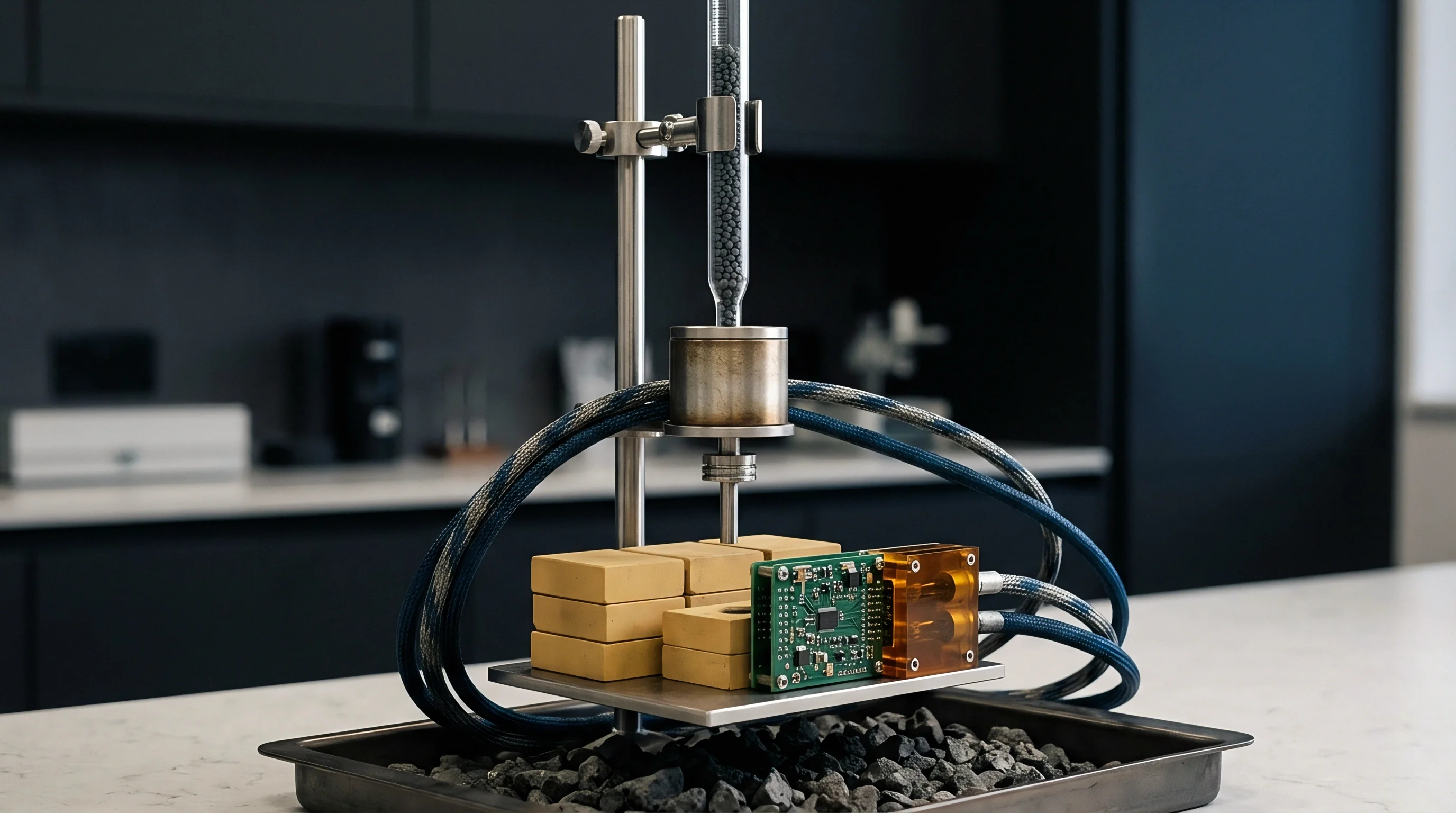
Kinetics
Organic solvent dissolution rates of cross-linked polymers depend on thermodynamic temperature gradients and mass transfer coefficients. When target analytes such as polybrominated diphenyl ethers, phthalates, or halogenated flame retardants reside inside dense epoxy matrices or solder masks, solvent penetration determines extraction efficiency. Static Soxhlet extraction, ultrasonic fluid agitation, and microwave-assisted extraction deploy different energy levels into the sample matrix, yielding distinct analyte release rates over time.
Solvents select compounds. Tetrahydrofuran swells rigid polyimide and epoxy networks, exposing trapped organic compounds to the liquid phase. Toluene and hexane mixtures target non-polar analytes without dissolving the entire thermoset substrate.
Standard recovery evaluations inject a known quantity of target analyte into an unspiked sample matrix or surrogate media. Recovery calculations compare the extracted analyte mass against the spiked addition. Incomplete polymer swelling leaves target molecules encapsulated, dropping standard recoveries below seventy percent in dense substrates.
| Solvent System | Target Analyte | Substrate Material | Extraction Method | Mean Recovery Range | Variance Factor |
|---|---|---|---|---|---|
| Tetrahydrofuran | Di(2-ethylhexyl) phthalate | Flexible PCB Polyimide | Soxhlet 16 Hours | 92% to 104% | Solvent purity grade |
| Hexane and Acetone (1:1) | Dibutyl Phthalate | Solder Mask Epoxy | Ultrasonic 60 Min | 74% to 88% | Acoustic energy density |
| Toluene | Polybrominated Biphenyls | FR-4 Epoxy Glass | Microwave Assisted | 88% to 98% | Thermal ramp rate |
| Isopropanol | Halogenated Ions | Molded IC Package | Reflux 120 Min | 68% to 82% | Particle surface area |
Acoustic cavitation in ultrasonic baths generates localized temperature spikes that accelerate mass transfer across the solid-liquid boundary. Power density attenuation across the fluid tank produces uneven extraction profiles when sample vials sit in acoustic dead zones. Microwave-assisted extraction elevates solvent temperatures above atmospheric boiling points inside sealed vessel systems.
Elevated temperature increases internal pore diffusion while accelerating matrix breakdown. Thermal stress degrades polymers. Prolonged heating causes thermal degradation of labile analytes, turning intact target compounds into unmeasured degradation fragments.
A third-party testing facility routinely attributes low standard recoveries to unpredictable polymer cross-linking that prevents solvent ingress.

Grain
Physical size reduction converts solid circuit board components into uniform powders to maximize total liquid interface area. Extraction efficiency scales with the inverse of particle diameter because diffusion path lengths shorten as particle radius decreases. Mechanical comminution techniques introduce significant analytical variance across testing sites depending on the chosen grinding mechanism and temperature control.
Cryogenic impact milling uses liquid nitrogen to freeze polymers below their glass transition temperature prior to mechanical impact. Brittle fracture under cryogenic conditions produces spherical particles with narrow size distributions. Room-temperature rotor grinding cuts ductile polymers into irregular, fibrous ribbons.
These fibrous particles pack tightly inside extraction thimbles, creating preferential solvent channelling that leaves central core regions unextracted.
Finer sample grinding reduces extraction residence time but increases analyte thermal loss risks during preparation.
Sieve sizing isolates target particle fractions between designated mesh apertures. Sieve fractions passing two hundred fifty micrometers achieve rapid dissolution kinetics compared to one-millimeter granules. Friction generated during dry mechanical milling elevates cutter head temperatures above eighty degrees Celsius.
Heat-sensitive target analytes undergo volatilization or thermal decomposition before solvent immersion occurs.
Milling generates friction heat. Particle size governs speed. Matrices trap target ions.

Sample Comminution Failure Mechanisms
- Cryogenic embrittlement failure occurs when elastic polymers retain flexibility at inadequate freezing temperatures, resulting in torn ribbons rather than fine particles.
- Thermal analyte volatilization happens when uncooled rotor mills exceed sixty degrees Celsius, vaporizing low-molecular-weight target compounds during processing.
- Sieve mesh contamination develops when soft solder mask particles smear across stainless steel filter apertures, altering subsequent particle size fractions.
- Electrostatic powder segregation manifests when fine ground particles adhere to mill chamber walls, systematically stripping specific material phases from the analyzed bulk.
Non-uniform particle preparation causes thirty percent yield swings between laboratories, generating false non-compliance declarations that trigger full shipment rejections at import customs.

Instrument
Gas chromatography coupled with mass spectrometry separates extracted organic analytes through capillary column partition coefficients. Quantification precision depends on clean baseline separation and stable ion source ionization. Dissolution extracts from electronic hardware carry non-volatile oligomers, plasticizer additives, and flame retardants into the injection port.
Deposited matrix residues inside the inlet liner adsorb target analytes, reducing the active fraction reaching the separation column.
Calibration defines lower bounds. Standard additions resolve interference.
Why Does Extraction Temperature Shift Inter-Laboratory Recovery Ratios?
Elevated extraction temperatures accelerate solvent diffusion kinetics through dense polymer matrices while simultaneously increasing the co-extraction of high-molecular-weight oligomers. Laboratories employing microwave vessels at one hundred thirty degrees Celsius extract greater total matrix mass alongside the target analyte than laboratories operating Soxhlet systems at sixty-nine degrees Celsius. These co-extracted oligomers deposit inside gas chromatography injection liners and mass spectrometer ion sources.
Matrix suppression reduces target ion yield, altering the measured signal intensity relative to pure calibration standards and creating divergence between testing facilities.
A fifteen percent recovery suppression occurs when co-extracted solder mask oligomers enter the mass spectrometer source at ion source temperatures below two hundred thirty degrees Celsius.
Internal standards correct for injection volume variations and systemic instrument drift. Deuterated internal standards match the chemical properties of target compounds, tracking signal suppression caused by matrix co-extractives. Non-deuterated surrogate standards fail to mirror target ionization changes inside contaminated source chambers, causing systematic calculation bias in reported concentrations.
- Divide the homogenized sample extract into four identical volumetric aliquots within auto-sampler vials.
- Add known, increasing concentrations of certified reference material solution to three of the vials while leaving the first unspiked.
- Inject each aliquot into the chromatographic column under identical operating pressure and thermal ramp parameters.
- Plot peak area responses against added concentration values to construct a linear regression line intersecting the concentration axis.
- Calculate the true sample concentration by evaluating the absolute value of the horizontal intercept.
The degree to which ion source contamination during high-throughput screening skews isotope dilution ratios remains a subject of ongoing laboratory investigation.

Dispersion
Statistical evaluation of inter-laboratory analytical variance relies on ISO 5725 precision parameters to separate measurement uncertainty from material batch heterogeneity. Method repeatability represents variability observed under identical conditions within a single facility over short intervals. Method reproducibility measures dispersion across different facilities, operators, equipment sets, and reagent lots.
Reproducibility variance consistently exceeds repeatability variance across all chemical extraction methods.
The Horwitz function predicts expected inter-laboratory relative standard deviation based on target analyte concentration. The Horwitz ratio compares experimental reproducibility relative standard deviation against this predicted threshold. HorRat values between zero point five and two point zero confirm acceptable inter-laboratory analytical performance.
HorRat values exceeding two point zero highlight severe analytical instability caused by method ambiguity or uncalibrated extraction parameters.
Consider an evaluation of di(2-ethylhexyl) phthalate extracted from a polyimide flexible circuit board. The true target concentration equals one hundred milligrams per kilogram. Laboratory A measures eighty-two milligrams per kilogram using high-power ultrasonic baths.
Laboratory B measures one hundred eighteen milligrams per kilogram using overnight Soxhlet reflux. Intra-laboratory repeatability standard deviation measures four point two percent. Inter-laboratory reproducibility standard deviation measures fourteen point eight percent.
Expanded measurement uncertainty calculated with a coverage factor of two reaches twenty-nine point six percent. The resulting measurement spread overlaps the target value while creating conflicting compliance calls between the two facilities.
Clause six point three of ISO 17025 dictates that invalid calibration curves invalidate all associated sample recovery calculations, forcing a complete re-extraction of the affected analytical batch.
Reproducibility bounds lab spread. Errors multiply across steps.
| Analyte Class | Concentration Range | Repeatability CV | Reproducibility CV | HorRat Value |
|---|---|---|---|---|
| Polybrominated Biphenyls | 100 to 1000 mg/kg | 3.8% | 11.2% | 1.15 |
| Phthalate Esters | 500 to 1000 mg/kg | 5.1% | 14.6% | 1.42 |
| Hexavalent Chromium | 10 to 100 mg/kg | 8.4% | 22.3% | 1.88 |
| Total Halogens | 200 to 800 mg/kg | 4.2% | 12.8% | 1.26 |
| Data evaluated across twenty-four accredited test facilities using standardized reference materials per IEC 62321 round-robin trials. | ||||

Conformity File Verification Criteria
- Homogeneity confirmation certificate documents that sample sub-lot variance remained below five percent of the target standard deviation prior to inter-laboratory distribution.
- Surrogate recovery logs state the exact numerical percentage of isotopic internal standard recovered from every individual sample vial.
- Method blank chromatograms prove that solvent reagents introduced zero background interference at the target analyte retention times.
- Calibration linearity data demonstrates a coefficient of determination exceeding zero point nine nine five across the working analytical range.
Section four of IEC 62321-1 stipulates that when inter-laboratory test results differ by more than the published reproducibility limit R, both testing bodies shall perform joint re-testing using a shared certified reference material.

Guardband
Boundary conditions for commercial batch release require decision rules that incorporate expanded measurement uncertainty into target regulatory thresholds. Simple acceptance rules pass materials when the measured value falls below the legal concentration ceiling, disregarding analytical measurement uncertainty. This approach assigns fifty percent probability of false acceptance when a measured value sits exactly at the specification limit.
Guardbanded decision rules subtract expanded uncertainty from the regulatory limit to establish a strict operational acceptance threshold.
Uncertainty shifts commercial liability. Guardbands absorb variance. Recovery shifts alter compliance.
Under a maximum restriction threshold of one thousand milligrams per kilogram for phthalates under RoHS regulations, an expanded uncertainty of fifteen percent requires an operational guardband limit of eight hundred sixty-nine milligrams per kilogram. A measured result of nine hundred twenty milligrams per kilogram achieves simple acceptance but fails guardbanded compliance verification. Setting internal limits without guardbands exposes importers to border enforcement rejections when market surveillance laboratories re-test incoming hardware using different extraction methods.
| Decision Rule | Uncertainty Multiplier | Effective Pass Limit | Commercial Allocation |
|---|---|---|---|
| Simple Acceptance | 0.0 x Expanded Uncertainty | 1000 mg/kg | Maximum consumer risk |
| Guardbanded 95% Confidence | 1.0 x Expanded Uncertainty | 850 mg/kg | Balanced risk share |
| Guardbanded 99% Confidence | 1.65 x Expanded Uncertainty | 752 mg/kg | Maximum producer risk |
| Recovery Corrected Pass | Normalized to 100% Recovery | Dynamic formula limit | Analytical adjustment model |
Standard recovery correction factors adjust raw instrument readings by dividing measured analyte concentrations by the fractional recovery of matrix spikes. A sample yielding eight hundred milligrams per kilogram with an eighty percent standard recovery adjusts to an calculated actual concentration of one thousand milligrams per kilogram. Applying unvalidated recovery corrections amplifies measurement uncertainty when the recovery factor itself carries high variance across test runs.
Acceptance limits set without accounting for laboratory variance shift latent non-compliance risk entirely onto the importing buyer.
Analytical recovery windows bounded between eighty and one hundred twenty percent protect buyers from systematic extraction underestimation without forcing unnecessary batch rejections.