Statistical Customs Sampling Mechanics against Laboratory Testing Standards
Align factory pre-shipment sampling with destructive customs laboratory thresholds to prevent border detentions, demurrage costs, and lot seizures.


Intake
Border authorities inspect imported electrical subassemblies using sampling plans that run on fundamentally different statistical assumptions than internal plant release gates. Customs officers clearing freight through a port terminal are not auditing goods against a vendor’s quality agreement. They enforce statutory market-surveillance rules intended to catch unsafe or non-compliant hardware at the frontier, relying on rapid attribute screening to police regulatory baselines rather than verifying process capability.
The operating characteristic curves of the two regimes barely resemble one another. Factory acceptance testing generally runs on ANSI/ASQ Z1.4 or ISO 2859-1 attribute sampling pegged to an acceptable quality limit, commonly 0.4 percent to 1.5 percent on populated circuit boards. A border agency working under an escalated enforcement mandate might apply an indifference quality level or a limiting quality ratio well above 8 percent.
The statutory objective is catching non-compliance in the lane, not protecting manufacturer yield.
Under ISO 2859-1 single sampling, normal inspection level II with code letter L evaluates 200 units from a 10,000-unit lot to reject on seven defectives at an acceptable quality limit of 1.5 percent.
The practical result is immediate commercial friction. When an ocean container is diverted to a bonded examination station, demurrage and chassis detention accumulate daily while specimens travel to a designated state laboratory. The holding charges often overtake the testing invoice within two weeks.
Customs protocols also pull far fewer units than factory plans: an agency often takes only three to five units for destructive safety testing, treating a single failed specimen as legal justification to hold or seize the entire bill of lading.
There is no averaging across lots or coupons under statutory rules. If customs pulls power supplies or assembled boards under a given tariff heading, the bench simply checks whether the hardware breaches safety thresholds or restricted substance caps. If one unit out of three breaks down under an overvoltage surge test, administrative rules treat the entire consignment as non-compliant.
Plant quality managers accustomed to an acceptable escape rate of 0.2 percent are frequently unprepared for that math: an escape rate that is defensible on a factory floor can trigger a total administrative seizure at the pier.
All secondary handling, custody logging, bond adjustments, and legal petitions triggered by that single failure fall entirely on the importer of record.

Allocation
Border authorities assign physical examinations through automated targeting engines that weigh importer compliance history, tariff volatility, and country of origin. Systems like the Automated Targeting System in the United States and cargo risk modules across the European Union scan manifest data against commodity classifications to flag entries. High-risk profiles trigger mandatory dockside holds, stripping containers out of the terminal flow before freight can enter domestic distribution.
Targeting Mechanics across Border Profiles
These engines generate composite risk scores for every arrival. Declared unit values that wander outside historical ranges for a Harmonized System subheading routinely trigger automated flags. Populated circuit assemblies draw scrutiny when documentation omits full manufacturer identification codes, or when manifests route through transshipment hubs linked to grey-market diversion.
Depending on the score, an entry routes to immediate paperless release, documentary review, full devanning, or off-site laboratory extraction.
Physical pulls occur inside bonded facilities under strict statutory custody. Officers strip cartons across the container cube, logging seal numbers and serial allocations. Operating guidelines typically require pulling from at least three pallet locations ~ taking cartons from top, center, and bottom tiers to counter deliberate packing bias.
Once pulled, the hardware is sealed into an evidentiary chain of custody that segregates it from commercial inventory, ensuring no substitutions occur on the way to the analytical bench.
| Regime Type | Standard Reference | Inspection Level | Nominal Sample Size | Acceptance Criteria |
|---|---|---|---|---|
| Customs Surveillance Screening | WCO Safe Framework | Targeted Non-Random | 5 to 13 units | Zero defects allowed |
| Statutory Safety Extraction | ISO 17025 Regulatory Protocol | Selected Risk Cohort | 3 to 8 units | Zero non-compliances |
| Internal Quality Gate | ANSI/ASQ Z1.4 Normal II | Lot Size Dependent | 125 to 315 units | Accept on 5, Reject on 6 |
| Supplier Pre-Shipment Audit | ISO 2859-1 Tightened | Escalated Sampling | 200 to 500 units | Accept on 2, Reject on 3 |

Preserving Chain of Custody
Custody rules dictate how extracted subassemblies move from the examination dock to the test bench. Officers seal samples in tamper-evident barrier bags marked with official seals, tracking numbers, entry dates, and tariff classifications. The transfer log must remain unbroken.
A gap in seal records or sign-offs compromises the legal validity of subsequent test results, often serving as the primary basis for petitioning against an improper detention or seizure.
Receiving staff at the analytical laboratory check inbound parcels against the customs transit manifest, verifying intact tamper seals and package serials before logging samples into their laboratory information management system. This unbroken tracking ties destructive test records directly back to the commercial customs entry, maintaining the evidentiary link required for administrative forfeiture hearings.
Factory warranties stay frozen while assemblies sit in regulatory custody, leaving the buyer to absorb carrying costs on immobilized inventory.


Bench
Accredited laboratories test customs samples across electrical, thermal, and chemical dimensions to verify statutory conformity. Operating under ISO/IEC 17025 accreditation, these facilities run calibrated test chambers that remove ambient environmental variables. When imported assemblies arrive on the bench, technicians evaluate them against market-access standards, completely ignoring the manufacturer’s internal build prints.

Destructive Environmental Screening
Physical safety protocols subject hardware to dielectric overstress, mechanical shock, and flammability testing. Technicians run high-voltage isolation checks between primary and secondary circuits under IEC 62368-1, measuring PCB creepage and clearance distances directly. Enclosures undergo glow-wire testing per IEC 60695-2-11, where technicians monitor flame spread and molten dripping; failing to self-extinguish within the required timeframe triggers an immediate non-compliance notice.
A laboratory applying IEC 62368-1 insulation resistance testing exposes isolation barriers to 3,000 volts alternating current for 60 seconds without permitting dielectric breakdown.
Thermal chambers then cycle board assemblies between temperature extremes under IEC 60068-2-14 while technicians monitor operating continuity. Thermal expansion mismatches between FR4 laminate and ceramic chip packages quickly stress marginal solder fillets, revealing micro-voids or poor wetting that passed the factory’s brief end-of-line functional check.

How Do Chemical Bench Tests Contradict Factory Declarations?
Chemical screening breaks subassemblies down to homogeneous materials to check compliance with substance caps like those in the European Union RoHS Directive. While factories routinely rely on supplier declarations and certificates of conformity, government laboratories mill boards, dissolve resins, and crush passives for direct spectroscopic analysis. Declarations carry zero weight against analytical findings.
- Energy dispersive X-ray fluorescence screening offers rapid elemental identification, screening for lead, mercury, and cadmium on termination finishes, passive components, and IC leadframes.
- Inductively coupled plasma atomic emission spectroscopy digests component resins in acid, measuring heavy metals down to detection limits below one part per million against statutory limits.
- Gas chromatography mass spectrometry isolates phthalate plasticizers from wire jackets and molded connectors, checking diisobutyl phthalate and dibutyl phthalate levels against the 1,000 parts per million regulatory ceiling.
- Ion chromatography maps halogen content in post-reflow flux residues and raw base laminate, catching ionic contamination capable of growing conductive dendrites under bias.
Bench testing regularly turns up restricted substances in lots accompanied by clean supplier paperwork. Independent component distributors occasionally ship reels containing banned brominated flame retardants or leaded termination finishes. Because border enforcement treats the importer under strict liability, a pristine folder of vendor declarations does not defend against an analytical test showing 1,200 parts per million lead on a surface-mount termination.
Standard purchase-order representations asserting regulatory compliance offer zero protection once analytical chemistry demonstrates a breach.


Friction
Contradictions between factory certificates and customs lab results cause immediate deadlocks. Manufacturers run acceptance tests on optimized coupons designed to isolate process variables under ideal conditions. Customs laboratories, by contrast, saw directly into functional production assemblies pulled at random from shipping containers.
This difference in sample provenance is usually why lots with clean factory paperwork fail at the port.
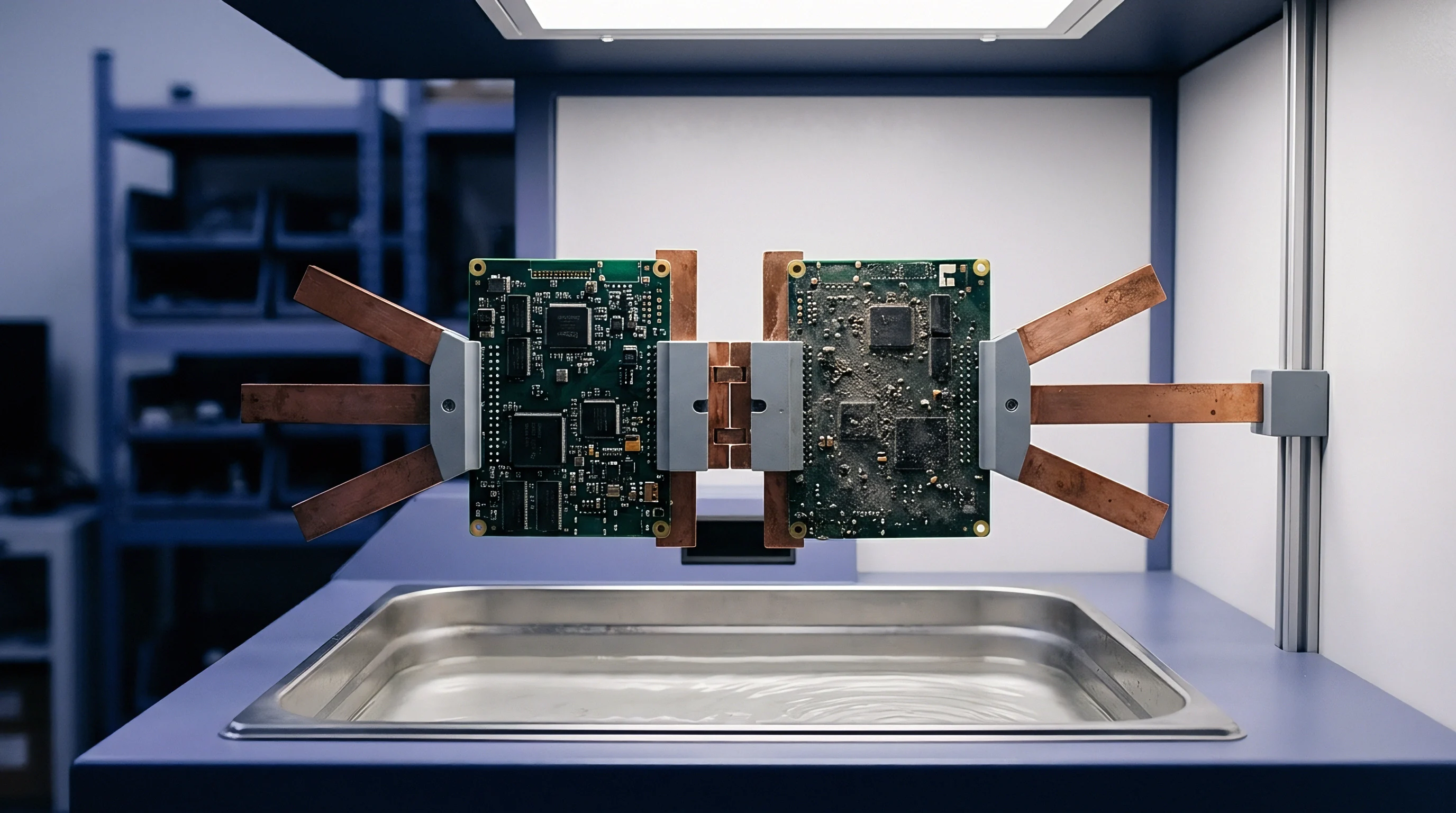
Coupons versus Finished Assemblies
Test coupons leave a persistent blind spot. Coupons positioned along panel breakaways verify through-hole copper plating thickness, layer registration, and dielectric separation under predictable thermal conditions. Yet these perimeter tabs bypass the heavy thermal mass gradients, flux outgassing pockets, and package shadowing found in the center of dense boards during reflow.
Customs technicians section the actual hardware, uncovering through-hole barrel cracks and voiding tucked under large ball grid arrays that coupon coupons never experience.
Guard-banding rules widen this rift. An accredited customs laboratory operates under ISO/IEC Guide 98-4 decision rules. Where a restricted substance ceiling is 1,000 parts per million and the lab’s expanded measurement uncertainty is 50 parts per million, a sample reading 960 parts per million can be failed outright if the enforcement mandate requires guard-banding against false acceptances.
The manufacturing plant, applying simple binary acceptance, records that same 960 parts per million as compliant.
| Evaluation Domain | Factory Control Method | Customs Laboratory Method | Decision Boundary Conflict |
|---|---|---|---|
| Plating Solderability | IPC J-STD-003 Dip and Look | Wetting Balance Analysis | Subjective visual rating versus quantitative dynamic wetting force curves |
| Dielectric Withstand | Fast 1-second production surge | Sustained 60-second dwell test | Transient leakage tolerated versus sustained dielectric breakdown detected |
| Flame Retardance | Raw resin manufacturer datasheet | Finished product needle flame test | Resin coupon rating invalidated by additive migration and flux residues |
| Trace Element Limits | Supplier composite declarations | Selective acid digestion ICP-OES | Averaged whole-assembly values versus strict homogeneous material thresholds |
Factory test certificates document conformity against internal purchase specifications, while customs enforcement assesses goods under independent statutory benchmarks.
Exposure
A customs rejection damages capital allocation, logistics budgets, and assembly continuity all at once. Once a laboratory issues an adverse finding, customs serves a notice of redelivery or notice of intent to seize. The importer cannot simply walk away; trade statutes require the company to export the cargo under customs bond, remediate the defect if permitted, or forfeit the lot for supervised destruction at the importer’s expense.

Logistics and Regulatory Penalties
Carrying charges multiply during administrative delays. A container held at an off-dock examination station or freight station incurs daily detention and demurrage fees ranging from 150 to 450 dollars. Over sixty days of procedural review, yard fees easily outstrip the invoice value of the electronics inside.
Simultaneously, continuous bond underwriters take notice; sureties frequently demand full cash collateral or cancel coverage entirely, freezing all pending entries.
- Issuance of formal seizure notice freezes cargo title, initiating strict administrative deadlines for filing petitions, posting supplemental collateral, and retaining customs counsel.
- Bond demand escalation compels the importer of record to secure single-transaction bonds set at up to three times the entered domestic value of the merchandise.
- Mandatory destruction or re-exportation imposes strict compliance deadlines under bonded cartage, leaving all freight, warehousing, and disposal costs with the buyer.
- Civil penalty assessment triggers standalone fines under statutory penalty provisions, assessed on the domestic value of the goods or multiples of duty.
Production downstream grinds to a halt. A contract manufacturer operating on tight production windows faces assembly shutdowns when an incoming batch of motor controller boards is impounded. Customer delivery penalties mount immediately.
Sourcing substitute assemblies from domestic brokers at spot prices wipes out product margin, leaving the business carrying heavy operational losses while the administrative petition crawls forward.
A contract clause permitting the buyer to deduct demurrage, test fees, and regulatory penalties directly from outstanding supplier invoices reallocates border failure risk.
Administrative appeals routinely take eighteen months to resolve technical disputes. Even when an importer establishes that the laboratory used improper test procedures, terminal demurrage and warehousing costs cannot be recovered from the government. The impounded hardware languishes in unconditioned bonded warehouses, where humidity and thermal fluctuations degrade moisture-sensitive packaging, ruining the components long before a release order is granted.
A port rejection turns usable hardware into a balance-sheet write-off, while legal penalties and disposal obligations remain fully enforceable.


Remedy
Controlling port-of-entry exposure requires rewriting procurement agreements so factory acceptance standards mirror statutory inspection protocols. Boilerplate warranties and standard factory acceptance test sheets provide no shield at the border. Master service agreements must stipulate that pre-shipment releases run on the same small-lot, destructive, homogeneous-material tests applied by government laboratories.

Contractual Test Alignment
Purchase orders need to define limiting quality criteria alongside traditional acceptable quality limits. Contracts should oblige the factory to draw samples directly from finished production runs for destructive analysis at an independent ISO/IEC 17025 test house before issuing shipping releases. Certified test packets should be linked to the manifest and commercial invoice prior to vessel departure, creating an evidentiary file before the container ever hits the terminal.
Adopting zero-defect thresholds for environmental and safety markers prevents border holds. While manufacturing plants rely on ANSI/ASQ Z1.4 sampling to manage general yields, regulatory parameters demand an isolated testing track. Any breakdown during pre-shipment dielectric or spectroscopic checks must automatically hold container loading and trigger engineering review before freight leaves the factory gate.
Third-party pre-shipment audits provide an essential cross-check. Importers can retain independent inspectors to sample finished cartons at the packing facility using random devanning rules. Inspectors draw hardware from sealed export packaging, apply serial-matched tamper seals, and dispatch specimens directly to certified laboratories.
That process produces defensible data that eliminates reliance on vendor self-certifications.
Effective purchase agreements back these requirements with direct indemnity mechanisms. Contracts should state clearly that suppliers assume all port demurrage, laboratory re-testing fees, legal expenses, and disposal charges if cargo fails statutory testing. Tying border liability directly to vendor payment terms gives suppliers a concrete incentive to police their own bill of materials, insulating the buyer from regulatory penalties and inventory stranding.
Whether customs administrations will ever reconcile their surveillance mechanics with factory-level statistical process controls remains an open question for international trade bodies.