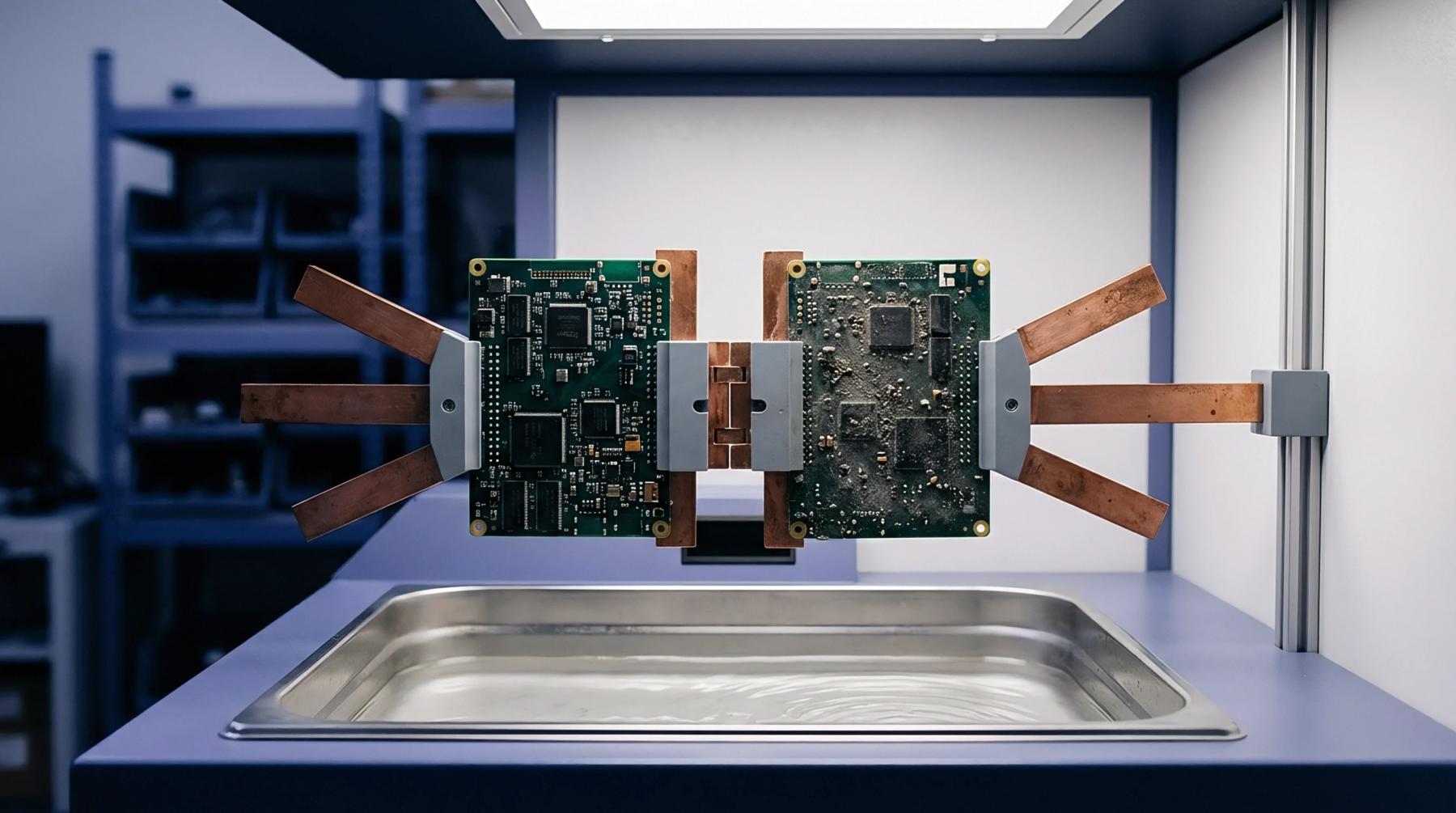
Thermal Uniformity Profile
Fluctuations in surface temperature across a heated workbench or press table degrade the consistency of multi-layer bond cycles during lamination. Platen thermal variation occurs when localized heating elements or cooling channels fail to maintain an isothermal state across the entire area of the tool surface. Differences in heat transfer capability between the center and the edges of the platen drive these gradients, often resulting in uneven resin flow or incomplete curing in specific regions of the laminated stack.
Designers minimize these effects by implementing high-conductivity alloys and redundant thermocouple arrays to monitor the heat distribution.
Process Influence Factor
Non-uniform heat distribution disrupts the chemical reaction rate of prepreg materials during the pressure cycle. If the platen exhibits cooler zones, the viscosity of the epoxy resin remains higher for longer, preventing the material from fully filling the voids in the circuit pattern. Conversely, areas that exceed target temperatures cause over-curing, which embrittles the bond and risks latent delamination during subsequent thermal stress in assembly.
Technicians verify the integrity of the setup using surface contact pyrometers or infrared imaging tools to confirm that the delta between the hottest and coldest points stays within the operational tolerance for the specific material stack-up.
Mechanical Constraint Boundary
Rigid thermal management represents a permanent limitation of the hydraulic press architecture rather than a variable adjustment for individual production lots. Mechanical constraints such as channel geometry and the placement of heating cartridges dictate the inherent distribution curve of the machine. Operators adjust the cycle duration or the clamping force to compensate for the recorded gradient, although these changes do not rectify the underlying thermal asymmetry.
Total elimination of variance remains physically impossible due to environmental heat loss at the edges of the tool, ensuring that spatial temperature divergence acts as a fixed parameter in every manufacturing protocol.