Rheological Behavior
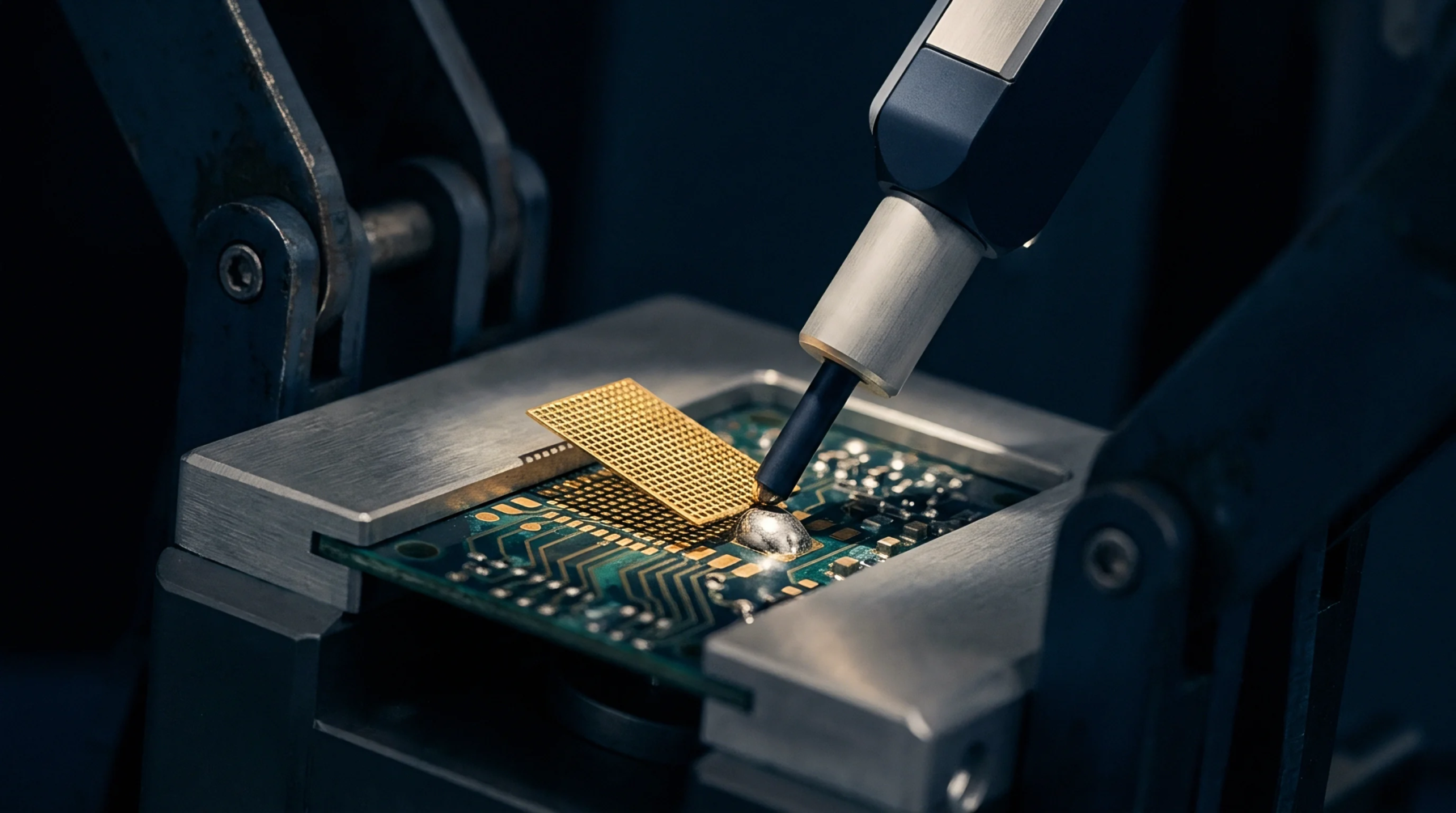
Time-dependent mechanical rebound exhibited by solder paste following intense high-shear deformation during the squeegee printing sweep governs post-print deposit shape and stability. In surface mount printing, viscoelastic recovery defines the rate at which paste transitions from a fluid state during squeegee shear back into a cohesive, non-flowing structure upon the copper pad. Proper recovery prevents slump, which causes bridging between closely spaced lands, while allowing the paste to fill apertures during blade travel.
The property is purely a rheological performance characteristic of the formulated solder paste under shear stress.
Shear Mechanics
Solder paste contains vehicle solvents, thixotropic agents, activator resins, and metal spheres that form a dynamic physical network. When the squeegee blade drives paste across the stencil foil, intense shear thinning breaks down internal intermolecular associations, lowering paste viscosity to facilitate smooth aperture filling. Once paste releases onto the pad surface, the mechanical shear force drops to zero instantly.
The paste must quickly regain structural stiffness through viscoelastic recovery to support its own vertical walls before entering the reflow oven. If recovery is too slow, gravitational forces cause deposit slump, spreading paste into adjacent soldermask spaces. If recovery occurs too rapidly, the paste resists clean detachment from aperture walls, reducing transfer volume and causing pad starvation.
Measurement Boundary
Rheometer testing applies oscillatory shear sequences to paste samples to quantify elastic storage modulus and loss modulus recovery curves over defined time windows. Production lines monitor deposit profiles using automated solder paste inspection, identifying edge breakdown and height loss resulting from insufficient structural recovery. Elevated ambient temperatures on the factory floor slow down this rebound, rendering the assembly vulnerable to print slump and subsequent solder bridging.
Component placement also tests this material property, as parts pressed into paste deposits must not cause excessive lateral displacement. Viscoelastic recovery governs paste retention limits during the temporal gap between stencil printing, component placement, and initial reflow heating.