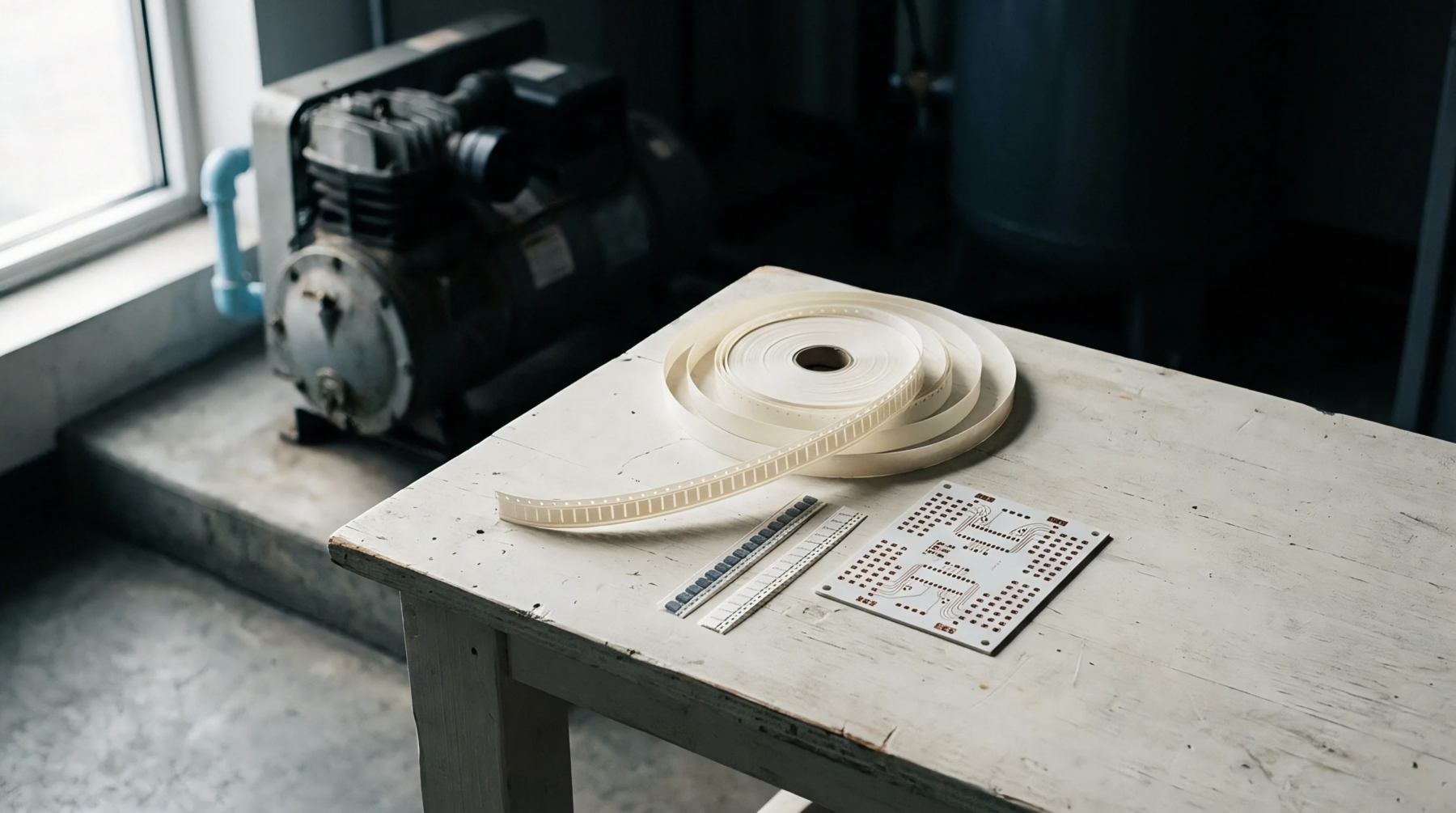
Measurement Instrument
Sensor arrays bonded to printed circuit board laminates are used to measure multidirectional deformation during mechanical stress testing. A configuration known as a strain rosette consists of three closely spaced strain gauges oriented at specific angles to capture the complete surface strain state. It enables the calculation of both principal strains and their orientation on the board surface.
Strain Calculation
Complex mechanical loads produce stresses that do not align with the coordinate axes of the board. Individual strain gauges can only resolve deformation along a single axis, which leaves the true maximum stress unknown. Utilizing a strain rosette provides the three independent strain measurements required to solve the transformation equations for a two-dimensional strain field.
These calculated principal strains are compared directly against the maximum allowable thresholds for laminate pad cratering.
Board Testing
Mechanical assembly steps such as board routing, connector insertion, and test fixture clamping generate high localized strains. During these operations, a strain rosette is bonded adjacent to sensitive components like ball grid array packages to monitor real-time mechanical stress. This testing prevents micro-cracking in solder joints before the board enters service.
If the measured strain exceeds limits, the assembly fixture is modified or the machine speed is adjusted to protect the board. By recording the strain levels throughout each process step, production engineers identify exactly which tool is causing dangerous deflection and resolve the issue before high-volume runs.