Deformation Profile
Temperature variations during assembly cause dissimilar materials to expand and contract at different rates, creating physical stresses. The thermomechanical strain represents the resulting deformation experienced by solder joints and copper traces due to this thermal mismatch. Engineers calculate this parameter to estimate the mechanical fatigue life of the electronic interconnects.
Solder Failure
During solder reflow and subsequent thermal cycling, the differences in expansion between the FR4 laminate and the silicon component create concentrated forces. This thermomechanical strain accumulates mostly in the corner solder balls of ball grid arrays. Microscopic cracking begins at these high-stress points and eventually propagates through the connection.
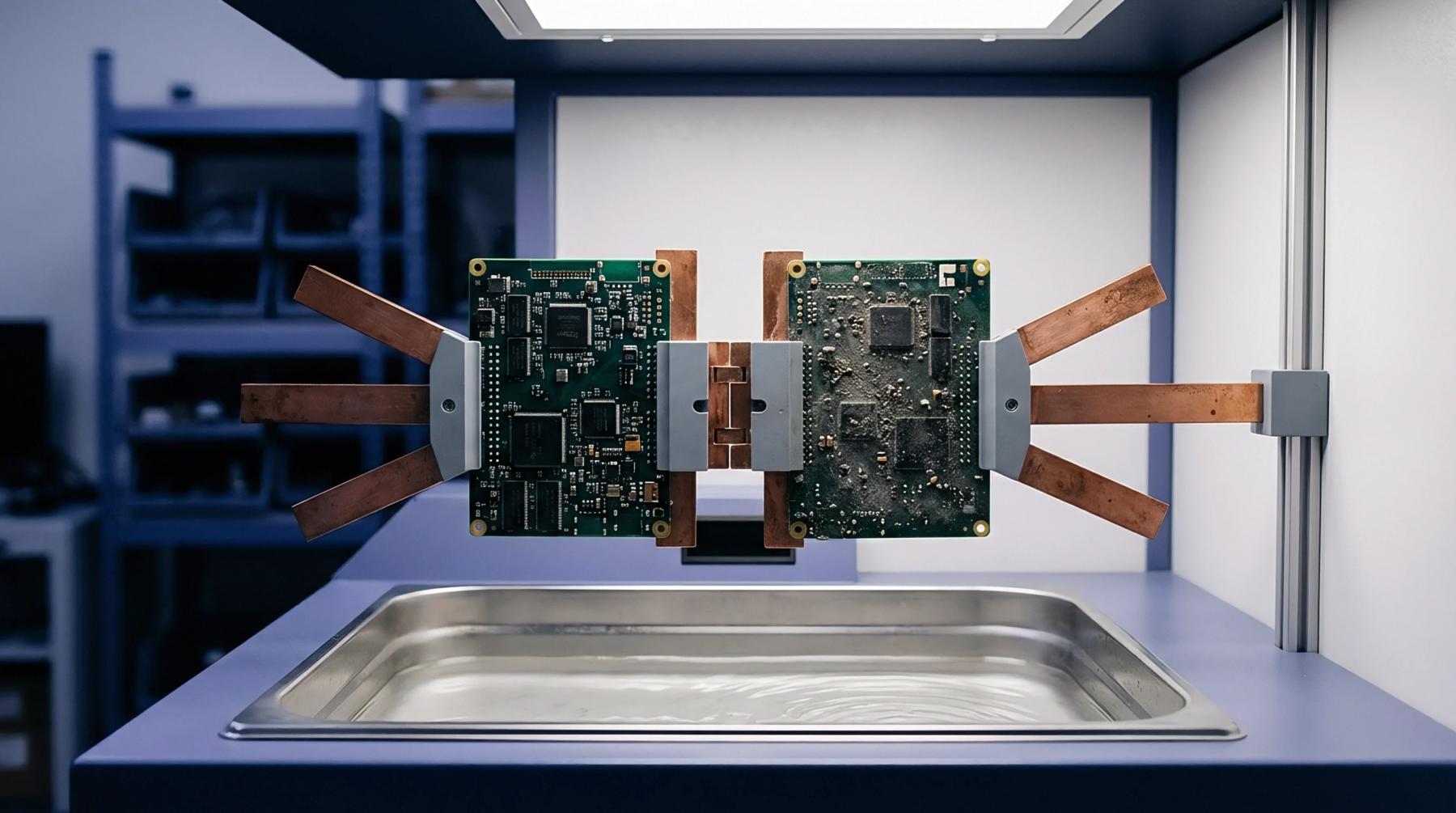
Automated industrial testing using thermal chambers allows technicians to monitor resistance changes to find when failure occurs.
Fatigue Mitigation
Mitigating this structural deformation requires selecting materials with closely matched coefficients of thermal expansion. Underfill resins are applied beneath large components to distribute the thermomechanical strain across a broader area. This reinforcement reduces the localized force on individual solder joints by locking the component to the board.
Laboratory testing of finished assemblies using thermal shock profiles confirms that the reinforcement is effective. If the assemblies pass the specified cycle count without showing trace resistance rises, they are cleared for field deployment.