Thermal Stress Protocol
Electrochemical migration evaluation involves subjecting printed board assemblies to specific high humidity and electrical bias conditions to quantify the propensity for metallic dendrite growth across insulating gaps. The ipc-tm-650 2.6.7.2 methodology triggers this phenomenon by placing test coupons into a climate-controlled chamber at eighty-five degrees Celsius and eighty-five percent relative humidity while applying a continuous direct current voltage. Failure occurs when internal electrical resistance drops below the specified megohm threshold due to the formation of conductive paths between copper features.
Insulation resistance measurement provides the primary quantitative output for this verification cycle.
Assessment Sequence
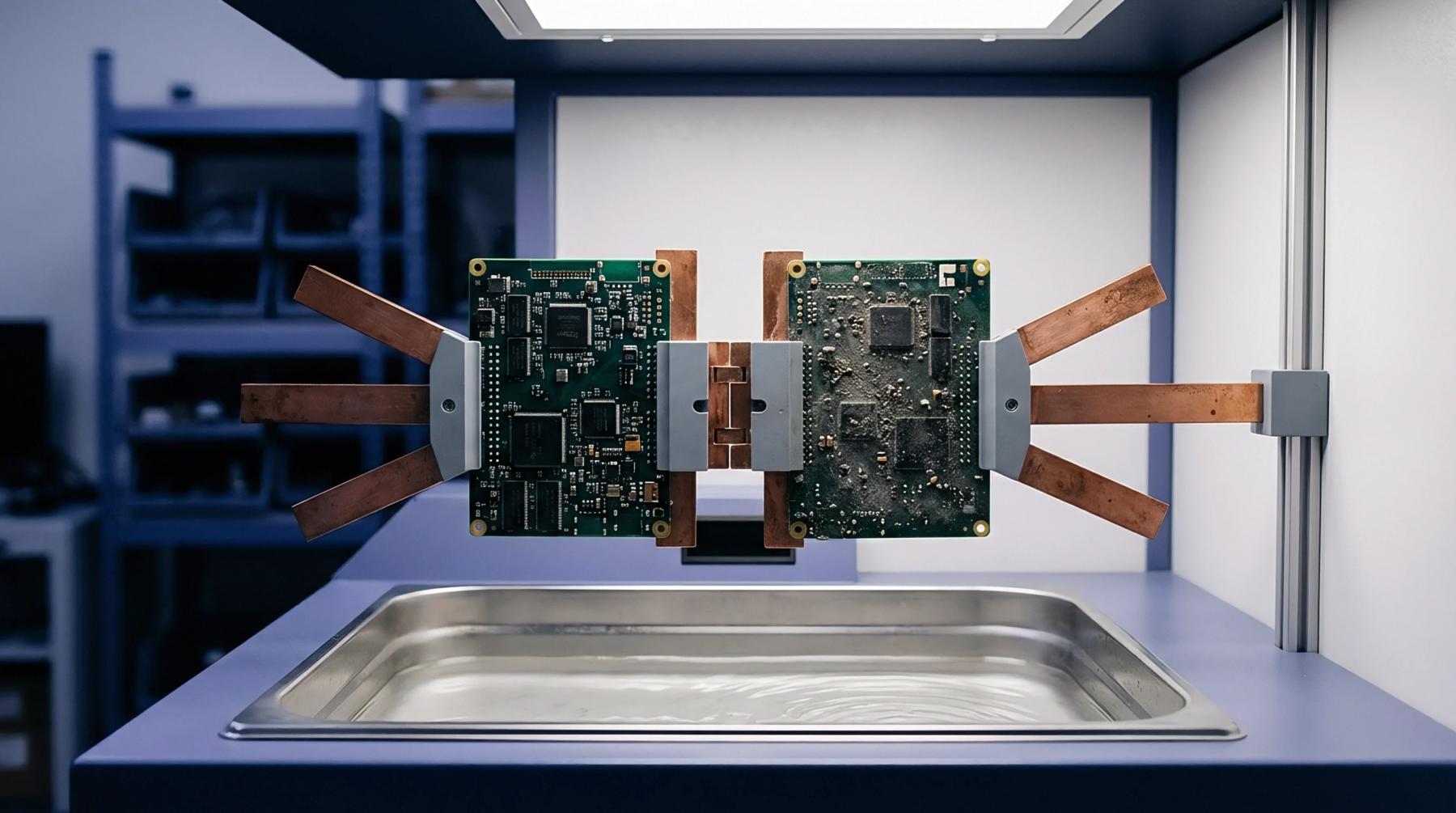
Engineers initiate the procedure by cleaning and baking coupons to remove surface moisture before attaching monitoring leads to the board surface. Data loggers record leakage current at intervals during the ninety-six hour exposure period to track the degradation of dielectric materials. Small fluctuations in current often indicate the beginning of electrochemical processes that might lead to permanent shorts.
Constant voltage monitoring ensures that the bias remains stable throughout the testing interval because voltage drops affect the rate of dendrite extension. Operators verify that the test setup maintains electrical continuity across all measured channels since any open circuit yields invalid data. The chamber logic adjusts airflow to prevent stagnant pockets of moisture from skewing the results at localized points on the assembly surface.
Voltage Boundary
Dielectric withstand capability dictates the maximum potential applied to the copper circuitry during these humidity exposure tests. Excess bias forces ion migration through the polymer matrix of the substrate more rapidly than service conditions demand. Precise control over this variable prevents artificial failures that do not correspond to actual field performance or end-use environment constraints.
Testing parameters prioritize the isolation of material properties rather than the assessment of complex component geometry. This controlled exposure confirms the chemical stability of solder masks and surface finishes when confronted with extreme moisture ingress combined with active electrical fields.