Preserving Solderability across Extended PCB Warehouse Storage Cycles
Preserve warehouse PCB solderability by specifying barrier plating thicknesses and enforcing hermetic moisture barrier packaging with active desiccant.
Oxide
Atmospheric tarnishing degrades copper pads whenever ambient air penetrates warehouse packaging. Exposure to humidity, airborne sulfur, and oxygen triggers solid-state reactions at the board surface at rates determined by the underlying metallurgy, ambient storage conditions, and the chemical finish. Unprotected copper migrates rapidly, forming cuprous oxide within hours of exposure before converting over several weeks into cupric oxide and copper carbonate films that resist standard liquid fluxes during surface-mount assembly.
Immersion tin finishes degrade along two distinct pathways. Ambient oxygen attacks the outer tin shell while copper from the base material diffuses upward into the tin at room temperature. This solid-state diffusion creates intermetallic compounds ~ specifically Cu6Sn5 and Cu3Sn.
As the Cu6Sn5 phase consumes the pure tin layer from the interface outward, these intermetallic crystals eventually reach the surface, where liquid solder cannot dissolve the resulting copper-tin alloy without aggressive acid fluxes that risk leaving corrosive ionic residues.
Immersion silver deposits held below 0.20 micrometers lose solderability within ninety days under Class 2 warehouse atmospheric conditions.
Organic solderability preservative coatings degrade differently during extended warehouse storage. Atmospheric oxidation, thermal evaporation of active azole complexes, and moisture plasticization break down the film, while ambient humidity fuels galvanic corrosion. Once oxygen penetrates this barrier, the underlying copper oxidizes beneath the coating, lifting the film and leaving an unsolderable boundary layer that resists solder paste wetting during convection reflow.
- Intermetallic compound creep consumes the pure tin reservoir through continuous solid-state diffusion until no unreacted solderable metal remains on the pad surface.
- Sulfur gas tarnishing converts immersion silver into insoluble silver sulfide dendrites that resist mild no-clean rosin fluxes.
- Organic film breakdown occurs through long-term desiccation and volatilization of protective triazole polymers in unconditioned storage facilities.
- Galvanic corrosion pitting develops at micro-voids in thin immersion gold platings, allowing underlying nickel to corrode into refractory nickel oxides.
Failing to isolate stored bare boards from ambient sulfur leads to complete assembly lot scrappage once desoldering voids exceed acceptable thresholds.
Barrier
Electroless nickel deposits insulate base copper from overlying finishes. In electroless nickel immersion gold stackups, this nickel layer forms a physical barrier that stops copper from migrating into the solderable gold flash, while the gold shields the nickel against oxidation during storage. When reflow begins, the ultra-thin gold flash dissolves into molten solder within two seconds, exposing the underlying nickel to build a reliable nickel-tin intermetallic bond with the solder alloy.
Will Intermetallic Growth Compromise Solderability during Storage?
Solid-state diffusion proceeds continuously at room temperature across copper-tin boundaries, driving steady intermetallic growth. As copper atoms migrate into the immersion tin, the thickness of solderable pure tin drops with every month in storage at a rate dictated by ambient temperature according to Fick’s laws of diffusion.
Porous plating caused by variations in bath chemistry directly affects deposit density and encourages copper migration. In electroless nickel coatings, phosphorus content dictates corrosion behavior: standard mid-phosphorus formulations contain seven to nine percent phosphorus by weight, low-phosphorus deposits suffer from accelerated intermetallic diffusion, and high-phosphorus deposits above ten percent resist migration but risk embrittlement under mechanical shock.
| Surface Finish | IPC Standard | Barrier Layer Thickness | Precious Layer Thickness | Nominal Warehouse Shelf Life |
|---|---|---|---|---|
| ENIG | IPC-4552B | 3.0 to 6.0 µm Electroless Nickel | 0.05 to 0.10 µm Immersion Gold | 24 Months |
| ENEPIG | IPC-4556 | 3.0 to 6.0 µm Electroless Nickel | 0.05 to 0.15 µm Immersion Gold | 36 Months |
| Immersion Tin | IPC-4554 | None (Base Copper Diffusion) | 0.8 to 1.2 µm Chemically Deposited Tin | 6 to 12 Months |
| Immersion Silver | IPC-4553A | None (Base Copper Substrate) | 0.12 to 0.40 µm Chemically Deposited Silver | 12 Months |
| OSP | IPC-6012 | None (Direct Copper Reaction) | 0.20 to 0.50 µm Substituted Benzimidazole | 6 to 9 Months |
Immersion gold layers plated below 0.05 micrometers contain micro-pores that let ambient sulfur and oxygen reach the underlying nickel. This exposed nickel converts to nickel oxide, causing the assembly defect known as black pad. Maintaining thicker, continuous nickel coatings through tight chemical bath control prevents this porosity, protecting solderability across two-year storage intervals.
Thin gold layers are often described as remaining completely solderable for two years regardless of warehouse humidity swings.
Desiccant
Moisture barrier bags protect stored laminate panels from absorbing ambient humidity. Standard low-density polyethylene pouches allow water vapor to penetrate within weeks, making long-term storage reliant on specialized military-grade packaging. Flexible laminates built with aluminum foil layers keep water vapor transmission rates below 0.005 grams per square meter per twenty-four hours under ASTM F1249 testing.
Because desiccant capacity drops upon exposure, activated clay and silica gel packs immediately begin absorbing moisture trapped inside the package during sealing. Sizing this desiccant charge requires calculating bag surface area, barrier foil transmission rate, and intended storage duration under MIL-D-3464 guidelines. Adding cobalt-free humidity indicator cards provides visual confirmation of internal conditions without breaking the heat seal.
| Bag Interior Area | Material WVTR (g/m²/day) | Storage Cycle Target | MIL-D-3464 Desiccant Units | Target Interior RH |
|---|---|---|---|---|
| 0.15 Square Metres | 0.002 (Foil Laminate) | 12 Months | 1.0 Unit Active Clay | Below 10 Percent |
| 0.30 Square Metres | 0.002 (Foil Laminate) | 24 Months | 2.0 Units Active Clay | Below 10 Percent |
| 0.50 Square Metres | 0.005 (Metalized Polyester) | 12 Months | 3.5 Units Molecular Sieve | Below 15 Percent |
| 0.80 Square Metres | 0.005 (Metalized Polyester) | 24 Months | 6.0 Units Molecular Sieve | Below 15 Percent |
| Calculations derived from MIL-P-116 packaging protocols assuming 25 degrees Celsius ambient warehouse temperature. | ||||
Vacuum sealing prevents ambient exposure by drawing air out of the barrier pouch before impulse heat sealing. However, excessive vacuum pulls the sharp corners of bare panels into the pouch wall, creating micro-punctures that let air infiltrate. A nitrogen purge followed by moderate vacuum drawdown creates an inert atmosphere while keeping sharp panel edges from puncturing the film.
- Incoming lot inspection verifies that outer packaging cartons show zero mechanical crush damage and that exterior shipping moisture seals remain intact.
- Seal verification audits confirm heat-seal weld width exceeds eight millimeters without wrinkle channels, micro-voids, or edge delamination.
- Indicator card evaluation checks the ten percent and twenty percent relative humidity spotting segments through the transparent pouch window immediately upon receipt.
- Secondary overwrap application places non-compliant or aged barrier pouches inside a secondary foil pouch with fresh desiccant charges whenever warehouse dwell exceeds twelve continuous months.
Specifying IPC-1601 paragraph 3.4.2 in the master supply agreement reassigns repackaging expenses directly to the vendor whenever moisture indicators trip in transit.
Warehouse inventories should sit within climate-controlled racking where ambient temperatures remain between eighteen and twenty-four degrees Celsius. Temperature swings expand residual air inside packaging pouches, accelerating seal fatigue and microscopic gas exchange until solderability degrades. Strict batch tracking enforces first-in, first-out consumption schedules so buried pallets do not exceed their guaranteed shelf life.
Contractual inclusion of IPC-1601 paragraph 3.4.2 shifts all repackaging costs back to the supplier if transit moisture indicators show exposure.
Wetting
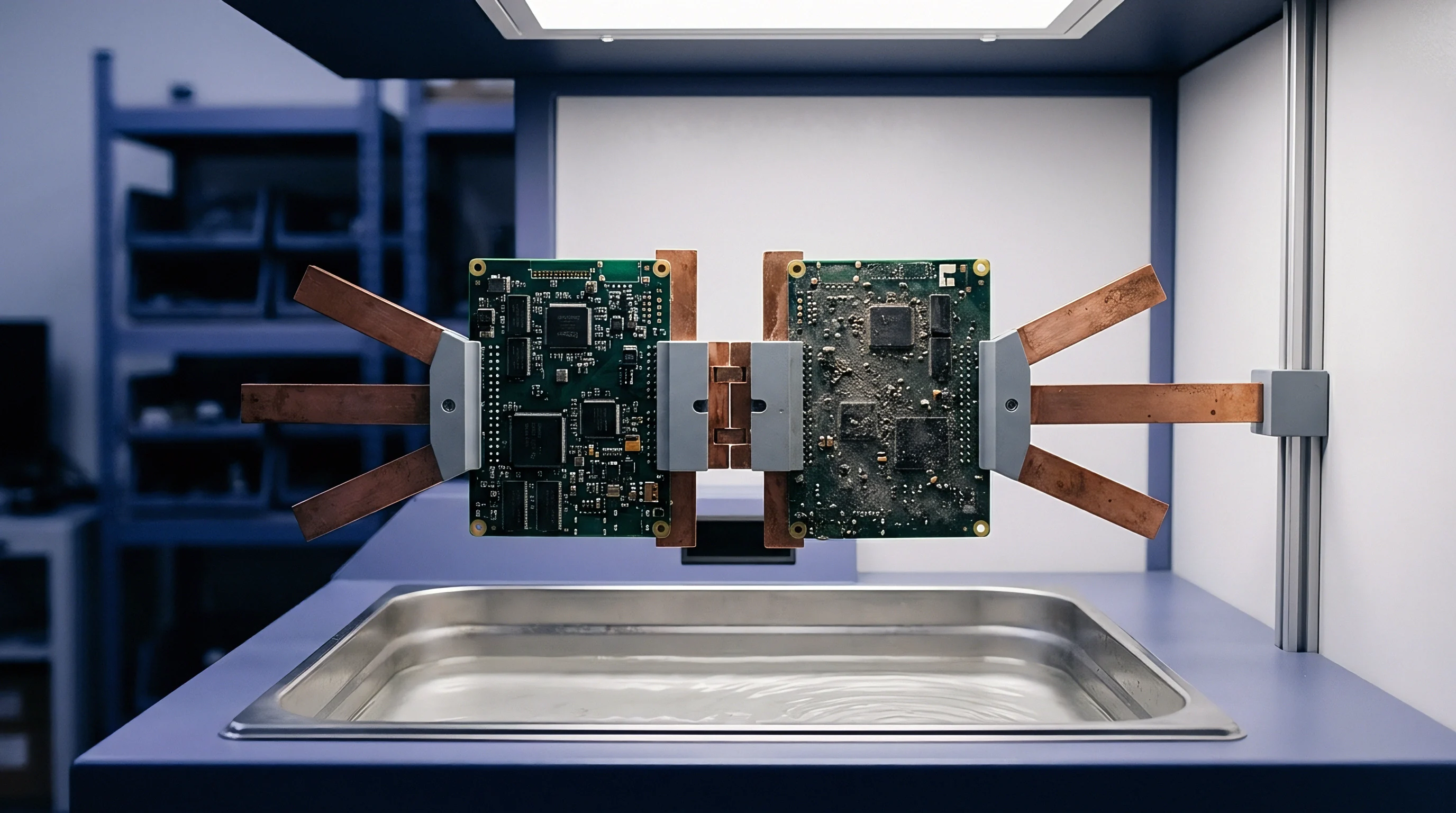
Evaluating the soldering performance of aged inventory relies on dynamic contact angle measurements. IPC J-STD-003 outlines both qualitative and quantitative procedures for checking surface terminations: while the dip-and-look method offers a quick visual screening, clean surfaces wet instantly, and wetting balance testing generates precise force-versus-time curves by measuring meniscus forces on a suspended coupon in molten solder.
May Baking Cycles Restore Degraded Surface Finishes?
Thermal conditioning drives out accumulated moisture from the dielectric core, but baking bare boards in open air accelerates copper diffusion into the surface finish. Heated air oxidizes unprotected pads and ruins remaining wetting performance, so baking operations should take place under vacuum or an inert nitrogen atmosphere to prevent rapid oxide formation.
Wetting balance curves readily identify passivated surfaces. The instrument measures zero-cross time ~ the interval between initial solder contact and the onset of positive wetting force. Pristine surface finishes cross the zero-force line within 0.8 seconds, whereas stored boards with advanced intermetallic growth or heavy tarnish require longer dwell times and often fail to reach positive meniscus force values within two seconds.
| Test Parameter | Pristine Board Target | Aged Acceptable Limit | Severe Degradation Scrap Value |
|---|---|---|---|
| Zero-Cross Time (t0) | Under 0.6 Seconds | Under 1.2 Seconds | Over 2.0 Seconds |
| Wetting Force at 2.0 Seconds | Over 0.25 mN/mm | Over 0.15 mN/mm | Below 0.00 mN/mm (De-wetting) |
| Maximum Wetting Force (Fmax) | 0.30 to 0.40 mN/mm | 0.20 to 0.30 mN/mm | Below 0.10 mN/mm |
| Contact Angle Calculation | Below 30 Degrees | Below 55 Degrees | Over 90 Degrees (Non-wetting) |
Steam preconditioning simulates extended warehouse aging. Exposing board coupons to eight hours of saturated steam at ninety-three degrees Celsius accelerates moisture-driven corrosion and diffusion. IPC J-STD-003 Category 3 preconditioning subjects incoming lots to this thermal stress before wetting balance testing, uncovering thin coatings, porous plating, and marginal chemical treatments that would fail over long storage cycles.
Warehouse temperature control matters far less than hermetic moisture exclusion.
- Spectroscopic surface analysis records elemental surface composition, confirming that carbon contamination and sulfur tarnish remain below ten atomic percent across outer terminations.
- Cross-sectional intermetallic measurement quantifies the remaining thickness of pure, unreacted tin over copper pads through metallographic optical microscopy.
- Wetting balance force profiles verify that maximum upward meniscus pull exceeds two-tenths of a millinewton per millimeter of perimeter within two seconds of alloy contact.
- Solder spread area documentation tracks the capillary expansion of standardized solder paste deposits over reflowed test coupons under controlled thermal profiles.
Using aggressive flux chemistry to compensate for advanced intermetallic degradation remains risky, as strong residues can trigger long-term electrochemical migration.
Recovery
Reconditioning aged circuit boards demands strict process windows to prevent laminate blistering. Core dielectric materials absorb atmospheric moisture during long warehouse storage. When unbaked boards pass through lead-free reflow ovens at peak temperatures between 245 and 260 degrees Celsius, trapped moisture vaporizes instantly, generating internal pressure that causes delamination and barrel cracking in plated-through holes.
Dehydrating aged panels requires thermal cycles calibrated to board thickness and layer count. Thin double-sided boards release moisture within four hours at 105 degrees Celsius, whereas multilayer boards with eighteen or more copper layers require sixteen to twenty-four hours at 120 degrees Celsius. Because heat accelerates solid-state diffusion, dehydration cycles run in ambient air degrade the outer surface finish by oxidizing copper-tin intermetallics.
Organic solderability preservatives evaporate during multi-pass thermal excursions while metallic barrier plates maintain structural cohesion.
Deciding whether to recover or replace a batch comes down to economics. Running offline vacuum bake cycles consumes machine capacity, labor, and schedule headroom. Rejuvenating suspect boards in chemical flux baths strips thin oxide layers, but aggressive acid treatments leave halide residues inside via holes that can cause electrical leakage under operating voltage.
Scrapping low-yield multilayer panels early often protects assembly margins better than attempting chemical recovery on heavily tarnished stock.
Drying components slowly at gentle heat preserves base laminate integrity far better than forcing moisture out through rapid baking.