Cyanoacrylate versus Epoxy Strain Gauge Strain Transfer Efficiency
Heat-cured epoxies achieve superior strain transfer efficiency and lower creep drift than cyanoacrylates under high temperatures and long-term static loads.

Mechanics
When a loaded metallic or composite structure deforms, that movement reaches the foil strain gauge grid only through the adhesive layer between them. How efficiently this transfer happens determines whether the output from a Wheatstone bridge reflects the true strain field in the substrate. In ideal conditions, an adhesive bond would act as an infinitely rigid shear coupling with zero thickness, passing strain into the grid without loss.
Real installations introduce finite adhesive thickness, shear compliance, and end-relief effects that systematically reduce the strain reaching the sensor.
To quantify this reduction, one has to analyze how shear lag operates across the substrate, adhesive, and backing interface. As the structural material elongates under axial load, stress enters the adhesive through interfacial shear. The adhesive deforms along the length of the gauge, progressively loading the carrier film and the embedded foil grid.
Near the center of a long enough strain gauge, grid strain comes close to matching substrate strain. Toward the active edges, however, grid strain drops off sharply to zero. The distance needed for shear stress to build up full axial strain defines the strain transfer length of the assembly.
Modeling this behavior relies on Cox’s classical shear lag formulation, adapted for flat foil sensors by Keil. The attenuation ratio ~ the strain felt by the grid divided by true strain in the substrate ~ depends on the geometry and elastic properties of the matrix. Lower shear modulus in the adhesive stretches out the transfer length, introducing noticeable integration errors on short gauges or across steep strain gradients.
Shear Lag Mechanics at the Substrate Boundary
Foil gauges never touch the underlying structure directly. Instead, strain moves across five distinct layers: the structural substrate, its surface oxide layer, the adhesive bondline, a polymeric carrier film (typically polyimide or phenolic-epoxy), and the etched foil grid. Calculations assume perfect adhesion across these boundaries, with no micro-slippage at any interface.
The shear lag equation determines the local transfer factor as a function of distance from the grid center, balancing the axial force gradient in the foil against the shear stress across the adhesive and backing:
fracd2 varεg(x)dx2 – β2 varεg(x) = -β2 varεs(x)
Here, varεg(x) is the axial strain in the grid at position x, varεs(x) is the uniform strain in the substrate, and β is the transfer parameter controlling how quickly edge effects decay. The parameter β depends directly on material shear moduli and layer thicknesses:
β = sqrtfracGaEg tg ta
Here Ga is the shear modulus of the adhesive, Eg is the elastic modulus of the grid alloy (typically Constantan or Karma), tg is grid assembly thickness, and ta is adhesive layer thickness. Higher β values allow rapid strain transfer over shorter distances, bringing transfer efficiency closer to unity.
Standard bench calculations highlight how sensitive this transfer is to adhesive shear modulus and bondline thickness. A lower shear modulus yields a smaller β, flattening the strain profile along the grid and pulling down the integrated average strain read by the instrument.
Interfacial Shear Stress Distribution and Strain Gradient Loss
Keil’s analytical model treats the bondline as a continuous shear spring between two elastic bodies. Interfacial shear stress peaks at the extreme ends of the installation and drops to zero at the center. If edge shear stress exceeds the adhesive’s yield strength, micro-yielding or localized delamination begins, leading to permanent loss of strain transfer and calibration drift.
Integrating the local transfer function over an active sensing length L gives the total strain transfer efficiency:
η = fracbarvarεgvarεs = 1 – frac2β L tanhleft(fracβ L2right)
When grid length L is large compared to transfer length LT = 1/β, the tanh(β L / 2) term approaches one, pushing efficiency η toward its theoretical maximum. On short grids ~ like the 0.6 mm or 1.5 mm patterns placed in stress concentration zones ~ β L drops considerably, leaving the installation far more sensitive to adhesive compliance.
| Adhesive Polymer Base | Elastic Modulus E_a (GPa) | Shear Modulus G_a (GPa) | Bondline Thickness t_a (µm) | Transfer Parameter β (mm⁻¹) | Strain Transfer Efficiency η (3 mm Grid) |
|---|---|---|---|---|---|
| Ethyl-2-Cyanoacrylate (Unfilled) | 1.45 | 0.52 | 8 | 2.94 | 0.9812 |
| Methyl-2-Cyanoacrylate (Toughened) | 1.85 | 0.68 | 10 | 3.12 | 0.9845 |
| Cold-Cure Epoxy (Room Temp) | 3.20 | 1.18 | 20 | 2.80 | 0.9798 |
| Heat-Cure Epoxy (Elevated Temp) | 4.50 | 1.67 | 15 | 3.85 | 0.9912 |
| Phenolic-Epoxy Matrix (High Temp) | 5.10 | 1.92 | 12 | 4.46 | 0.9948 |
The table illustrates that while cyanoacrylates reach high initial efficiency through thin bondlines (8 to 10 micrometers), heat-cured structural epoxies achieve higher transfer efficiency despite thicker bondlines (12 to 15 micrometers) thanks to their much higher shear modulus. Reliable transfer requires mechanical rigidity across the joint.
Strain transfer efficiency drops below 0.982 when adhesive thickness exceeds 25 micrometers under 2000 microstrain cyclic load.
Around notch roots or fillet radii, spatial strain gradients are steep, and spatial integration error combines with adhesive shear lag. If substrate strain varies sharply across the joint, shear lag smooths out the peak, underreporting maximum local stress. Using an adhesive with a high shear modulus minimizes this smoothing effect.
Thin bondlines paired with stiff resins confine the transfer length to the outer 5 percent of the grid footprint. As temperature rises or plastic softening increases adhesive compliance, that transfer zone moves inward toward the center, causing the effective gauge factor to drop during testing.
Bond
Surface preparation sets the baseline adhesion between structural metals and polymer gluelines. Establishing a reliable transfer interface means turning a dirty or oxidized metal surface into a high-energy substrate fit for chemical wetting and mechanical anchoring. Bond integrity depends directly on consistent micro-roughness and complete removal of oils, oxides, and surface moisture.
Cyanoacrylates and epoxies wet substrates differently. Low-viscosity cyanoacrylates (2 to 10 centipoise) flow into micro-cavities almost instantly under light thumb pressure. Epoxies are much thicker (200 to 1500 centipoise), requiring steady clamping pressure and heat to flow into surface features without trapping air voids.
Clamping pressure sets the final bondline thickness ta. Variations in clamping force across a batch introduce unwanted scatter into the shear lag parameter β. Hand-pressed cyanoacrylate bonds rely on thumb pressure through a Teflon film, yielding bondlines between 3 and 25 micrometers depending on operator feel.
Epoxy installations use spring clamps, silicone pads, or vacuum bags to maintain a steady 100 to 150 kilopascals through curing, producing consistent bond dimensions.
Interfacial Surface Energy and Micro-Mechanical Interlocking
Degreasing followed by mild abrasion expands the effective surface area of aluminum and titanium. Abrading with 220-grit to 400-grit silicon carbide paper leaves a cross-hatched topography with surface roughness values (Ra) of 0.4 to 0.8 micrometers, allowing liquid adhesive to key into micro-crevices before setting.
Chemical conditioning comes next. Acidic cleaners strip loose particles and native oxides, while neutralizers bring surface pH to the level required by the adhesive. Cyanoacrylates are particularly sensitive to pH: even slightly acidic surfaces retard anionic polymerization, leaving an uncured, soft boundary layer that degrades strain transfer.
Contact angle testing offers a quick check on surface energy. Clean aluminum yields water contact angles below 10 degrees, guaranteeing full wetting by monomers or resins. Contaminated surfaces show contact angles over 45 degrees, leading to fluid bead-up, trapped micro-voids, and early bond failure under fatigue loading.

Bondline Thickness Variations under Production Clamping Pressure
Keeping the adhesive layer uniform requires controlled force during cure. Trapped micro-voids disrupt local stress distribution, creating concentration points where micro-cracking begins. These voids usually stem from volatile outgassing, exothermic boiling of volatile components, or air whipped in during manual mixing.
- Wipe the substrate surface with isopropyl alcohol or methyl ethyl ketone until clean wipes show no residue.
- Wet-abrade the metal surface using 320-grit silicon carbide paper with acidic surface conditioner to strip native oxides.
- Apply neutralizer solution using clean cotton swabs in single unidirectional strokes to bring surface pH to 7.0.
- Align the gauge with polyimide tape, apply adhesive to the backing film, and press the gauge onto the prepared surface.
- Maintain a continuous spring clamping pressure of 120 kilopascals over a silicone pad throughout the cure cycle.
Bondline thickness directly affects strain transmission. If clamping pressure drops below 50 kilopascals during epoxy cure, the bondline can swell to 40 micrometers or thicker. That extra thickness reduces parameter β, cutting strain transfer efficiency by over 1.5 percent at room temperature and more than 8 percent at elevated temperatures.
Cyanoacrylates fail in thick bondlines. Because cure relies on surface moisture, gaps over 50 micrometers stay partially uncured in the center. Unreacted monomer acts like a plasticizer, dragging the effective shear modulus below 0.1 GPa and spoiling measurement accuracy.
The shape of the adhesive edge controls stress concentrations where the carrier ends. An abrupt square edge concentrates shear stress right at the boundary, encouraging debonding. A smooth 45-degree tapered fillet spreads peak shear stress along the substrate, extending fatigue life in dynamic tests.
Field debonding can stem from technician contamination as well as moisture-driven hydrolysis of the polymer matrix.
Chemistry
The performance gap between ethyl cyanoacrylates and structural epoxies stems from their molecular structures. Cyanoacrylates are single-component monomers that cure rapidly via anionic polymerization. Structural epoxies form three-dimensional thermosetting networks through multi-part reactions between epoxy resins and hardeners.
These structural differences set hard limits on shear modulus, heat resistance, creep, and long-term durability.
Ethyl-2-cyanoacrylate monomers pair electrophilic cyano (-CN) and ester (-COOR) groups on a vinyl double bond. Trace hydroxyl ions (-OH) from humidity or substrate surfaces trigger instant polymerization, forming long linear carbon chains with no crosslinks between them. This linear thermoplastic layout gives cyanoacrylates good room-temperature stiffness, but leaves them vulnerable to thermal softening, solvent degradation, and creep under steady load.
Epoxy systems react liquid diglycidyl ethers of bisphenol-A (DGEBA) or novolac resins with amine curing agents. This ring-opening reaction builds covalent bonds in three dimensions, forming a dense thermoset network. That tight crosslinking restricts chain movement, giving epoxies excellent thermal stability, stable shear modulus over wide temperature ranges, and resistance to creep.

Polymer Crosslinking Density and Thermal Stability Limits
Unfilled ethyl cyanoacrylates lack crosslinks between polymer chains, leading to a modest glass transition temperature (Tg) between 65°C and 80°C. As operating temperatures approach Tg, linear chains slide past each other under shear stress, causing shear modulus Ga to drop sharply.
Structural epoxies allow crosslink density to be tuned using hardener selection and post-cure schedules. Two-part room-temperature epoxies reach glass transition temperatures between 70°C and 110°C, while heat-cured systems using anhydride or aromatic amine hardeners (cured at 150°C to 175°C) exceed 200°C Tg. Working well below Tg keeps the resin in a glassy state, preserving high shear modulus and strain transfer performance.
| Adhesive Chemistry | Matrix Structure | Glass Transition T_g (°C) | Max Operating Temp (°C) | Outgassing TML (% at 10⁻⁵ Torr) | REACH SVHC Risk Exposure |
|---|---|---|---|---|---|
| Ethyl Cyanoacrylate (Standard) | Linear Thermoplastic | 68 | 80 | 3.45 | Low (Solvent Free) |
| Modified Alkoxy-Cyanoacrylate | Linear Thermoplastic | 85 | 100 | 2.10 | Low (Low Odor) |
| Amine-Cured Room-Temp Epoxy | 3D Thermoset Network | 95 | 120 | 0.78 | Medium (Aliphatic Amines) |
| Anhydride-Cured Heat-Cure Epoxy | Dense 3D Network | 175 | 200 | 0.22 | High (Acid Anhydrides) |
| Phenolic-Novolac Epoxy Matrix | Ultra-Dense Network | 230 | 260 | 0.12 | Medium (Phenolic Residues) |
Outgassing under vacuum illustrates another contrast. Linear cyanoacrylates show Total Mass Loss (TML) values over 3.0 percent due to unreacted monomer evaporation and thermal breakdown. Crosslinked epoxies routinely meet space standards like ECSS-Q-ST-70-02C, keeping TML under 1.0 percent and Collected Volatile Condensable Material (CVCM) under 0.1 percent.
Moisture Absorption Kinetics and Hydrolytic Degradation
Ambient moisture diffuses into the polymer matrix over time. Cyanoacrylates carry ester links along their carbon backbone that suffer hydrolytic breakdown in warm, humid conditions (such as 85 percent relative humidity at 50°C). Water breaks the linear chains, reducing molecular weight and causing shear strength to decay.
Hydrolytic Scission breaks ester side-chains, degrading shear strength in linear acrylic polymers exposed to hot, humid environments. Plasticizer Ingress occurs when absorbed water clusters in free-volume voids, dropping Tg by 15°C to 20°C. Interfacial Debonding happens when water displaces physical bonds at the polar metal-oxide surface, leading to adhesive failure. Outgassing Depolymerization breaks down linear cyanoacrylate chains in thermal vacuum conditions, depositing volatile monomers on surrounding optics or electronics.
Epoxies absorb water up to a saturation limit between 1.0 and 3.5 weight percent depending on polymer backbone polarity. Water absorption acts as a plasticizer, lowering Tg by approximately 5°C to 10°C per percent of absorbed moisture, but does not cause permanent chain scission under normal operating conditions. Post-cure heating schedules increase crosslinking density, reducing internal free volume and restricting water diffusion rates.
Compliance with IPC-9701 thermal cycling demands post-test bond retention exceeding 95 percent of initial gauge factor calibration.
RoHS and REACH regulations limit several hardeners used in structural adhesives. Certain aromatic amines (like 4,4′-diaminodiphenylmethane) and acid anhydrides appear on the REACH candidate list for Substances of Very High Concern (SVHC). Test facilities and suppliers must track chemical declarations across supply chains to avoid unexpected restrictions on standard adhesives.
Under Clause 4.2 of European Standard EN ISO 527-1, deformation testing requires continuous climate monitoring so that moisture-induced micro-yielding does not skew baseline modulus measurements.
Hysteresis
Under sustained static load, a strain gauge bridge signal often drifts lower over time. This decay happens independently of relaxation in the underlying metal. The primary cause is viscoelastic shear creep in the adhesive matrix: as the polymer creeps, it passes less shear force into the grid, creating an apparent strain loss even under constant structural stress.
Linear cyanoacrylates creep noticeably at room temperature. Held together only by weak Van der Waals forces, uncrosslinked chains slide under sustained shear stress. Under a constant 2000 microstrain load, a cyanoacrylate bond can see its initial output drop 2 to 6 percent within 24 hours ~ a rate that accelerates rapidly above 45°C.
Epoxies show far less creep under the same conditions. Their 3D covalent network locks polymer chains in place, keeping relaxation rates below 0.1 percent over 1000 hours of steady load at room temperature. This makes crosslinked epoxies essential for static load cell calibrations and long-term health monitoring.
Viscoelastic Relaxation and Zero Drift under Sustained Load
Maintaining long-term strain stability requires an adhesive matrix that resists physical aging. Stress relaxation fits a generalized Maxwell-Weichert model, where shear modulus Ga(t) decays over time under constant strain:
Ga(t) = Ginfty + sumi=1n Gi e-t / τi
Here Ginfty is equilibrium shear modulus, Gi represents relaxation strengths, and τi are relaxation time constants. For cyanoacrylates, short-term τi values fall in the range of minutes to hours, causing prompt signal decay. For crosslinked epoxies, room-temperature τi values extend into decades.
Zero drift occurs when a gauge fails to return to its initial electrical zero after mechanical cycling or thermal swings. Linear cyanoacrylates suffer from zero drift because peak shear stress at the grid edges causes localized plastic micro-yielding. Uncrosslinked chains slip permanently, preventing full mechanical recovery on unloading.
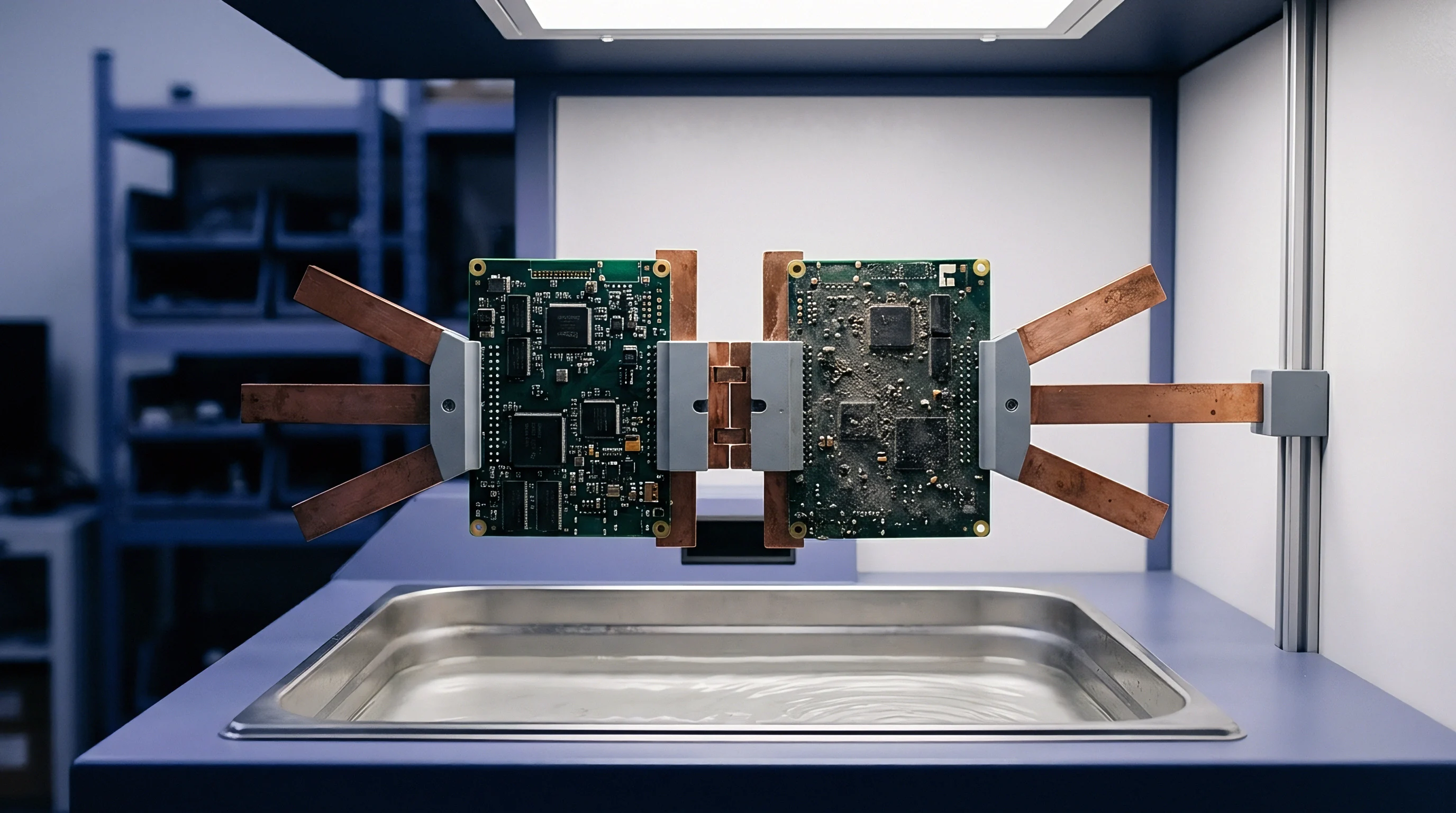
During a flight-test wing spar program where fast-curing cyanoacrylate was chosen to meet tight deadlines, zero drift reached a 4.2 percent span decay after 500 thermal cycles. That unexpected zero shift forced technicians to strip the wing panels and re-instrument the spar using heat-cured epoxies.
Cyclic Fatigue and Micro-Crack Propagation in Matrix Polymers
Cyclic loading creates concentrated stresses in thin adhesive films. Under dynamic testing (such as 10 Hz at ±1500 microstrain), cyanoacrylate gluelines show poor fatigue life. Micro-cracks start at the fillet edges of the brittle linear polymer and travel inward along the carrier interface, shortening effective bond length and lowering transfer efficiency η until the bond fails completely.
Toughened epoxies include elastomeric micro-domains ~ such as carboxyl-terminated butadiene acrylonitrile rubber particles ~ dispersed through the matrix. These inclusions stop micro-cracks by absorbing energy at crack tips. As a result, toughened epoxies can withstand over 107 full-strain reversal cycles at ±2000 microstrain with no measurable loss in transfer efficiency or sensitivity.
Strain measurement integrity under static sustained loads relies on a polymer matrix operating well below its viscoelastic relaxation threshold.
Hysteresis loops recorded during loading cycles reflect the adhesive’s mechanical loss tangent (tan δ = G” / G’). High loss tangents mean energy is being lost as internal heat. At room temperature and low frequencies, cyanoacrylates show loss tangents between 0.05 and 0.12, producing wide hysteresis loops.
Structural epoxies stay below 0.008, yielding narrow loops and tight agreement between loading and unloading curves.
An aerospace client rejected an entire dataset because room-temperature cyanoacrylate bonds caused uncalibrated hysteresis drift, resulting in a twenty-four thousand dollar cost penalty.
Thermal
Temperature shifts alter both adhesive properties and substrate dimensions. Maintaining steady strain transfer across cryogenic (-196°C) to elevated (+200°C) ranges requires accounting for expansion coefficient (CTE) mismatch, shear modulus softening, and differential strain across the bondline.
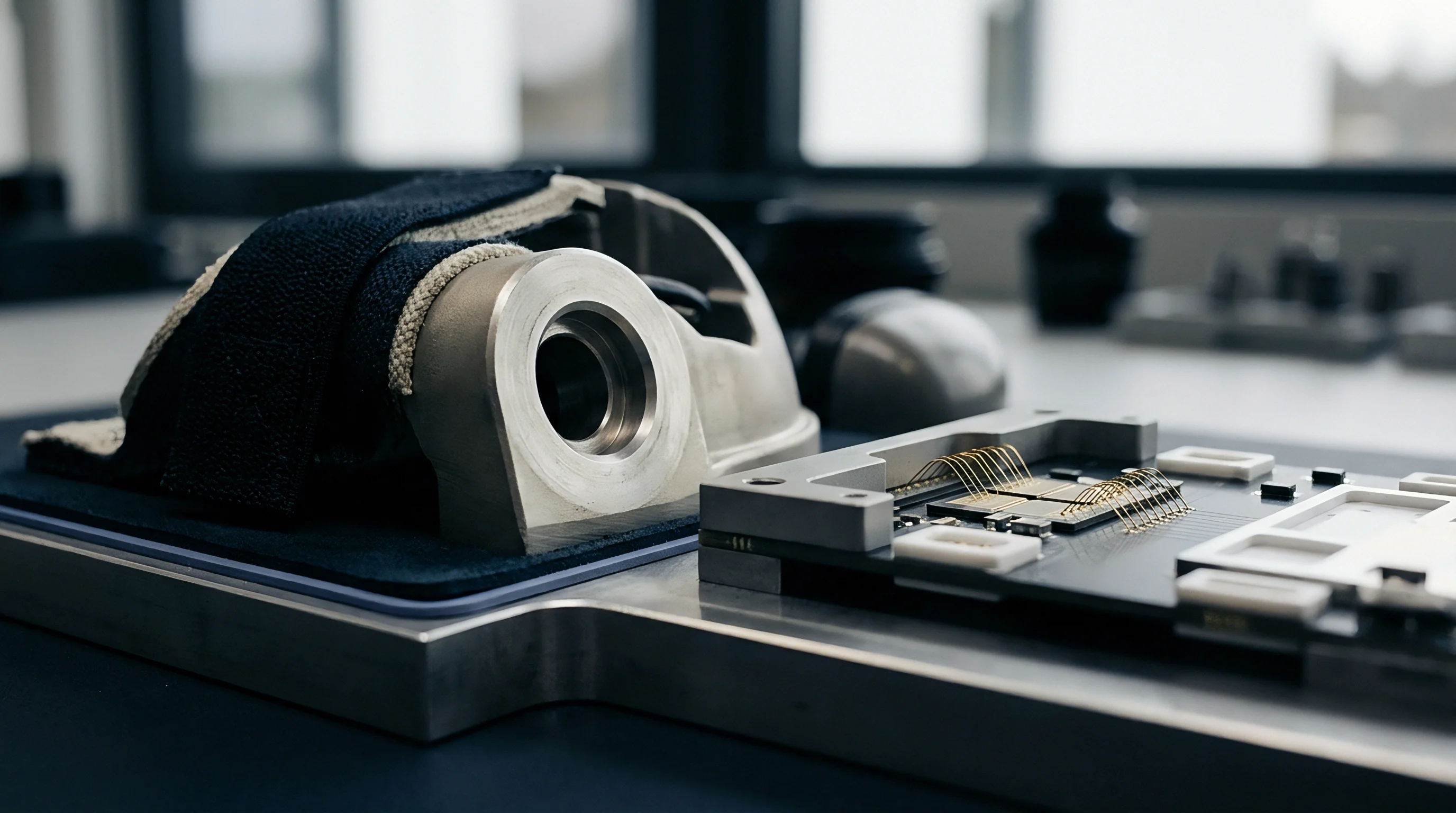
Cyanoacrylates have high thermal expansion coefficients (80 × 10-6/K to 120 × 10-6/K) compared to structural metals like aluminum (23 × 10-6/K) or steel (11 × 10-6/K). During temperature swings, the high-CTE polymer expands against the rigid substrate, generating internal shear stress. This thermal stress adds directly to mechanical shear, risking early bond failure or false strain readings.
Structural epoxies can be filled with inorganic powders (like silica or alumina) to bring bulk CTE down to 25 – 40 × 10-6/K, closely matching aluminum. Reducing expansion mismatch keeps interfacial shear stress low during thermal sweeps, preserving bond integrity.
Expansion Coefficient Mismatch and Thermal Strain Attenuation
Unequal thermal expansion between substrate, adhesive, and polyimide carrier creates residual shear stress as the assembly cools after curing. This built-in stress consumes part of the bond’s shear capacity, lowering the strain threshold at which debonding occurs.
Adhesive shear modulus drops steeply as temperature approaches glass transition. The strain transfer parameter β(T) becomes an explicit function of temperature:
β(T) = sqrtfracGa(T)Eg tg ta
When temperature rises from 23°C to 75°C, the shear modulus Ga of an ethyl cyanoacrylate drops from 0.52 GPa to under 0.05 GPa. This loss of stiffness collapses β, driving strain transfer efficiency η on a 3 mm gauge from 0.981 down to 0.812. The instrument then registers only 81.2 percent of actual strain, creating an 18.8 percent measurement error.
| Adhesive Type | Test Temp (°C) | Strain Level (µε) | Shear Modulus G_a (GPa) | Transfer Ratio η | Hysteresis Shift (%) |
|---|---|---|---|---|---|
| Standard Cyanoacrylate | -40 | 1500 | 1.10 | 0.989 | 1.45 |
| Standard Cyanoacrylate | 23 | 1500 | 0.52 | 0.981 | 0.82 |
| Standard Cyanoacrylate | 75 | 1500 | 0.04 | 0.812 | 8.60 |
| Heat-Cured Epoxy | -40 | 1500 | 2.10 | 0.994 | 0.08 |
| Heat-Cured Epoxy | 23 | 1500 | 1.67 | 0.991 | 0.05 |
| Heat-Cured Epoxy | 150 | 1500 | 1.05 | 0.987 | 0.22 |
| Heat-Cured Epoxy | 200 | 1500 | 0.45 | 0.952 | 1.15 |
The table demonstrates that heat-cured epoxies maintain transfer efficiencies above 0.985 across a broad temperature range, from cryogenic conditions up to engine test temperatures.
Can Any Fast Adhesive Maintain Strain Fidelity beyond Yield?
Measuring plastic strain (30,000 to 50,000 microstrain) pushes adhesives to their limits. When structural metals yield, localized slip occurs rapidly. Brittle cyanoacrylates crack once substrate strain exceeds 1.5 to 2.0 percent (15,000 to 20,000 microstrain), cutting off strain transfer and causing open-circuit readings.
Capturing plastic deformation requires modified epoxy-phenolic or polyurethane adhesives capable of 10 to 20 percent elongation without fracturing. These formulations maintain non-linear transfer capabilities well past the structural yield point.
- Determine the thermal envelope of the test article, accounting for transient spikes.
- Choose an adhesive with a glass transition temperature Tg at least 30°C above maximum test temperature.
- Check CTE compatibility between adhesive, substrate, and carrier film.
- Ensure adhesive elongation capacity is at least double the expected peak strain.
- Run post-installation thermal sweeps to stabilize crosslinking before taking test data.
Linear chain movement under combined thermal and plastic strain leads to permanent zero shifts. Cryogenic conditions bring the opposite issue: below -50°C, cyanoacrylates become extremely brittle. Thermal shock cracking can pop the gauge clean off the substrate without any applied load.
Thermal strain lag increases exponentially as operating temperature approaches the glass transition point of the adhesive.
Phenolic-epoxy installations cured at 175°C remain stable up to 260°C in continuous service. The high cure baseline holds the polymer network well above secondary relaxation thresholds, preserving calculated strain transfer values.
Whether rubber-toughened cyanoacrylates can match cold-cure epoxies for long-term outdoor infrastructure monitoring remains a point of debate in the field.

Contract
Procurement specifications for structural testing define precise installation methods to ensure valid data. In aerospace ground testing and sensor production, adhesive selection isn’t a casual preference ~ it is a binding contract requirement. Quality control must verify documentation to confirm that installed gauges meet strain transfer standards.
RFQ documentation should specify approved adhesive classes based on test duration and environmental exposure. Fast-curing cyanoacrylates are acceptable only for short laboratory screening tests under 8 hours and below 1000 microstrain. Static qualification, fatigue testing, and transducer manufacturing require certified epoxy systems with full cure logs.
Receiving inspection must audit dossiers to confirm records include adhesive lot numbers, cure temperature profiles, surface preparation steps, and baseline insulation resistance. An undocumented installation holds no value in a certified test program.
Test Dossier Requirements and Calibration Certificate Integrity
Accepting gauge installations requires verifiable records. Quality inspectors evaluate installations against electrical and physical standards before signing compliance certificates.
Every installation dossier must include five verification elements to clear quality inspection:
Surface Preparation Log recording grit size, surface chemical treatment, and contact angle measurements. Adhesive Batch Traceability documenting lot codes, expiration dates, and storage conditions. Cure Profile Chart tracking ramp rates, soak temperatures, dwell times, and clamping pressure.
Insulation Resistance Receipt certifying grid-to-substrate resistance above 10,000 Megohms at 50 Volts DC. Shunt Calibration Verification confirming bridge linearity and baseline zero stability.
Missing cure profiles invalidate the calibration certificate. If clamping pressure is unrecorded during cure, bondline thickness remains unknown, leaving shear lag calculations and transfer factors unverified during quality audits.
Return Arithmetic and Field Failure Liabilities
The financial cost of gauge debonding or drift rises quickly once hardware is in testing or service. Accounting models must balance the small assembly savings of fast-cure cyanoacrylates against the risk of failed tests and delays.
Using cyanoacrylate saves about 45 minutes per gauge by skipping thermal cure cycles. On a test article with 200 channels, that saves roughly $3,000 in technician labor. But if creep causes zero drift over 2 percent during a two-week static test, the client rejects the dataset.
Rejection forces complete re-instrumentation ($15,000 in materials and labor), oven re-rental ($12,000), test rig downtime ($35,000), and delay penalties ($5,000 per day). The initial $3,000 savings from using cyanoacrylate turns into a net loss over $70,000.
Standard contracts mandate that data corruption from bond failure requires vendor-funded re-instrumentation and re-testing. Quality clauses based on IPC-A-610 or MIL-STD-883 reject installations showing voids over 5 percent of the carrier footprint.
Contracts specifying strain measurement should require compliance with standards like VDI/VDE 2635 or ASTM E1237. Enforcing full qualification dossiers protects testing programs from field failures and ensures reported data is reliable.