Calculating Weighted Fault Coverage across Boundary Scan Interconnect Domains
Weighted fault coverage balances boundary register access against unmonitored cluster pins to calculate genuine manufacturing defect escape risk.
Weighted fault coverage balances boundary register access against unmonitored cluster pins to calculate genuine manufacturing defect escape risk.

Hybrid fixture nodal access limits depend on probe pointing accuracy, PCB flexure under IPC-JEDEC-9704 strain limits, and boundary scan partitioning.

Boundary scan accessibility delivers over 95 percent structural interconnect coverage on high-density assemblies without physical bed-of-nails test probes.
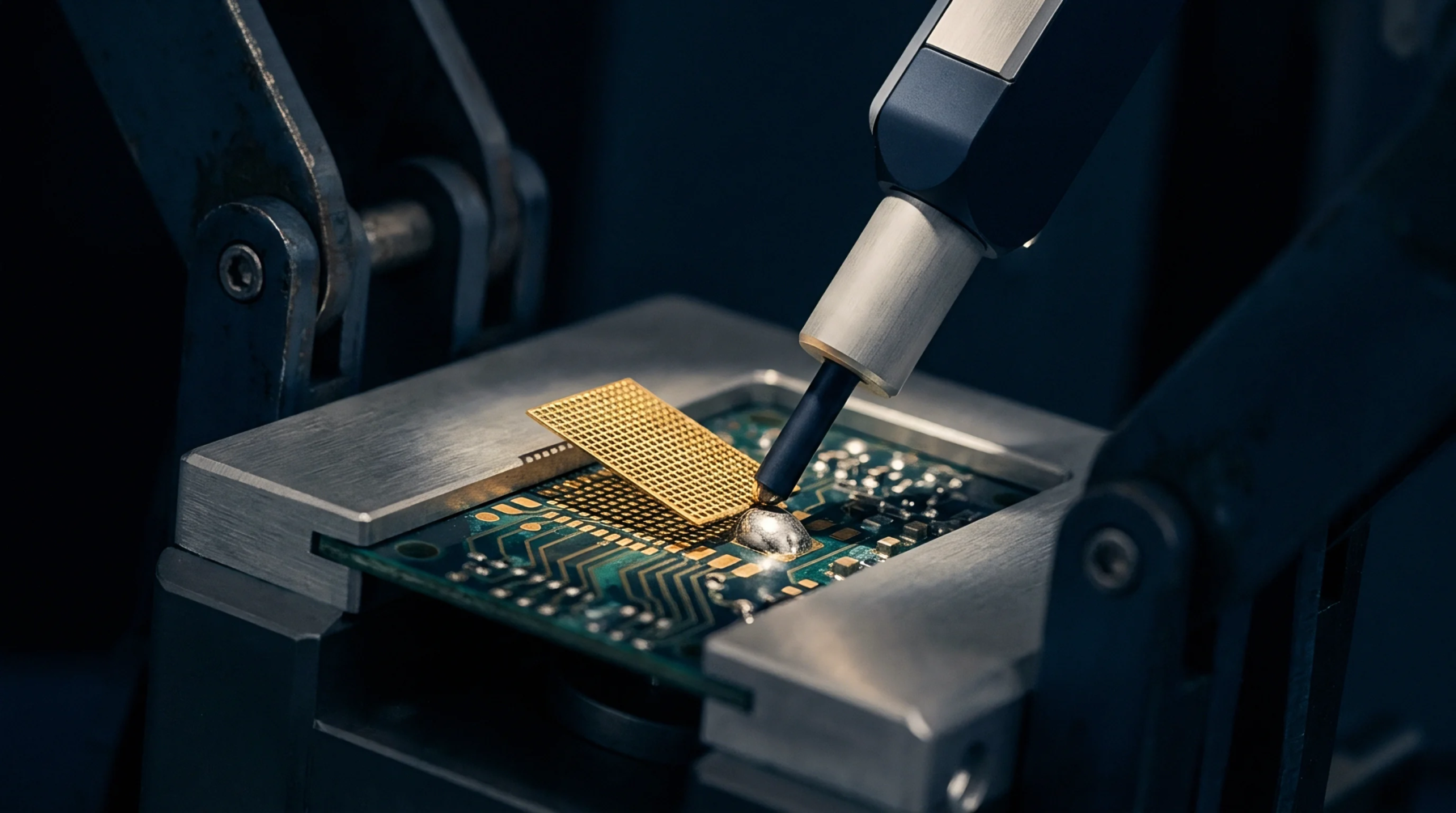
Verify structural fault coverage on high density assemblies by combining boundary scan with radiographic inspection where physical probe access falls below eighty percent.

Optimizing boundary scan access for high-density interconnects replaces physical probes with silicon registers, maximizing fault coverage and lowering test cost.

Transferring in-circuit test fixtures demands mechanical receiver alignment, guard loop settling verification, and fault-injection correlation to prevent escapes.

Unified test coverage requires de-duplicating shared fault opportunities across in-circuit probing and boundary scan using standardized PCOLA-SOQ metrics.

Eliminating high speed ICT escape vectors demands AC boundary scan integration, controlled overdrive pulse timing, and board strain limits during fixture probing.

Partial nodal access models predict field escapes by multiplying baseline DPMO against unprobed structural and functional coverage gaps across dense nets.

Integrating hybrid boundary scan and flying probe regimes eliminates unreached structural defects by establishing 99 percent nodal fault coverage.
Expertise is a utility, not a secret. sentiention™ publishes its working knowledge as open reference: intelligence layer covering the materials it sources, the markets it enters, and the reference that serves both.