Quantifying Structural Composite Matrix Degradation Caused by Organic Acid Flux Activators in Selective Soldering
Quantifying composite matrix degradation requires depth-resolved FTIR and nanoindentation to track silane debonding and Tg loss from unreacted acid flux.
Attack
Selective soldering deposits active chemistry locally. Liquid flux formulations classified as ORL0 or ORM0 under J-STD-004B rely on aliphatic dicarboxylic acids to strip tin oxides at 260°C to 300°C. Glutaric acid, succinic acid, and adipic acid serve as primary activators, carried in water or isopropyl alcohol vehicles. The thermal profile in selective soldering concentrates heat at the mini-wave nozzle while adjacent substrate areas remain between 80°C and 130°C. This temperature gradient leaves flux activators unvolatilized across peripheral board areas, keeping liquid dicarboxylic acids in direct contact with the FR-4 composite matrix during and after the soldering cycle.
Cured FR-4 laminates consist of brominated bisphenol-A diglycidyl ether crosslinked with dicyandiamide or phenolic novolac curing agents, reinforced with woven E-glass fiber bundles. At operating temperatures between 90°C and 140°C in the presence of localized moisture, unreacted dicarboxylic acids catalyze the hydrolysis of ester and ether bonds within the crosslinked network. Carboxylic protons attack ether linkages along the polymer backbone to facilitate nucleophilic cleavage, severing network chains, lowering crosslink density, and leaving low-molecular-weight hydrophilic fragments throughout the dielectric matrix.
Unreacted glutaric acid residues maintained at 85°C and 85 percent relative humidity lower surface insulation resistance from 10 gigohms to 12 megohms within 96 hours under IPC-TM-650 Method 2.6.3.7.
Wave contact times of 2.0 to 4.5 seconds per site deliver enough energy to react activators inside the solder joint barrel, but spray flux overspray landing 3 mm to 15 mm from the pin receives insufficient heat. Activator consumption drops below 25 percent in these peripheral zones. The unspent acid acts as a continuous source of hydronium ions, accelerating matrix decomposition during post-assembly burn-in or high-humidity operational storage.
Non-rosin water-soluble residues are often expected to evaporate during preheat, yet gas chromatography records show that polycarboxylic activators decompose into persistent low-volatility anhydrides rather than venting off the substrate.
Matrix
Hydrolytic breakdown of the crosslinked thermoset structure induces physical plasticization and a measurable depression in glass transition temperature (Tg). As dicarboxylic acids sever crosslinks, free volume within the epoxy network expands. Water absorption accelerates, compounding the mechanical softening through secondary hydrogen bonding with hydroxyl groups on severed polymer chains.
Dynamic mechanical analysis measures this degradation across the composite plane. Under IPC-TM-650 Method 2.4.24, tan delta peak temperatures record shifts in structural response. Baseline high-Tg FR-4 material exhibiting a standard Tg of 175°C drops to 148°C following repeated selective solder exposures where unreacted adipic acid resides on unmasked laminate.
The loss tangent widens, indicating a broad distribution of relaxation times caused by localized matrix heterogeneity.
| Exposure Condition | Glass Transition Tg (°C) | Storage Modulus E’ at 25°C (GPa) | Storage Modulus E’ at 150°C (GPa) | CTE Below Tg (ppm/°C) |
|---|---|---|---|---|
| Unexposed Virgin Laminate | 176.4 | 24.8 | 18.2 | 42.1 |
| Preheated Only (120°C Topside) | 174.9 | 24.3 | 17.8 | 43.0 |
| ORL0 Flux with Single 3s Dwell | 161.2 | 21.6 | 13.4 | 51.8 |
| ORL0 Flux with Triple 3s Dwells | 147.5 | 18.1 | 9.6 | 64.2 |
| ORM0 Flux with Triple 3s Dwells | 139.8 | 15.9 | 7.2 | 71.5 |
Thermal expansion coefficients perpendicular to the weave (z-axis CTE) expand from 42 ppm/°C to over 70 ppm/°C when matrix degradation advances. This mismatch amplifies cyclic shear strain at plated through-hole barrel corners during subsequent operating cycles, generating copper barrel cracks and inner-layer interconnect separations.
A composite matrix losing more than twenty degrees of glass transition temperature under localized thermal dwell exhibits premature z-axis barrel shear under thermal shock.
Flexural modulus measurements confirm bulk structural degradation. Standard three-point bending tests on exposed laminate strips show up to a 35 percent reduction in flexural rigidity at 125°C. The degradation concentrates within the outer 50 micrometers of the laminate surface, creating a mechanical modulus gradient between the skin and core that promotes surface micro-cracking under vibrational loads.
The exact threshold where polycarboxylic chain termination halts under variable relative humidity remains uncharacterized across alternative halogen-free phenolic curing systems.
Leach
Liquid activators migrate along the microscopic interface between the epoxy matrix and structural glass filaments. Organosilane coupling agents, such as gamma-glycidoxypropyltrimethoxysilane, bind glass fibers to the epoxy resin. Acidic flux residues hydrolyze these siloxane bonds (Si-O-Si and Si-O-C), stripping the adhesion promoter from the glass surface.
Can Carboxylic Activators Dissolve Silane Coupling Agents?
Protons from glutaric and succinic acids attack siloxane linkages at the glass sheath interface. Once the silane sheath dissolves, an open microscopic capillary forms along the glass fiber bundle. Flux vehicle solvents draw mobile bromide, chloride, and copper ions directly into these interfacial voids.
Under continuous DC electrical bias, copper dissolution occurs at the anode, creating cupric ions that migrate toward the cathode along the degraded glass-resin interface. Reaction with unspent dicarboxylic acid anions precipitates copper salts, followed by electrochemical reduction that forms dendrites, known as Conductive Anodic Filaments (CAF).
| Hole-to-Hole Pitch (mm) | Flux Chemistry | Selective Dwell Time (s) | Mean Time to Short (Hours) | Failure Rate at 500h (%) |
|---|---|---|---|---|
| 0.80 | No Flux (Control) | 0.0 | > 1000 | 0.0 |
| 0.80 | ORL0 Succinic Base | 3.0 | 640 | 4.2 |
| 0.80 | ORM0 Glutaric Base | 3.0 | 310 | 28.5 |
| 0.50 | ORL0 Succinic Base | 3.0 | 285 | 36.0 |
| 0.50 | ORM0 Glutaric Base | 3.0 | 112 | 84.0 |
Dielectric breakdown occurs rapidly once the filament spans the inter-conductor gap. Resistance across adjacent plated holes drops from over 100 megohms to less than 10 ohms within seconds of path bridge completion.
Failure to constrain flux migration and thermal dwell along tight hole-to-hole pitches generates latent field shorts that escape initial factory electrical testing.

Depth
Fourier-transform infrared spectroscopy coupled with attenuated total reflectance (FTIR-ATR) pinpoints matrix cleavage depth. Chemical profiling across cross-sectioned laminate layers identifies specific functional group transformations. Carbonyl absorption peaks around 1735 cm⁻¹ indicate ester linkages, while peaks at 1180 cm⁻¹ represent aromatic ether bonds.
Acid degradation increases the free carboxyl peak intensity at 1710 cm⁻¹ while diminishing ester and ether band intensities.
Does Dynamic Mechanical Analysis Resolve Micro-Cleavage?
Nanoindentation resolves localized mechanical property gradients that bulk dynamic mechanical testing smooths over. Indenting cross-sectioned solder sites at 5-micrometer increments from the hole wall outwards reveals elasticity decay profiles. Hardness near the glass-resin boundary drops by 40 percent in zones subjected to concentrated flux pooling.
Depth profiles establish that chemical degradation is not confined to the substrate surface:
- Primary hydrolysis layer extends from 0 to 15 micrometers into the laminate, exhibiting complete ether band depletion and major micro-void development.
- Secondary diffusion zone spans 15 to 45 micrometers, characterized by partial crosslink breakdown, reduced elastic recovery, and plasticizer absorption.
- Interfacial capillary tracks extend up to 180 micrometers along glass yarn bundles, creating low-resistance electrolytic conduits across internal layers.
- Bulk unreacted core beyond 200 micrometers maintains baseline glass transition values and nominal crosslink density.
Moisture accelerates interfacial debonding.
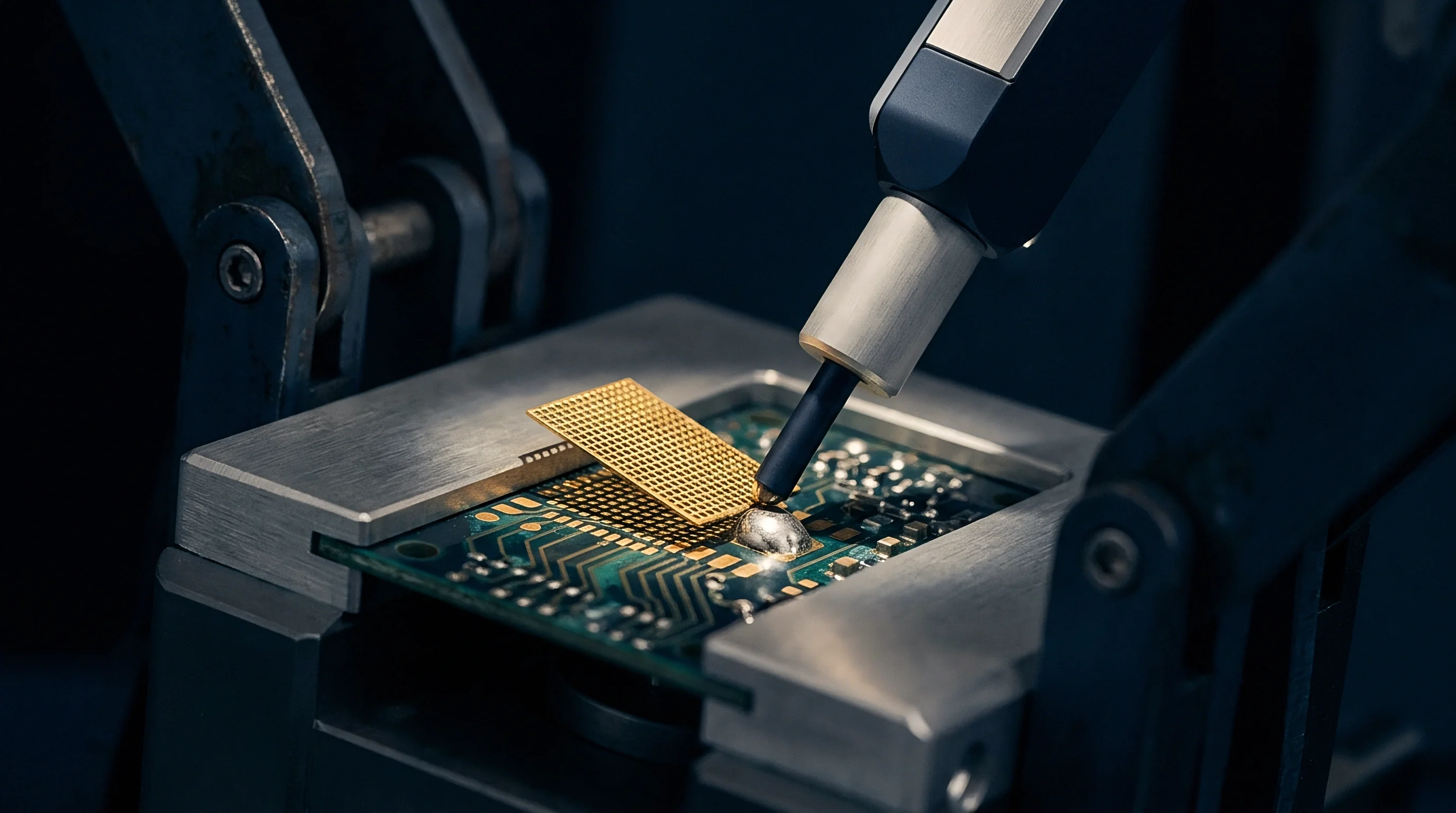
Direct molten alloy contact cleans the immediate pad circumference, but adjacent areas retain concentrated chemical deposits. Measuring degradation depth requires automated micro-sampling across both the washed contact area and the unwashed thermal transition zone.
IPC-A-610 Class 3 acceptance mandates zero visible composite blistering or weave texture exposure, yet cross-sectional depth profiling exposes sub-surface matrix degradation long before surface blistering shows under optical inspection.
Yield
Preventing structural composite degradation requires strict control over flux deposition volume, preheat temperature profiles, and tooling clearances. Micro-drop jetting systems deliver droplet volumes down to 15 nanoliters, restricting flux deposition strictly to through-hole annular rings and avoiding broad spray patterns that pool on bare laminate.
Selective soldering machines must achieve top-side preheat temperatures between 110°C and 130°C to flash off alcohol and water carriers before the assembly reaches the solder bath. Insufficient preheating leaves excess moisture on the board, accelerating hydrolytic chain scission during solder wave contact at 280°C.
| Deposition Technology | Volumetric Accuracy (Cpk) | Positional Tolerance (mm) | Tooling Cost per Assembly ($) | Laminate Degradation Risk |
|---|---|---|---|---|
| High-Pressure Spray Valve | 0.85 | ± 1.20 | 0.00 | High |
| Micro-Drop Jetting Valve | 1.45 | ± 0.25 | 0.00 | Low |
| Machined Titanium Pallet Shield | 1.80 | ± 0.10 | 1450.00 | Negligible |
| Custom Magnetic Masking Plates | 1.65 | ± 0.15 | 820.00 | Negligible |
Titanium aperture pallets physically block overspray from landing on unheated composite areas. The pallet exposes only target pin groups to the fluxer and solder nozzle, isolating adjacent surface-mount parts and unmasked laminate. Solder wave dwell times kept between 2.2 and 3.2 seconds maintain joint wetting while avoiding thermal degradation of the cured epoxy matrix.
Excessive flux volume cannot compensate for inadequate preheat or poor pin solderability.