
Evaluating Solder Joint Fatigue Dynamics during High Volume ICT Actuation
Minimizing ICT solder joint fatigue requires triaxial strain gauge profiling below 500 microstrain at actuation speeds under 1,000 microstrain per second.
Minimizing ICT solder joint fatigue requires triaxial strain gauge profiling below 500 microstrain at actuation speeds under 1,000 microstrain per second.

Calibrating ASIC thermal cycling requires matching ramp rates and dwell times to die-level thermal lag, isolating latent microvia defects without exceeding fatigue limits.

Partial nodal access models predict field escapes by multiplying baseline DPMO against unprobed structural and functional coverage gaps across dense nets.

Converting return rates to a warranty reserve requires multiplying test escape fractions by total landed failure costs and scaling across Weibull life curves.

Resolving intermittent high speed signal integrity escapes requires pairing static boundary scan with embedded IJTAG at speed stress testing to catch dynamic physical layer failures.
Unprobed high-speed nets demand combined boundary scan and thermal screening to bound latent defect escape liabilities before batch signoff.

Quantifying component change masking in multi-tier assemblies requires sensitivity matrix formulation, thermal transient screening, and interface nodal access audits.

Dynamic vector synthesis and IJTAG internal monitoring resolve mixed-signal diagnostic ambiguity in access-constrained clusters, cutting escape rates below 20 PPM.
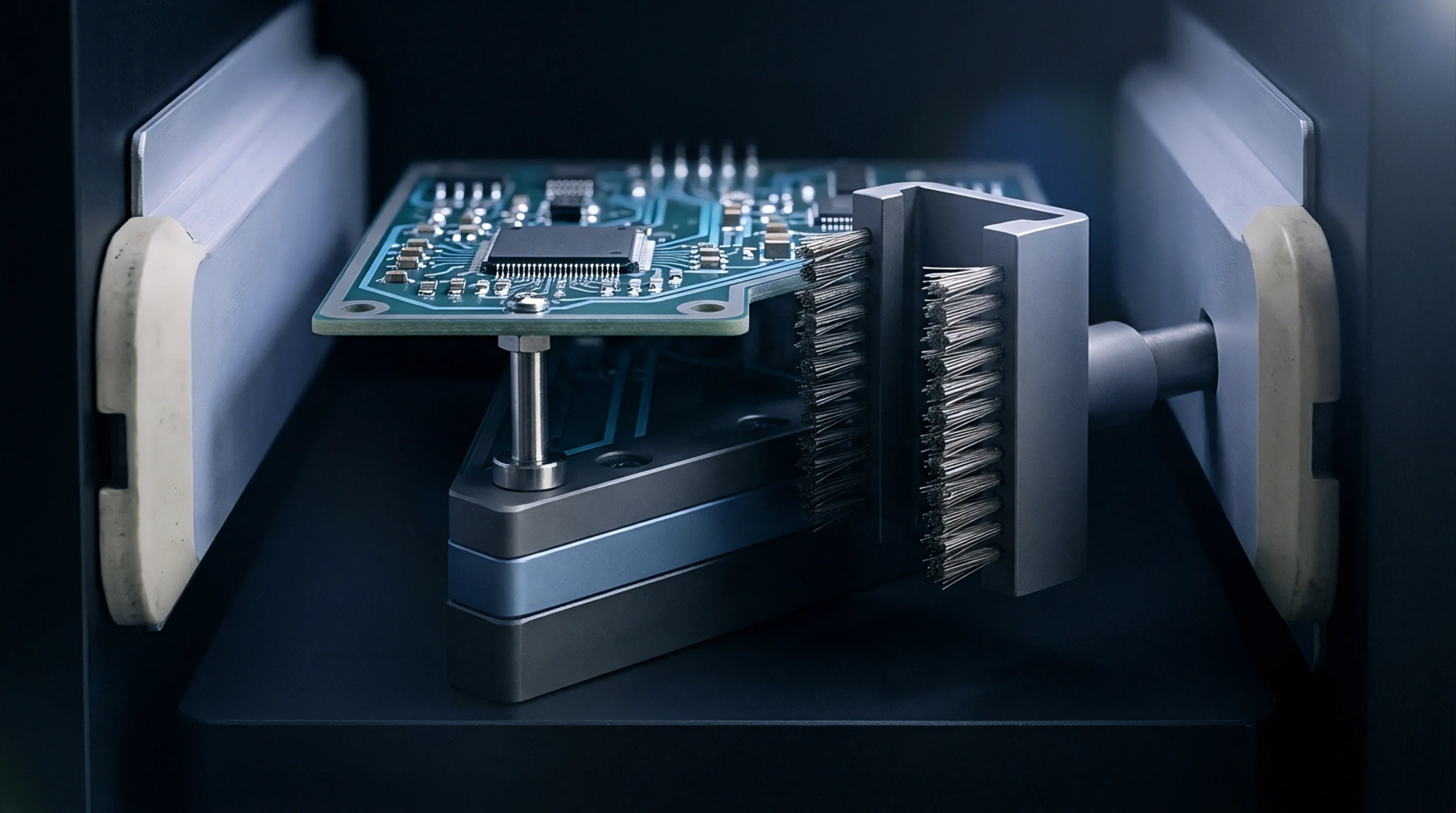
Unscreened high-frequency channel structural escapes drive PCI Express residual bit error rates above spec limits by inducing localized signal resonances.
First pass yield gaps in high-density assemblies stem from optical test blind spots, microvia structural fatigue, and restricted physical probe access.

Integrating hybrid boundary scan and flying probe regimes eliminates unreached structural defects by establishing 99 percent nodal fault coverage.

Electrical test coverage metrics require mapping physical nodal access and test regimes against a complete structural fault universe to limit field escapes.
Expertise is a utility, not a secret. sentiention™ publishes its working knowledge as open reference: intelligence layer covering the materials it sources, the markets it enters, and the reference that serves both.