Interfacial Silane Degradation Kinetics in High Frequency Substrates under Cyclic Damp Heat Loading
Silane bond hydrolysis under damp heat elevates loss tangent and reduces copper peel strength, requiring moisture-stable laminates and explicit baking notes.
Steam
Water vapour penetration through polymer free volume reaches equilibrium within high-frequency substrates after 168 hours of humidity exposure. Moisture accumulation occurs rapidly inside fluoropolymer, hydrocarbon ceramic, and low-loss polyphenylene ether matrix structures. Thermodynamic water activity creates osmotic pressure along internal phase boundaries.
Water drives rapid bond breakdown. The organofunctional silane coupling agent, applied at thicknesses between 2 and 15 nanometers to bridge glass fiber surfaces with resin networks, undergoes hydrothermal attack when moisture accumulates at the filler interface.
Siloxane networks forming the primary chemical bridge feature covalent silicon-oxygen-silicon and silicon-oxygen-substrate bonds. These linkages exhibit sensitivity to hydrolytic cleavage under cyclic thermal and moisture loading. As moisture migrates into the laminate bulk, water molecules attack the polarized silicon-oxygen bonds through nucleophilic substitution.
Hydrolytic attack converts rigid siloxane structures into terminal silanol groups, weakening the chemical anchor between inorganic glass reinforcement and organic resin matrices.
Condensation Dynamics at Glass Substrate Interlayers
Capillary forces pull liquid phase fluid into microscopic gaps between inorganic reinforcement filaments and surrounding matrix resins. Glass weave architectures, including spread glass styles like 1078 and 1067, present extended surface boundaries where silane coverage variance leaves localized voids. Water molecules cluster inside these sub-micron un-bonded areas during damp heat exposure.
Liquid condensation within these interfacial pockets creates localized chemical environments that accelerate siloxane hydrolysis.
Continuous thermal cycling between ambient room conditions and 85 degrees Celsius expands and contracts trapped moisture pockets within the matrix. Dynamic pressure variations across the substrate bulk force water deeper into the resin-filler boundary. Interfacial adhesion decays rapidly.
Repeated vapor expansion fractures remaining siloxane crosslinks, resulting in permanent mechanical decoupling along the glass filament surfaces.
Organosilane Hydrolysis Mechanisms in Hydrocarbon Resins
Covalent linkages between vinyl-functionalized coupling agents and silica particles degrade when exposed to thermodynamic water activity near unity. Hydrocarbon resin systems rely heavily on organosilane primers to achieve mechanical strength and stable dielectric properties. In dry conditions, silane molecules form a hydrophobic monolayer that shields inorganic surfaces from moisture ingress.
Under prolonged cyclic damp heat, water molecules displace the organic functional groups by breaking the weaker hydrogen bonds before hydrolyzing the primary siloxane bridges.
Hydrolysis converts single siloxane bonds into pair-terminated silanol species, disrupting the interfacial network structure. Silanol accumulation increases the local concentration of polar functional groups along the filler boundary. These polar sites act as moisture traps, drawing secondary water molecules into the interface and establishing a self-sustaining degradation cycle.
Matrix micro-cracking occurs as localized swelling strains exceed the strain-to-failure limit of the weakened polymer resin.
Hydrolytic cleavage of siloxane linkages increases free hydroxyl density along the glass reinforcement surface.
Material suppliers frequently maintain that elevated dissipation factor values under damp heat stem entirely from reversible water absorption rather than structural silane breakdown.
Kinetics
Reaction rates governing siloxane bond rupture scale exponentially with temperature when relative humidity exceeds 85 percent. Silane degradation follows pseudo-first-order chemical reaction kinetics driven by interfacial water concentration and localized matrix strain. Thermal energy supplies the necessary activation threshold to break silicon-oxygen bonds, while moisture concentration dictates the forward reaction equilibrium.
Hydrolysis velocity accelerates in environments characterized by continuous temperature fluctuations, where thermal expansion mismatch places silhane bonds under mechanical tension during moisture ingress.
Interfacial chemical equilibrium shifts toward silanol formation as elevated temperatures increase polymer chain mobility and water solubility. The degradation rate coefficient depends heavily on resin system polarity, filler treatment uniformity, and glass substrate surface chemistry. Non-polar fluoropolymer and hydrocarbon systems exhibit lower equilibrium water uptake, yet localized moisture condensation along non-uniform silane layers produces high reaction rates within discrete micro-domains.
Arrhenius Rates for Bond Scission
Activation energy values for siloxane bond cleavage in damp environments center near 75 kilojoules per mole. Thermal acceleration factors derived from Arrhenius modeling enable life-expectancy predictions for printed circuit board substrates operating in harsh outdoor enclosures. At 85 degrees Celsius and 85 percent relative humidity, the rate constant for siloxane hydrolysis increases by two orders of magnitude compared to standard operating conditions at 25 degrees Celsius.
Elevated thermal energy lowers the energy barrier for water molecules to execute nucleophilic attack on silicon atoms.
Reaction kinetics transition from reaction-limited to diffusion-limited regimes as hydrothermal exposure continues past 500 hours. Initial degradation depends directly on intrinsic chemical reaction rates at the silane interface. Long-term degradation depends on water diffusion velocity through the matrix bulk to replace consumed reactants.
Substrates containing high volume fractions of micro-silica fillers exhibit complex kinetic profiles due to the high interfacial surface area requiring silane coverage.
Micro-Void Formation along Filler Interfaces
Interfacial delamination creates sub-micron cavities along inorganic filler particles as cleaved silanol molecules cluster together. These cavities disrupt the mechanical load transfer between resin and glass reinforcement, lowering structural rigidity across the panel. Micro-voids accumulate near glass fibers.
Over time, neighboring micro-voids coalesce into continuous moisture channels, establishing paths for moisture transportation through inner substrate layers.
- Hydrolytic Siloxane Scission breaks covalent silicon-oxygen bonds across the glass-resin boundary layer under elevated water activity.
- Silanol Condensation Failure occurs when moisture blocks the reverse condensation reaction, preventing self-healing of ruptured chemical linkages.
- Interfacial Void Coalescence merges sub-micron cavities along glass fibers into continuous micro-channels that accelerate fluid transport.
- Osmotic Resin Delamination generates localized fluid pressure inside interfacial pockets, driving mechanical separation between matrix and reinforcement.
Whether localized silanol condensation can re-establish covalent interfacial coupling during post-stress baking profiles remains an open question in hydrothermal aging research.

Loss
High-frequency signal attenuation expands rapidly when absorbed water polarizes the glass-resin boundary layer. Water presents a relative permittivity near 78 and a high dissipation factor across microwave frequencies. The conversion of hydrophobic siloxane bonds into polar silanol groups introduces free hydroxyl dipoles that reorient under high-frequency electromagnetic fields.
Signal degradation follows quickly. This dipolar relaxation mechanism elevates dielectric loss tangent figures across frequency bands from 1 to 77 gigahertz.
Substrate electrical performance changes dramatically as moisture and silanol groups accumulate at the trace interface. Transmission line conductor losses increase due to altered skin-effect distribution along degraded copper treatment profiles. Micro-voids along glass fibers create localized dielectric variations, generating impedance discontinuities that reflect signal energy and degrade differential pair phase alignment.

Dielectric Shift from Polar Hydroxyl Accumulation
Hydroxyl groups attached to silicon atoms present a dipole moment that shifts the complex permittivity of low-loss substrates. The real part of dielectric permittivity increases proportionally with the concentration of absorbed water and generated silanol species. Low-loss hydrocarbon laminates with a dry dielectric constant of 3.38 at 10 gigahertz shift toward 3.52 after 1,000 hours of cyclic damp heat testing.
Dissipation factor values experience greater percentage shifts, frequently doubling from baseline figures.
Frequency-dependent loss curves reveal distinct absorption peaks corresponding to rotational relaxation of bound water molecules along silane chains. At millimeter-wave frequencies, dipolar losses dominate conductor losses in thin substrate stackups. Moisture retention ruins signal integrity.
The physical accumulation of water within interfacial micro-voids alters dielectric constant spatial uniformity, driving signal skew across matched length routing.
Phase Velocity Variations across Humidity Cycles
Signal propagation speeds along differential microstrip pairs alter as ambient moisture levels fluctuate during environmental testing. Dielectric constant creep directly changes signal phase velocity, reducing phase margin in radar and high-speed digital systems. Differential phase drift causes errors.
Laminates exhibiting high silane hydrolytic stability retain constant phase characteristics across thermal and humidity excursions.
| Laminate Resin Family | Initial Dk (10 GHz) | Aged Dk (10 GHz) | Initial Df (10 GHz) | Aged Df (10 GHz) | Interfacial Silane Type |
|---|---|---|---|---|---|
| 4.05 | 4.32 | 0.0120 | 0.0185 | Standard Amino-Silane | |
| 3.64 | 3.75 | 0.0042 | 0.0068 | Vinyl-Functional Silane | |
| 3.38 | 3.45 | 0.0027 | 0.0039 | Hydrophobic Alkyl-Silane | |
| 3.00 | 3.03 | 0.0011 | 0.0014 | Fluorinated Silane Layer | |
| Data measured via IPC-TM-650 Method 2.5.5.5 split-post dielectric resonator at 23°C following 24-hour room temperature stabilization. | |||||
Substrates exposed to 85 degrees Celsius and 85 percent relative humidity for 500 hours display a dissipation factor increase of 0.0018 at 10 gigahertz.
Uncontrolled dissipation factor growth across operational humidity cycles forces RF system redesigns, broadens passband filter ripple, and invalidates insertion loss budgets in high-frequency hardware.
Stress
Accelerated reliability testing applies elevated vapor pressure to drive water molecules into glass-reinforced laminates. Environmental test chambers utilize cyclic humidity combined with temperature ramps to force rapid moisture ingress and evaluate silane hydrolytic resistance. Testing protocols expose potential delamination risks before bare boards integrate into high-reliability field assemblies.
Microsection analysis following stress exposure isolates structural failure modes occurring within the dielectric bulk.
Standard qualification routines subject raw substrates, unpopulated panels, and finished circuit assemblies to continuous thermal and atmospheric pressure gradients. Evaluating post-exposure microsection coupons reveals micro-void density, copper peel degradation, and glass weave separation. Failure mechanisms identified during accelerated testing correspond directly to long-term field failures caused by silane interface hydrolysis.
Can Cyclic Humidity Profiles Accelerate Siloxane Bond Cleavage?
Repeated transitions between 25 degrees Celsius and 85 degrees Celsius drive dynamic vapor pressure differentials across the substrate bulk. Cyclic moisture loading forces water molecules through resin free volume faster than steady-state humidity exposure. Thermal cycling speeds chemical cleavage.
The combination of alternating mechanical strain from thermal expansion mismatch and continuous water availability breaks siloxane coupling bonds at accelerated rates.
Moisture condensation rates inside micro-voids peak during the cooling phase of humidity cycles. As ambient chamber temperature drops, relative humidity inside small internal cavities exceeds saturation limits, forming liquid water droplets. Liquid water accelerates silanol formation compared to water vapor phase interactions, making cyclic stress profiles far more destructive to substrate interfaces than constant isothermal damp heat.
Damp Heat Test Profiles for High Frequency Board Qualification
Environmental chambers operating at 85 degrees Celsius and 85 percent relative humidity evaluate long-term substrate reliability. Highly Accelerated Stress Testing subjects bare laminates to 110 degrees Celsius or 130 degrees Celsius under unsaturated vapor pressure conditions to shorten qualification cycles. Coupon testing isolates raw materials.
Proper sample preparation prevents artificial edge-flashing delamination from skewing moisture absorption measurements.
- Bake raw substrate coupons at 105 degrees Celsius for 4 hours to establish dry mass baseline.
- Measure baseline capacitance, loss tangent, and copper peel strength across test coupon arrays.
- Load test coupons into environmental chamber configured for 85 degrees Celsius and 85 percent relative humidity.
- Execute environmental exposure for 500 hours with periodic mass gain measurements at 168-hour intervals.
- Perform high-frequency split-post cavity testing within 30 minutes of removing coupons from chamber.
- Prepare microsections across high-density interconnect vias to inspect for glass-resin interfacial delamination.
IPC-TM-650 Method 2.6.16 defines the moisture resistance baseline, mandating post-exposure dielectric breakdown testing that fails panels displaying micro-delamination along internal glass fibers.

Bond
Copper adhesion to low-loss dielectric matrices relies on chemical coupling combined with nanometer-scale mechanical anchor sites. High-frequency designs specify Very Low Profile and Hyper Very Low Profile copper foils to minimize conductor losses caused by skin effect resistance. Smooth coppers reduce mechanical anchoring capabilities, placing primary responsibility for peel strength on chemical silane coupling agents applied to the foil surface treatment layer.
Smooth copper weakens under humidity.
Hydrolysis of the copper-silane-resin interface degrades mechanical peel strength following damp heat conditioning. Water molecules attack both the organofunctional silane-resin crosslinks and the inorganic silane-copper oxide bonds. Loss of chemical coupling along smooth copper foils leads to trace lifting, pad delamination during soldering, and reduced fatigue life under operational mechanical vibration.
Copper Foil Treatment Degradation in High Velocity Interfaces
Ultra-low profile foil treatments utilize thin silane primers that experience hydrolytic attack under cyclic moisture loading. Chemical treatments applied to copper foil surfaces include zinc, nickel, and silane passivation layers designed to prevent oxidation and foster resin adhesion. When exposed to damp heat, moisture penetrates the thin dielectric interface, hydrolyzing the organosilane coupling layer and oxidizing the underlying copper surface treatment.
Foil treatment breakdown changes electrical skin depth parameters while reducing physical adhesion. Copper oxide layer reduction by trapped silanol groups alters conductor interface impedance. Micro-peel testing demonstrates that peel strength decay correlates directly with the density of hydroxyl groups present at the copper-resin interface after environmental exposure.
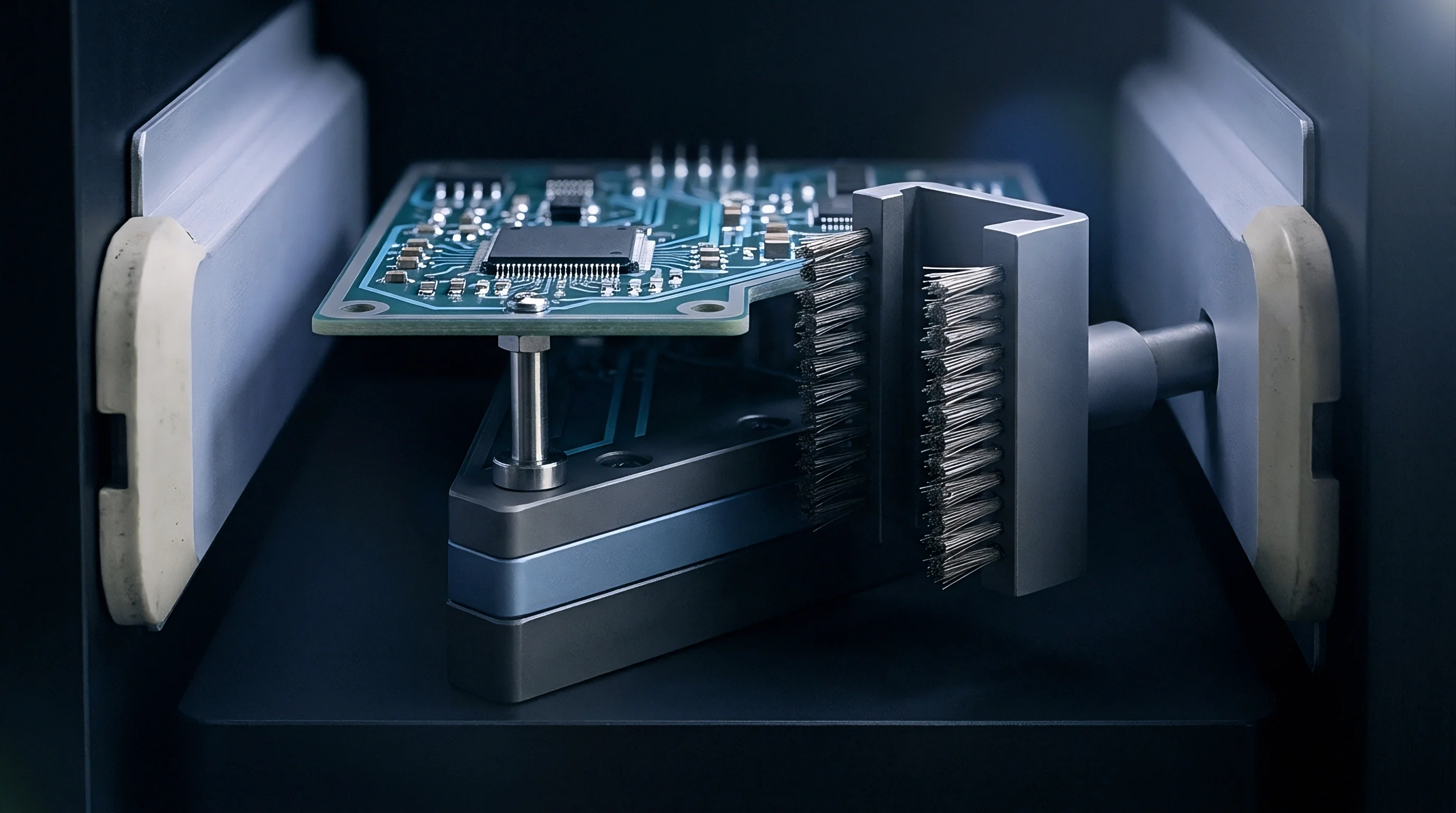
Peel Strength Retention Limits for Smooth Coppers
Standardized 90-degree peel testing quantifies structural strip force decay following hydrothermal aging. High-frequency laminates utilizing smooth foils exhibit baseline peel strengths between 0.6 and 0.9 newtons per millimeter. After 1,000 hours of cyclic damp heat testing, peel strength values drop by 30 to 50 percent if the silane coupling layer lacks hydrolytic stability.
Clean interfaces prevent micro-voiding.
| Foil Profile Grade | Surface Roughness Rz (µm) | Initial Peel Strength (N/mm) | Post-1000h Peel Strength (N/mm) | Peel Strength Retention (%) | Interfacial Failure Mode |
|---|---|---|---|---|---|
| 5.8 | 1.45 | 1.25 | 86.2 | ||
| 2.2 | 0.95 | 0.72 | 75.8 | ||
| 1.2 | 0.78 | 0.48 | 61.5 | ||
| 0.7 | 0.62 | 0.31 | 50.0 |
IPC-4101 slash sheet provisions dictate a minimum peel strength retention of 75 percent following damp heat conditioning.
Selecting copper foil with dual-layer silane passivation preserves micro-strip peel strength across extended cyclic damp heat exposure.
Dossier
Procurement specifications establish explicit environmental aging thresholds for low-loss laminates before releasing artwork files to fabrication partners. Purchasing desks pricing high-frequency boards must account for panel yield losses associated with moisture sensitivity and post-bake processing requirements. Specifying hydrophobic, hydrolysis-resistant silane surface treatments on laminate purchase orders prevents field reliability claims and stabilizes unit pricing across volume production runs.
Fabrication notes on master drawings dictate mandatory panel handling, storage, and pre-baking routines. Fabricators reject unbaked production panels. Board shops operating under strict quality agreements track material lot numbers against environmental test records, ensuring that raw laminate batches meet moisture stability standards prior to inner-layer etching and multilayer lamination operations.
Laminate Slash Sheet Verification for Moisture Stability
Standard industry datasheets report electrical characteristics measured under dry conditions at room temperature. Sourcing teams look beyond standard marketing parameters, demanding IPC-4101 qualification documentation that verifies material performance following damp heat stress. Material procurement contracts specify maximum allowable limits for moisture absorption, dielectric constant shift, and peel strength loss.
Verifying slash sheet compliance involves auditing fabricator incoming material inspection logs. High-frequency designs operating above 10 gigahertz require laminate specifications that mandate specialized alkyl-silane or fluorinated coupling treatments. Panel yields drop without baking.
Substrate materials lacking certified moisture stability documentation risk rapid electrical degradation in humid operating environments.
Fabrication Drawing Procurement Requirements for Panel Yields
Fabrication notes on master assembly drawings specify mandatory pre-bake profiles to prevent thermal shock delamination. Panel utilization math depends directly on material stability; laminates prone to silane hydrolysis suffer higher scrap rates during post-assembly reflow operations. Including clear moisture handling instructions in the purchasing dossier protects quotes from unexpected yield adders.
- Hydrolytic Stability Certification requires laminate suppliers to provide 1,000-hour damp heat test data per IPC-4101 standards.
- Pre-Lamination Baking Protocol dictates inner layer core baking at 110 degrees Celsius for 3 hours prior to multilayer press cycles.
- Copper Surface Treatment Specification designates HVLP foil grades featuring dual-passivated hydrophobic silane primers.
- Post-Exposure Coupon Auditing mandates high-frequency cavity resonance testing on panel margin coupons following assembly reflow.
Pre-baking core laminates prior to lamination removes absorbed water without degrading organosilane chemical bonds.
Purchasing desks that embed explicit moisture aging limits into master fabrication drawings secure consistent RF performance while eliminating warranty disputes over field-degraded hardware.